vampire colony
'Salem's Lot: A NovelThe vampire colony is the organized, proliferating force behind the destruction of Jerusalem’s Lot. It begins with the premise of a single initiating vampire and grows by converting the living through blood, invitation, and nocturnal contact. Unlike an invading army, it does not need to seize the town openly: it enters bedrooms, draws victims across thresholds, removes bodies from institutional custody, and uses the town’s habits of privacy, gossip, and disbelief as cover. Its decisive strength is therefore social as much as supernatural—the colony makes ordinary life assist its expansion.
Nature and Structure
The colony consists of a central vampire power and the newly converted dead who extend that power through successive attacks. Matt Burke explains that, according to the old literature, a vampire cannot simply enter a house and drink a man’s blood; the victim must invite it inside. That rule gives the colony a method of operation as well as a supernatural limitation. Danny Glick can infect Mike Ryerson, Mike can infect another resident, and the chain can continue outward through homes that appear disconnected from one another. The process resembles contagion, but it also depends on consent distorted by ignorance: a resident may open the door because refusing to believe the danger is more comfortable than recognizing it.
The colony’s structure is not fully bureaucratic or publicly visible, yet it is coordinated by a master figure. When Corey Bryant encounters the stranger who identifies himself as Kurt Barlow, Barlow’s genial mockery and hypnotic charm conceal his authority. He treats names as superficial labels and presents himself as a figure who has come from many lands, while Corey is drawn into laughter and temporarily loses the distance needed to judge him. The exchange reveals a hierarchy in which the master does not merely attack bodies; he captures attention, weakens resistance, and makes submission feel like ordinary conversation.
Methods of Expansion
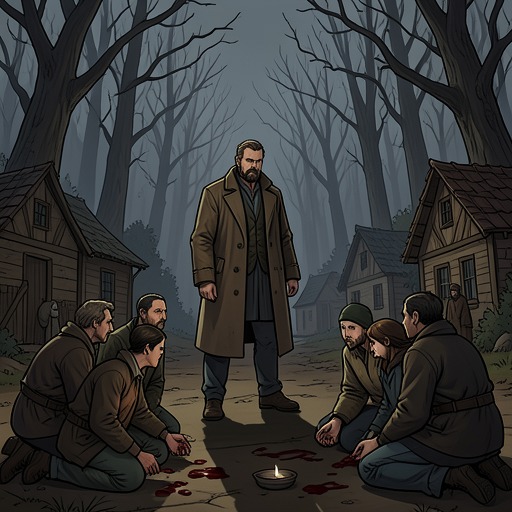
The colony grows through a sequence of disappearances, deaths, and returns that initially look unrelated. Danny Glick’s burial on the first real day of fall places the dead child at the center of a public ritual, but the colony’s activity soon moves beyond the cemetery and into the town’s domestic spaces. Mark Petrie dreams of vampires going from house to house, telephoning and begging to be admitted. In his vision, some residents understand the truth at an instinctive level yet let the visitors in because accepting the supernatural explanation would be harder than surrendering to it. The imagined scene identifies invitation as a psychological vulnerability as well as a formal rule.
The infection then acquires a recognizable bodily pattern. Mark predicts that many people will lie in bed with drawn curtains, assuming that weakness, nausea, and loss of appetite indicate a cold or influenza. These symptoms turn the colony’s feeding into a false medical narrative: the infected can remain inside ordinary categories long enough for the danger to spread. The town’s clinical and funeral systems become part of the field in which the colony operates. Marjorie Glick’s body shows no surface lividity and no sign of rigor or incipient rigor, conditions that recall the unexplained state of Mike Ryerson and frustrate ordinary diagnosis.
The colony also removes evidence. The bodies of Floyd Tibbits and the McDougall baby disappear from the Cumberland County Morgue, while Mike Ryerson is likewise gone. The thefts transform isolated deaths into an organized crisis: corpses are no longer secure once they have entered official custody. Later, when Mark Petrie and Jimmy Cody pull Roy McDougall from a crawl space, daylight makes the body writhe, steam, sag, yellow, and retreat toward shadow. The scene exposes the colony’s dependence on darkness and demonstrates that its members are not simply dead victims but altered agents capable of concealment and movement.
Social and Spatial Conditions
The colony’s success depends on Jerusalem’s Lot as a particular social space. Brock Street and Jointner Avenue divide the nearly circular township into quadrants, while roads, bridges, farms, wooded hills, trailers, cemeteries, and houses provide separate but connected zones of access. The trailers and shacks of the Bend form an especially exposed margin, surrounded by junked cars, children, improvised yards, and poorly maintained septic systems; Dell’s offers a regular gathering place for drinking and fighting. Yet the colony is not confined to the marginal district. It can move through the whole town because the road system and domestic architecture connect social classes that otherwise remain separate.
The town’s apparent security is itself a protective screen for the vampires. Jerusalem’s Lot is a bedroom community for Portland, Lewiston, and Gates Falls, with little local industry and consolidated schools serving several towns. A longer absence list could pass unnoticed, and many residents no longer participate in the neighborhood gatherings that once made unusual behavior visible. Jimmy Cody recognizes that a vampire colony could be founded with relative ease under these conditions: workers commute away, school absences are dispersed, church attendance is inconsistent, and television has replaced much communal surveillance. The colony therefore exploits not primitive isolation but modern anonymity.
The same town that produces constant gossip also produces effective secrecy. Multiple-party telephone lines ensure that residents always have someone to discuss, and the Bend supplies much of the scandal, but gossip does not become knowledge of the supernatural threat. The town can preserve private shame, domestic violence, sexual secrets, and unexplained horror behind a collective poker face. The colony’s concealment works because Jerusalem’s Lot is accustomed to knowing fragments about everyone while understanding almost nothing completely.
Recognition and Counterforce
Recognition begins when ordinary explanations fail to contain the accumulating evidence. Ben Mears, Matthew Burke, and Jimmy Cody connect the infection of Mike Ryerson with the Glick family tragedy, the disappearance of bodies, and the possibility that residents are vanishing without being missed. Cody warns that people may be lying behind drawn shades, waiting for sunset, while fewer residents appear on the streets each day. The colony’s most frightening feature is not a single spectacular attack but the prospect of a town emptying gradually, one household at a time.
Its presence is also registered through reactions that precede conscious understanding. On a rainy morning, some awake residents turn on every light in their homes, retrieve religious symbols from drawers, attics, or jewelry boxes, and move carefully from room to room without looking outside. They do not know the truth, and their suspicions remain vague, but their bodies behave as though they recognize an approaching enemy. The refusal to look out the windows becomes a communal gesture of defensive ignorance: the residents sense that visibility itself may invite contact.
The colony’s members are vulnerable to religious force when that force is embodied in genuine conviction. Ben uses a cross against Marjorie Glick after she rises from the mortuary table and calls for Danny. The object does not merely identify her condition; it drives her backward, and her laughter answers the dwindling circle of resistance. She then elongates, becomes translucent, and seems to seep into the wall like smoke before disappearing. The episode shows both the colony’s evasive power and the limits of physical confrontation: even when repelled, an individual vampire may escape rather than be destroyed.
Consequences and Narrative Significance
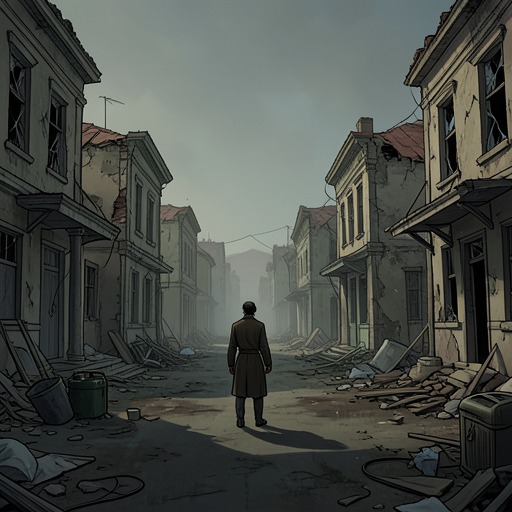
The colony converts the town’s geography into a map of hidden occupation. Homes become possible feeding sites, bedrooms become thresholds, crawl spaces become shelters, the morgue becomes a compromised archive of the dead, and the cemetery becomes a point where public mourning meets supernatural continuation. The ordinary village remains visually recognizable, but its meaning changes. A lit house may contain frightened survivors or a concealed vampire; a missing body may signal reanimation rather than burial; a familiar illness may be the first visible stage of conversion.
Its expansion also collapses distinctions between victim and perpetrator. Danny Glick is first understood as a dead child, Mike Ryerson as a missing gravedigger, and Roy McDougall as a corpse recovered from concealment. Yet each can become an instrument of further infection. The colony preserves the emotional identity of its victims only long enough to weaponize familiar relationships: children return to rooms, spouses remain bound to domestic spaces, and the dead call for those they loved. That distortion makes resistance morally and psychologically difficult, because destroying the vampire may require confronting the recognizable person still present in the monstrous body.
The vampire colony ultimately embodies the novel’s contrast between a town that believes nothing truly terrible can happen there and a darkness that has already learned the town’s routines. Jerusalem’s Lot’s roads, commuting patterns, private houses, funerals, medical institutions, and habits of silence do not stop the colony; they provide its infrastructure. The organization’s horror lies in its patient scalability. Once the first infection is granted, each unexamined absence, closed curtain, compromised corpse, and opened door can become another link in the chain, allowing supernatural domination to appear first as local misfortune and only later as the transformation of the entire community.