Ben Mears and Jimmy Cody
'Salem's Lot: A NovelBen Mears and Jimmy Cody are bound by a medical and anti-vampire alliance that turns private terror into organized investigation. Ben is the returning writer whose book already imagines a town marked by sex murders and mutilations, yet whose rational disbelief is steadily broken by the evidence around him. Jimmy is the local doctor who begins from clinical uncertainty but becomes one of the few people willing to examine the impossible without surrendering either judgment or action. Together they move from interpreting unexplained injuries to identifying the Undead and preparing an armed assault on Kurt Barlow.
From Medical Inquiry to Shared Suspicion
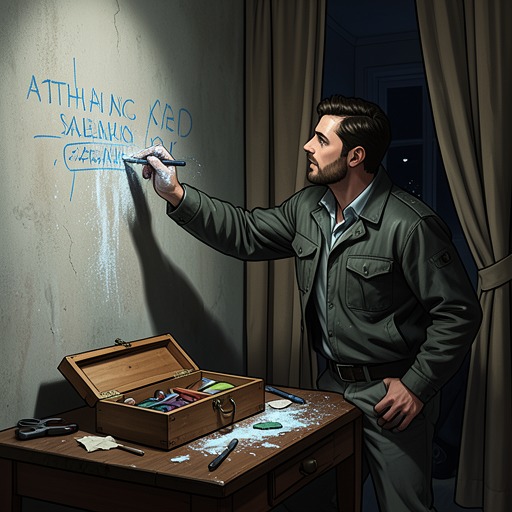
The partnership grows through a crisis of interpretation. Ben’s fictional plan for a town story involves opening with a sex murder and describing the mutilation in minute detail; Ralphie Glick’s disappearance gives that imagined violence an unsettling real-world counterpart. Jimmy, meanwhile, approaches the cases through medicine and procedure. His reflections on aspirin expose both the usefulness and limits of medical knowledge: doctors can administer remedies without fully understanding the brain, pain, or the mechanisms by which a substance works. That humility becomes important when ordinary diagnoses fail. Jimmy does not simply replace science with superstition; he recognizes that medical certainty rests on incomplete knowledge.
Matt Burke’s account of the supernatural initially makes belief difficult, and the people around him repeatedly confront the barrier represented by the word “can’t.” Ben traces his own movement toward belief by acknowledging that he had dismissed Matt because such things could not be true, even though he could find no weakness in Matt’s story. Jimmy’s role in this transition is practical rather than rhetorical. His medical perspective provides a way to examine bodies, symptoms, and wounds while the investigators test whether the apparent disease is actually something more dangerous.
Investigation and Emergency Action
The alliance becomes explicit when Jimmy joins Ben, Matt Burke, and Mark Petrie at the hospital after Susan Norton disappears. Jimmy reports the disappearance as bad news and demands to know whether Ben is certain that Susan has become a vampire. Ben answers by introducing Mark and directing Jimmy to Mark’s firsthand account of Danny Glick’s visit. Mark then recounts the encounter from beginning to end, supplying testimony that connects the adult investigation to a child’s direct experience.
Ben responds to Susan’s disappearance not with retreat but with an immediate objective: he wants to move against Barlow before dark. Jimmy accepts the urgency, cancels all his calls, and contacts the county sheriff’s office, only to learn that McCaslin has disappeared as well. The discovery of a pistol near Susan’s car makes the threat material and immediate. Ben places the weapon on Matt’s bedside table, and the ordinary hospital room becomes a planning center for an operation that must proceed before daylight gives way to the vampires’ active hours.
Jimmy also helps widen the investigation beyond the central group. The closure of Foreman’s establishment and complaints about the dump are linked to the disappearance of Dud Rogers, while Jimmy, Ben, and Mark are expected to make statements to McCaslin’s office. The alliance therefore operates in tension with failing civic institutions: police authority is compromised, witnesses are vanishing, and the investigators must act before formal processes can catch up with the danger.
Clinical Proof and the Undead Body
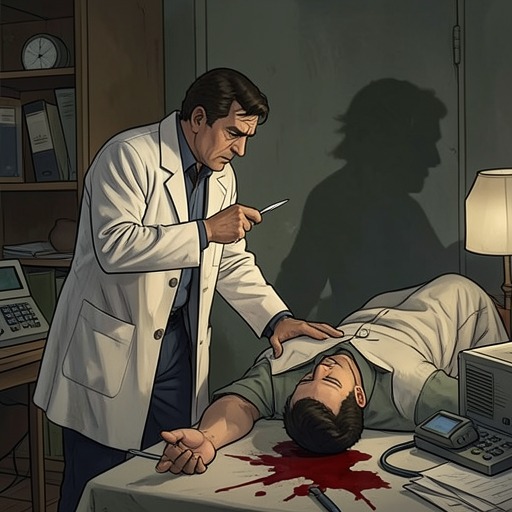
Jimmy’s most decisive contribution is his examination of Marjorie Glick’s body. Ben hesitates over the stake, still trying to preserve the idea that she is dead in an ordinary sense. Jimmy rejects that defense. He has wrapped a blood-pressure cuff around her arm, pumped it, and obtained a reading of 00/00; he has also placed his stethoscope against her chest, allowing the group to hear the silence within it. His conclusion is categorical: she is not merely dead but Undead.
This scene gives the alliance its characteristic method. Jimmy does not persuade Ben through faith alone, nor does Ben force Jimmy into a conclusion by emotional pressure. The diagnosis is built from instruments, examination, and a result that ordinary medicine cannot explain. Yet the clinical procedure does not neutralize the horror. Instead, the blood-pressure cuff and stethoscope make the contradiction more exact: the body can be measured, but measurement reveals a condition outside accepted medical categories.
When Jimmy tells Ben to act quickly and leave for daylight, he converts diagnosis into protocol. The hammer placed in Ben’s hand becomes the practical extension of Jimmy’s finding, while Father Callahan supplies the religious command. Jimmy’s medical certainty thus supports the group’s violence against the vampire, showing how clinical observation and ritual belief become complementary rather than mutually exclusive forms of knowledge.
Trust, Witnessing, and the Barlow Campaign
Jimmy’s relationship with Ben is also sustained by trust under conditions in which communication is increasingly unreliable. When Ben cannot be reached, Matt Burke contacts Father Callahan and reports that Ben left the hospital with Jimmy, while Susan is also missing. Jimmy’s disappearance is therefore not treated as an isolated absence; it becomes evidence that the entire investigative network has been penetrated. Later, when Ben, Jimmy, and Mark reunite at the hospital, Jimmy does not dismiss Ben’s conclusion about Susan, but tests it by asking for confirmation and hearing Mark’s evidence.
The partnership also depends on shared witnessing. Jimmy listens to accounts, examines bodies, handles weapons, and participates in decisions whose consequences cannot be reversed. His medical identity gives him a special position between skepticism and belief: he can name what the body shows, but he must accept that the body’s condition exceeds the explanatory framework with which he began. Ben, by contrast, carries the emotional cost of Susan’s disappearance and the knowledge that a woman he loves has become part of Barlow’s threat. Jimmy’s presence helps transform that grief into action without erasing its personal force.
Breakdown and Last Stand
The alliance reaches its most desperate point when the lights go out. Jimmy runs back to Matt’s room with the news that the line at the Petrie house is dead and that Barlow may be there. His recognition that the group has been dangerously slow is inseparable from the shrinking daylight and the loss of time. The medical investigator who once considered how to obtain an exhumation order is now running through a hospital as the enemy moves against a living family.
Ben and Jimmy’s cooperation therefore marks the novel’s passage from explanation to resistance. Jimmy’s instruments establish that the apparent corpses are not ordinary corpses; Ben’s testimony and determination turn that knowledge into an offensive plan. Their alliance cannot prevent every loss, and it does not restore the world to rational normality, but it creates a disciplined response to a threat that local authorities, conventional diagnoses, and private denial have failed to contain. Its significance lies in that fusion of care and combat: Jimmy remains a doctor even when medicine reaches its limit, and Ben remains a witness even when witnessing demands that he act.