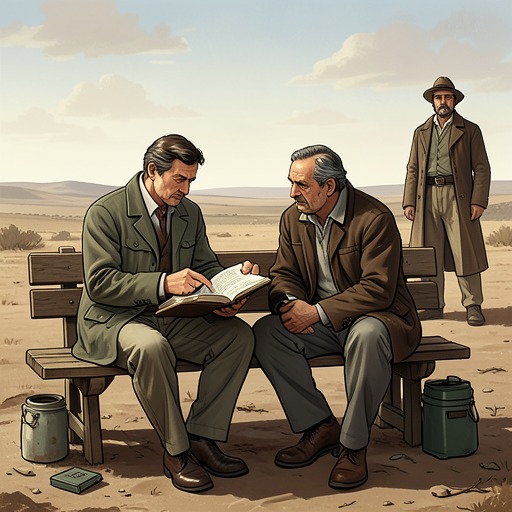
Ben Mears and Matt Burke
'Salem's Lot: A NovelBen Mears and Matt Burke are joined by an anti-vampire alliance that gives the novel its principal human partnership. Their bond begins in conversation, but it becomes increasingly consequential as Matt’s knowledge and Ben’s personal connection to the Marsten House converge. Together they transform suspicion into investigation, investigation into resistance, and private fear into a collective decision to fight.
Identity and First Contact
Matt Burke is an older, educated resident of ’Salem’s Lot whose manner combines patience, courtesy, and an unsettling willingness to take impossible testimony seriously. Ben Mears is a novelist returning to the town while preparing a book connected with the Marsten House. His literary project gives Matt an immediate reason to question him: Matt asks whether Ben’s new book is about the house, then returns to the question when Ben does not answer directly. The exchange establishes that the house is not merely a subject of local gossip but the point at which both men’s interests and fears meet.
Their early relationship is therefore marked by reserve rather than instant intimacy. Matt asks Ben for a substantial favor despite their short acquaintance, and Ben approaches Matt’s knowledge with caution. Matt’s home, filled with an ancient Motorola television and a KLH sound system with quad speakers, presents an ordinary domestic setting for an extraordinary conversation. The contrast matters: supernatural knowledge does not arrive in a remote castle or isolated laboratory, but through an apparently familiar town resident whose house is still anchored in everyday objects and routines.
From Suspicion to Investigation
Matt becomes the first person in ’Salem’s Lot to treat Ben’s account as something other than madness. He explains that he once had an experience connected with the house on the hill, an experience that made him sympathetic to stories appearing irrational in the light of ordinary knowledge. He does not immediately disclose the whole experience, but his willingness to withhold judgment gives Ben a form of intellectual protection that the town’s conventional explanations cannot provide.
Ben, in turn, recognizes that Matt is not easily deceived. When the two men discuss the Marsten House, Straker, and the unexplained events gathering around them, they deliberately leave important facts unsaid. Their conversation becomes a tentative conspiracy: neither man possesses complete certainty, yet each understands that the other is observing the same darkness. Ben is uneasy because Matt may be indulging in harmless eccentricity—or confronting something much more serious—but that uneasiness does not sever the connection. It becomes the pressure that drives them to test their suspicions together.
Matt’s trust in Ben is also practical. When Matt speaks with others, he identifies Ben as a good friend and expects him to be involved in the inquiry. Ben likewise tells Matt that, apart from himself, the people connected with the Marsten House are the only new arrivals in town and that his own presence cannot explain what is happening. Their reasoning is provisional but cumulative: the house, its occupants, the missing bodies, and the town’s changing atmosphere begin to form a pattern that neither man can dismiss.
Shared Danger and Emotional Reliance
The alliance deepens as the supernatural crisis moves from rumor to physical evidence. Matt participates in the examination of a corpse and confronts the grotesque possibility that bodies have been taken from the Cumberland County Morgue. Medical and rational procedures remain present, but they no longer settle the matter. Instead, the two men must work at the boundary between clinical observation and supernatural interpretation, using ordinary investigation to identify an extraordinary threat.
When the group’s account of the horror is finally assembled, the experience affects Ben and Matt differently. Matt expresses his sorrow to Ben after the revelation of Susan’s fate, treating grief as a reality that must be acknowledged rather than an obstacle to be ignored. He takes one of Ben’s hands, and Ben allows the gesture without resistance. This moment makes their alliance more than a tactical arrangement: Matt becomes a source of physical and emotional steadiness when Ben is confronting loss, guilt, and the collapse of his earlier hopes.
Matt also helps convert grief into purpose. He tells Ben that the next day will begin a hunt, not only for Barlow but for the many lesser vampires who will follow. His language frames the struggle as prolonged and organized rather than as a single confrontation. He urges Ben to pursue the vampires by day, when their power is limited, until Barlow is forced to flee or is dragged into sunlight. Matt’s counsel supplies the alliance with a strategy, while Ben supplies the personal determination created by his connection to the house and Susan.
Organization and Final Commitment
Matt’s role expands from confidant and investigator to organizer of resistance. He has already spoken with Father Callahan and secures the priest’s participation on the condition that Ben, Susan, and Mark first speak with Straker at the new shop. The condition shows Matt working through alliances rather than acting alone: he coordinates different kinds of knowledge—Ben’s personal history, Susan’s connection to the town, Mark’s unusual courage, and Father Callahan’s religious authority.
The partnership also depends on shared uncertainty. Neither Ben nor Matt can present a complete explanation at the outset, and their first conversations contain omissions, hesitation, and the fear that they may be helping a harmless delusion or something darker. Yet the alliance gains strength precisely because it is tested against evidence. Each new discovery narrows the distance between rational disbelief and supernatural fact, while each personal loss raises the cost of remaining passive.
After Susan’s death and the destruction of Straker, Matt refuses to let Ben’s despair become surrender. He insists that the enemy remains active and that the vampires’ hunger will continue to spread. His appeal for Ben to stay and fight with the group is both a strategic request and a moral one. Ben’s answer is not treated as the isolated resolve of a hero; it is the result of the relationship Matt has built with him, a commitment made possible by trust, shared mourning, and a common understanding of the danger.
Narrative and Thematic Significance
Ben Mears and Matt Burke embody the novel’s meeting of imagination and experience. Ben arrives as a writer whose earlier success belongs to a period before darkness overtook his life, and his attempt to write again is entangled with the Marsten House. Matt represents a different kind of interpretation: he is willing to respect rational knowledge while admitting that rational knowledge may be inadequate. Their alliance makes the novel’s central epistemological conflict interpersonal. Ben needs Matt to test what he has seen; Matt needs Ben’s presence, memory, and willingness to act.
Their relationship also joins private trauma to communal defense. Ben’s interest in the house begins as a literary and personal return, but Matt helps reveal its public consequences. The threat is not confined to Ben’s childhood memory, Susan’s fate, or one haunted building; it is spreading through the town. Matt’s friendship therefore gives the narrative a structure of recognition: one man’s frightening perception becomes credible when another man listens, remembers, investigates, and finally commits himself to the same fight.
The alliance’s decisive value is its refusal of both easy disbelief and helpless fascination. Matt does not simply reassure Ben, and Ben does not merely borrow Matt’s authority. They challenge, correct, and sustain one another. By the time Matt asks whether Ben will remain with the group, their relationship has moved from acquaintance to fellowship under siege. Their shared resistance does not erase loss, but it turns companionship into an instrument against the darkness.