Ben and Mark enter Eva Miller’s root cellar
'Salem's Lot: A NovelBen and Mark enter Eva Miller’s root cellar during the final assault on the vampire forces occupying Jerusalem’s Lot. The action is decisive because it turns the hidden infrastructure of the outbreak—a sealed chamber beneath an apparently ordinary house—into the site where the hunters can reach Kurt Barlow. The scene binds together the novel’s recurring oppositions between daylight and darkness, domestic shelter and contamination, human tools and supernatural force, and disbelief and faith.
The Approach to the Cellar
The assault begins inside a house already saturated with death. Ben Mears and Mark Petrie enter through the kitchen, where the odor of decay is described as palpable and wet, while the cellar door stands open. The open entrance does not make the descent easy: the stairs appear intact in the sunset light, but Mark is shuddering with fear, and Ben understands that the search may lead to his death. The cellar therefore functions as a literal threshold. Above it lies the familiar interior of Eva Miller’s home; below it waits the concealed enemy and the accumulated horror that the house has been made to contain.
The moment also occurs against the larger geography of Jerusalem’s Lot. The town is organized by intersecting roads, with Brock Street crossing Jointner Avenue at right angles, while wooded high ground, the Royal River, farms, trailer districts, cemeteries, and the Marsten House create distinct zones of visibility and danger. Eva Miller’s cellar belongs to the same pattern of hidden spaces that has allowed evil to spread beneath ordinary social life. The town’s assumption that nothing truly terrible could happen in such a pleasant place is exposed as a fatal misreading; the cellar is the underside of that reassuring surface.
Grief and the Discovery of the Hidden Door
Before Ben and Mark can reach Barlow, they encounter the remains of Jimmy Cody. Mark cannot look at the body, while Ben kneels, turns Jimmy over, and pulls six blades from him. The gesture is both practical and intimate: Ben removes the weapons that have pinned Jimmy down, cradles him in his arm, and addresses him in grief. Jimmy’s death gives the descent a personal cost. The hunters are not entering the cellar as detached investigators; they are moving through the immediate aftermath of the loss of an ally.
Mark then perceives the concealed route. His hand appears to glow as he points toward a Welsh dresser, and Ben realizes that the furniture cannot be large enough to conceal the vampire’s hiding place unless something lies behind it. Together they throw their combined weight against the dresser. It crashes over, shattering Eva Miller’s long-ago wedding china and revealing a small chest-high door set into the wall. The broken china makes the discovery more than a mechanical obstacle. An object associated with marriage and domestic continuity is destroyed as the house yields its secret, suggesting how completely the infected cellar has ruptured the ordinary meanings of home.
A new Yale padlock secures the door. Ben strikes it twice with a hammer, but the lock does not give way. The five-dollar fastening becomes an almost absurd final barrier between the hunters and the supernatural enemy: after surviving vampires, death, and the collapse of the town, they are momentarily stopped by cheap hardware. Ben’s frustration turns into resolve. If necessary, he will force his way through the wood with his teeth, a declaration that the assault has passed beyond ordinary calculation.
The Consecrated Ax
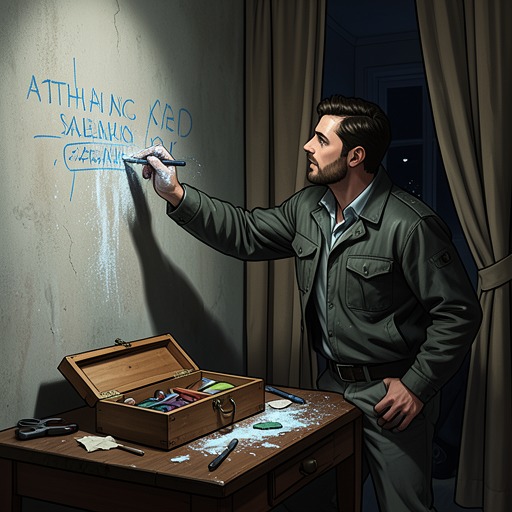
The means of entry comes from the tool board beside the cellar stairs. Ben sees an ax hanging from two steel pegs, its blade covered by a rubber guard. He takes it down, removes the cover, and uses one of his ampoules of holy water to douse the blade. The water begins to glow on the floor, and after Ben applies more of it to the ax, the blade glimmers with an uncanny light. The weapon remains an ordinary household implement in origin, but ritual action changes its function. It becomes an instrument of resistance whose power is not merely mechanical.
Ben’s contact with the ax marks a crisis and resolution in his long struggle between belief and unbelief. Holding the haft gives him an immediate sense of certainty, as though power has welded his hands into their grip. The sensation is described through electrical imagery—power humming up his arms like volts—yet it is also explicitly associated with whiteness, force, and a conviction that the weapon is right for the task. The scene does not present faith as calm doctrinal confidence. It arrives as a physical, elemental energy that interrupts Ben’s earlier groping through uncertainty.
Mark witnesses the transformation with amazement. As Ben raises the ax, a cold blue fire spreads down the handle and up his arms, making him appear to work inside a column of fire. The force that takes hold of him is not characterized as conventionally Christian possession; it is more primitive and unfinished, an elemental Power that seems to move through the material world. This ambiguity gives the moment its force. Holy water activates the ax, but the resulting energy exceeds a simple emblematic gesture, joining religious ritual to wood, metal, muscle, and the enclosed architecture of the cellar.
Breaking Through and the Event’s Significance
Ben brings the ax down in a gleaming arc. The blade bites into the wood and sinks to the haft; repeated blows send splinters flying, and on the fifth strike it breaks through into emptiness. He widens the opening with almost blinding speed until the cellar door can no longer withstand the attack. The physical sequence is carefully staged as escalation: the hammer fails, the consecrated tool succeeds, and the locked boundary collapses under repeated human effort amplified by supernatural power.
The action also reverses the technological pessimism that shadows the novel. The broader world is marked by dangerous inventions, diminishing resources, pollution, nuclear weapons, electricity pylons, and the sense that modern systems have become sinister rather than hopeful. Jerusalem’s Lot itself is cut by Central Maine Power lines, one pylon looming near the Marsten House like an alien sentinel; the town dump and its fire-prone landscape likewise expose the costs of neglect. Against that background, Ben’s weapon is not a modern machine but an old ax, altered by holy water and wielded through embodied conviction. The scene does not restore naïve optimism. Instead, it makes resistance possible through an unstable assemblage of material labor, inherited ritual, courage, and force.
The cellar entry is therefore both an assault and a passage through a symbolic underworld. The men descend past death, overturn the furniture that conceals the entrance, destroy a cheap modern lock, and break through the final wooden barrier before sunset closes their opportunity. The action prepares the confrontation with Barlow while also revealing that the enemy’s apparent security depends on concealment within ordinary places. Once the door is breached, the boundary between the safe town and its hidden vampire colony can no longer hold. Ben and Mark’s entry converts fear into movement and secrecy into an exposed target, making it the crucial physical and spiritual threshold of the final campaign.