Chapelwaite haunting
'Salem's Lot: A NovelChapelwaite haunting describes the mansion’s transformation from an ominous inherited residence into a contaminated Gothic space whose buried history becomes physically active. The house is feared before its supernatural tenants are seen: workers dislike entering it, local people associate it with madness, and its rooms preserve memories of bloodshed, disappearance, and family rupture. When Charles Boone and Calvin McCann investigate, the haunting ceases to be rumor. It becomes an encounter with the Undead and with a deeper Force that has shaped the Boone family’s fate.
Reputation and Historical Burden
Chapelwaite is already treated as dangerous when Charles Boone takes possession of it. A local logger tells Calvin McCann that anyone who lives there must either be a lunatic or risk becoming one, while the workmen who are asked to deliver firewood insist on coming by the sea road and in daylight. The warning establishes the house as socially isolated before any apparition appears: its reputation is transmitted through local knowledge, and ordinary contact with the building is regarded as a risk.
Mrs Cloris, who brings several young women to clean the house, gives that reputation a more precise history. She says that the house has always been bad, while distinguishing the building’s moral atmosphere from the character of Stephen Boone, whom she remembers as kind. Her account reaches back to the quarrel between Robert Boone and his brother Philip over stolen items in 1789, after which no Boone has been happy at Chapelwaite. The house therefore carries not one isolated crime but a family sequence of unhappiness, conflict, and inherited damage.
The history is also marked by literal blood. Mrs Cloris recalls an accident on the cellar stairs in which Randolph Boone’s daughter Marcella died, followed by Randolph’s suicide from remorse. The house has thus been built, inhabited, and remembered through violence. Her description turns architecture into a record: floors, stairs, walls, and cellar spaces preserve events that the living have tried to treat as family history rather than as an active supernatural presence.
Sounds, Workers, and the House as Contamination
Mrs Cloris’s testimony gives the haunting its first sensory form. She has heard thumpings and crashings inside the walls, as well as a strange wailing that is half laughter. These sounds are not presented as a single inexplicable incident; they are recurring disturbances witnessed by someone who has worked in the house and claims to be neither blind nor deaf. Her conclusion is that Chapelwaite is a dark place, and her hesitation suggests that the account itself approaches a forbidden knowledge.
Charles initially responds with amusement and asks whether she suspects ghosts rattling chains. Mrs Cloris rejects that explanation as too simple. She distinguishes the noises from conventional ghost stories and implies that the house contains something more embodied and more dangerous: entities that wail, blubber, crash through darkness, and may draw the living into their own condition. The contrast between Charles’s skepticism and her practical testimony establishes the haunting as a knowledge problem. The local woman recognizes the house through accumulated experience, while the new owner still treats its warnings as superstition.
The social reaction around Chapelwaite resembles a wider pattern in Jerusalem’s Lot. The town is surrounded by rumors of a haunting, colored lights over the Central Maine Power lines, a possible dark coven, and explanations involving satanic rites or unexplained disappearances. In the town itself, gossip travels through telephone wires and conversations, while officials resist hearing the truth: when Ben Mears and Mark Petrie try to tell Parkins Gillespie what has been happening, he calmly refuses to listen. Chapelwaite’s haunting therefore belongs to a world where real supernatural danger is repeatedly filtered through rumor, disbelief, and institutional denial.
The Cellar and the Manifestation of the Dead
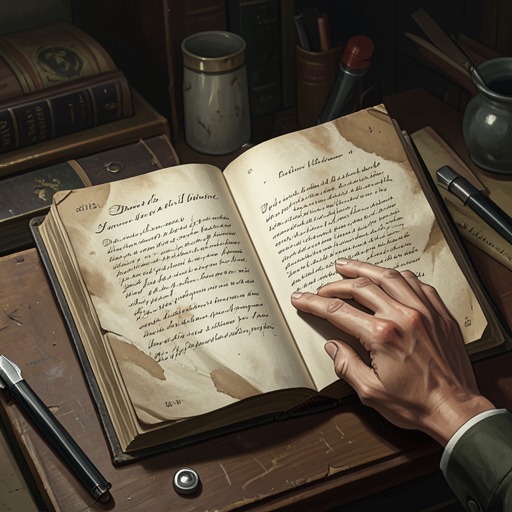
The haunting becomes direct when Calvin McCann discovers a strange book in the upstairs study and hears a noise in the wall. Charles first dismisses the sound as rats, but the investigation leads them through the house’s interior spaces and toward the cellar. The movement from study to wall to underground chamber gives the haunting a material geography: what has been hidden is not merely in the past but inside the structure itself.
In an alcove at the far end of the cellar, the granite walls give way to polished wood that appears black and nonreflective. A single chair stands beneath a decayed hemp noose fastened to an overhead beam. Calvin correctly identifies the place as where a man hanged himself, with his daughter’s corpse lying at the foot of the stairs. The setting makes the earlier family history visible and concentrates it into one oppressive tableau: the noose, the chair, the stairs, and the dead child form a domestic crime scene preserved as an architectural chamber.
The wall then swings open. From the darkness emerges a face with black eyes, a toothless agonized grin, and a yellow, rotted hand. The figure advances with a mewling sound, and candlelight reveals a livid rope-burn around its neck. A second apparition follows: a girl with a pallid, mouldering face, a corpse-grin, and a head hanging at a lunatic angle. The haunting thus confirms Mrs Cloris’s account while intensifying it. The dead do not simply make noises in the walls; they inhabit concealed passages and attempt to claim the living.
Charles and Calvin escape only because Charles throws his candle at the figure and follows it with the chair beneath the noose. Afterward Charles’s memory becomes confused, and he wakes in his room with Calvin beside him. The interruption of his recollection gives the encounter the shape of trauma: the scene is witnessed in precise physical fragments, then collapses into darkness. The house has not merely frightened its occupants; it has damaged their ability to narrate what happened.
Blood, Inheritance, and the Wider Force
After the cellar encounter, Charles concludes that Chapelwaite is connected to a deeper drama. He accepts that Mrs Cloris was right about blood calling to blood and about those who watch and those who guard. In his understanding, the house has awakened a Force that has slept in the village of Jerusalem’s Lot for half a century. This interpretation links the immediate haunting to a larger supernatural history rather than confining it to the Boone family’s domestic tragedies.
Charles also identifies the victims of that history as his ancestors, who were slain and taken into unholy bondage as nosferatu, the Undead. The haunting therefore operates through hereditary return. The dead are not detached apparitions from an unrelated past; they are bound to the Boone lineage, and Charles’s arrival at Chapelwaite places him within the same chain of blood, violence, and supernatural control. His inheritance is consequently double-edged: he receives the house, but he also inherits the danger that the house conceals.
The state remains incomplete even after the apparitions are seen. Charles says that he has awakened the Force but still sees only part of the truth, and he fears that fuller knowledge would reveal something worse. That partial understanding is central to Chapelwaite haunting. The house discloses enough to establish the reality of its evil while withholding its entire structure, making discovery itself part of the danger.
Narrative and Thematic Significance
Chapelwaite haunting turns a family mansion into a supernatural beacon and a spatial archive of repression. The house’s sealed walls and cellar do what family memory cannot: they retain the evidence of quarrels, accidents, suicide, disappearance, and the return of the dead. The Gothic effect comes from the collision of domestic familiarity with an interior that refuses to remain passive. A chair, a noose, a staircase, and a partition become instruments through which buried history enters the present.
The haunting also shows how local society produces competing explanations for the same darkness. Rumor names the danger as a coven, a satanic rite, a UFO phenomenon, or a mass disappearance; official figures avoid the subject; and ordinary people cling to religious symbols without understanding why. In Jerusalem’s Lot, residents who wake during the supernatural crisis turn on every light, retrieve religious objects, and refuse to look out their windows even though they do not know the truth. Chapelwaite belongs to this same atmosphere of instinctive dread: the body and the community register danger before reason can formulate it.
At the center of the state is a conflict between skepticism and recognition. Charles begins by treating Mrs Cloris’s warning as an amusing superstition, but the cellar forces him to accept that the house contains active, predatory dead. His final response is not mastery but entrapment. He cannot simply leave, believes himself a pawn in a darker drama, and understands that the house has awakened forces connected to his own blood. Chapelwaite haunting is therefore both a supernatural condition and an inheritance: the past does not remain buried, because the building has made it a living presence.