Danny Glick Dies After Hospitalization
'Salem's Lot: A NovelDanny Glick Dies After Hospitalization marks the passage from unexplained childhood trauma to officially recorded death, while preserving the medical language that initially conceals the nature of what has happened to Danny. His hospitalization gives the town an apparently rational framework for his symptoms, but his sudden death, the condition of his body, and the later comparison with other anomalous corpses make the hospital episode an early diagnostic failure in the vampire outbreak.
Admission and Medical Explanation
Danny Glick, recorded as Daniel Francis Glick, is a twelve-year-old boy from Brock Road in Jerusalem’s Lot. He is admitted on September 22, 1975, by his father, Anthony H. Glick, after an encounter that has left him in shock and with only partial memory. The hospital record lists nausea, disinterest in food, constipation, and general sluggishness among his symptoms. These details place Danny inside an ordinary clinical system: his body is measured, categorized, and subjected to tests even though the initiating event cannot be adequately narrated by the patient or his family.
The physicians find no decisive physical cause in the initial examinations. A marrow sample and chest X-ray are negative, while a previous examination has shown only 86 percent hemoglobin. The proposed diagnosis is pernicious anemia, primary or secondary, combined with mental shock. Secondary anemia is considered unlikely because there is no history of ulcers, hemorrhoids, bleeding piles, or other obvious blood loss. The doctors recommend further investigation, including a barium enema and X-rays for possible internal bleeding, and prescribe daily vitamin B12. Pending those tests, the hospital releases him from immediate medical scrutiny rather than recognizing his condition as an encounter with the undead.
The Night Death
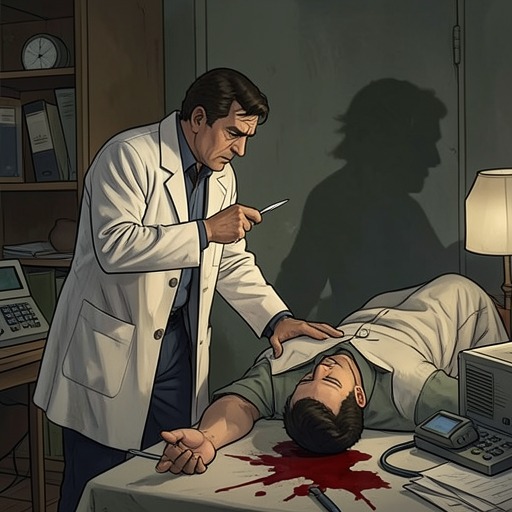
The decisive reversal occurs at one o’clock in the morning on September 24. A nurse enters Danny’s room to administer his medication and finds the bed empty. Near the foot of the bed lies an oddly wasted white bundle. Her first interpretation is mundane: she assumes Danny has tried to reach the bathroom and has collapsed because he is too weak. When she turns him over, she momentarily thinks the vitamin B12 has helped, because he appears better than he has since admission.
That impression ends when she touches his wrist. The flesh is cold, the light blue veins beneath the skin are motionless, and Danny is dead. The nurse runs to the station to report a death on the ward. The scene is important precisely because it joins routine hospital procedure to an impossible physical change: treatment seems to improve the boy’s appearance, yet the apparent improvement is revealed as the stillness of death. The clinical setting does not prevent the supernatural event; it gives the event a familiar vocabulary that can delay recognition.
From Patient to Omen
Danny’s death later becomes a reference point in the investigation of other bodies. When James Cody examines a corpse at Matt Burke’s house, Matt explicitly connects its condition with what Cody had said about the Glick boy. The comparison suggests that Danny’s unexplained death is not an isolated medical tragedy but part of a recurring pattern: bodies lack the expected signs of ordinary death, and observers struggle to decide whether they are truly dead at all. Parkins Gillespie even asks whether the body is dead and whether anyone has tried to wake it, exposing the uncertainty that Danny’s case has already introduced.
The investigation expands beyond the hospital. The theft of bodies from the Cumberland County Morgue in Portland reveals that the problem is no longer confined to one child or one family. Corpses become active objects of fear, surveillance, and forensic attention. At Green’s Mortuary, Marjorie Glick’s body is examined under conditions that recall both a hospital and a laboratory. Her condition is judged strikingly similar to Mike Ryerson’s: there is no surface lividity and no sign of rigor or incipient rigor. This later evidence retrospectively sharpens the significance of Danny’s death, making the hospital record an early fragment in a chain of anomalous deaths and returns.
Institutional Blindness and Narrative Consequences
The episode demonstrates how medical institutions classify abnormal bodies without possessing the conceptual means to interpret them. Danny is treated as a patient with anemia, shock, and gastrointestinal symptoms; after death, he becomes a body to be reported and processed. The hospital’s procedures are not presented as deliberately negligent. Rather, their ordinary competence becomes part of the horror, because plausible tests and diagnoses can coexist with a cause that lies outside accepted medical knowledge.
The death also intensifies the emotional and investigative pressure on Jerusalem’s Lot. The Glick family tragedy is no longer merely a missing-child mystery or a frightening episode remembered through damaged testimony. Danny’s hospitalization supplies a date, an admitting record, symptoms, a proposed diagnosis, and a witnessed death. Those administrative facts lend institutional weight to an event that the town is not yet prepared to understand. Later, when investigators confront further corpses, hospital observations, mortuary examinations, police questioning, and missing bodies form a growing archive of evidence against the town’s ordinary explanations.
Danny’s death therefore functions as both an ending and a beginning. It ends his brief status as a frightened survivor whose memory is incomplete, but it begins the process by which the wider vampire crisis becomes visible through repeated bodily signs. The hospital cannot save him because it mistakes the supernatural transformation for disease; nevertheless, its records and the nurse’s direct observation preserve the concrete evidence from which the truth gradually emerges. In the structure of the story, Danny’s death is the first major institutional witness to the darkness spreading through Jerusalem’s Lot.