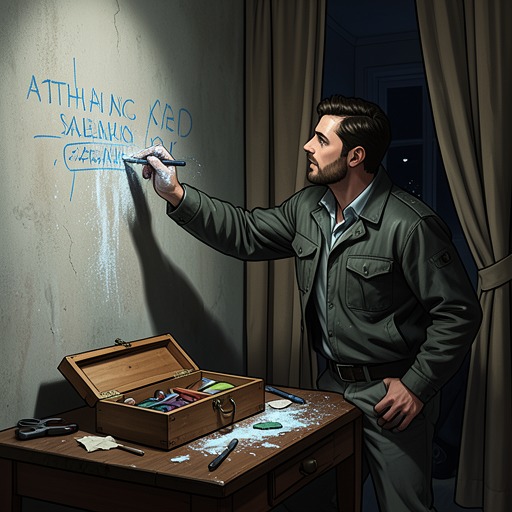
Discovery of Barlow’s hiding place
'Salem's Lot: A NovelDiscovery of Barlow’s hiding place is the crucial transition from suspicion to action in the vampire hunt. A seemingly incidental image—blue chalk beside a pool table—becomes a usable address when Jimmy Cody reconstructs its details and identifies the covered billiard table in Eva Miller’s boardinghouse as Kurt Barlow’s refuge. The discovery gives Ben Mears and Mark Petrie a target, compresses the remaining daylight into a race against time, and makes the hidden geography of Jerusalem’s Lot suddenly legible as a map of occupation and danger.
The Clue in the Ordinary World
The breakthrough begins with an object that appears harmless and domestic. Jimmy sees blue chalk, three shaded lights in a row, and men moving around a green table while brushing chalk from their fingertips. The image is not initially a complete vision or an explicit message; it is a fragment lodged among the dead children’s toys in a trailer. Its power comes from the collision between ordinary recreation and supernatural concealment. The pool table belongs to the familiar social world of games, smoke, and conversation, yet the image is linked to the place where the vampire master is hidden.
The clue also depends on the physical and social texture of Jerusalem’s Lot. The town is arranged around intersecting roads, with Brock Street crossing Jointner Avenue at right angles and giving the settlement the appearance of a telescopic sight. Its neighborhoods range from the wooded high ground near the Marsten House to the trailer-filled Bend, whose rough domestic spaces stand beside roads leading toward bars, farms, and outlying properties. In such a town, a billiard table is not an abstract symbol: it is a concrete object that can be traced through local knowledge, ownership, and memory.
Jimmy Cody Deciphers the Image
The first obstacle is interpretive rather than physical. Mark points out that there is no pool hall in the Lot and that the nearest one is in Gates Falls. Jimmy rejects that possibility because he knows Barlow would not need to use a public hall; some residents keep pool or billiard tables in their homes. This distinction changes the clue from a general image into a search for a private interior. The investigation therefore moves through the town’s domestic spaces rather than toward an obvious commercial location.
Jimmy then reaches the missing detail through association with plastic. He recalls plastic toys, picnic utensils, and protective covers before the image resolves into a pool table draped in a large plastic dustcover. The accompanying thought is that the felt might mildew and that Ed Craig had mentioned the danger. Once the covered table appears in his mind, Jimmy identifies the place with complete conviction: Barlow is in the basement of Eva Miller’s boardinghouse. The deduction is important because it joins three kinds of evidence—the visible blue chalk, the architectural image of the billiard table, and remembered local knowledge—without treating any one clue as sufficient by itself.
From Recognition to Pursuit
Mark responds immediately by proposing that they go and get Barlow, but Jimmy first tests the discovery against the boardinghouse itself. He phones Eva Miller’s number and lets the call ring ten times, then eleven, then a dozen. The absence of an answer is frightening precisely because Eva Miller’s boardinghouse normally contains many residents, including elderly men who are often present. The silence transforms the address from a plausible hypothesis into an urgent warning: the house that should be occupied and responsive has become unnaturally still.
The timing makes the discovery a tactical decision. It is quarter past three, daylight is running out, and the hunters cannot reach Ben by telephone because the line at Mark’s house is dead. Jimmy nevertheless decides to leave at once. If the deduction is wrong, they can return with daylight still available; if it is right, they can come back for Ben and stop Barlow’s clock. The phrase captures the practical objective of the expedition: locate the vampire before daylight ends, then exploit the cycle that confines him to concealment.
Space, Silence, and the Hidden Enemy
The scene gives the boardinghouse’s basement a significance beyond that of a mere hiding place. The house is part of the town’s ordinary network of residence and gossip, yet its lower level becomes a sealed chamber for the power controlling Jerusalem’s Lot. The contrast follows a recurring spatial pattern in the novel: the surface town continues to display familiar roads, houses, lights, and routines while concealed interiors hold the truth. The same terror appears elsewhere when people wake, turn on every light, and instinctively search for religious symbols without understanding what threatens them; they avoid looking out their windows because ordinary sight has become dangerous.
The discovery also reverses the hunters’ earlier condition. They had entered spaces where silence signaled that they were not alone, and they had faced clues whose meaning remained delayed. Here, silence supplies confirmation rather than merely atmosphere. Eva Miller’s unanswered telephone suggests that the boardinghouse has been emptied or subdued, while the covered pool table provides the material marker of Barlow’s presence. A familiar object, removed from use and hidden under plastic, becomes an index of the hidden master.
Consequences and Narrative Significance
The identification of Eva Miller’s basement changes the investigation’s scale. Before it, the anti-vampire effort is forced to infer Barlow’s movements from disappearances, altered bodies, vanished corpses, and partial testimony. The absence of markers is itself a problem: Danny Glick is the only corpse with a known grave, while the other dead have disappeared. Jimmy’s deduction supplies what the investigation lacks—a place where the enemy can be confronted directly.
The clue therefore functions as both explanation and command. The blue chalk and covered table do not merely reveal a fact about Barlow; they organize the next action. Jimmy and Mark leave immediately, intending to return for Ben if their judgment proves correct. Their movement from image to address, from address to telephone, and from failed contact to departure is a compact investigative sequence in which perception becomes decision. The boardinghouse basement is no longer an indistinct possibility. It is the point toward which the remaining resistance must converge, and the discovery initiates the assault that will lead to Barlow’s destruction.