Faith as supernatural power
'Salem's Lot: A NovelFaith as supernatural power is the governing rule behind the novel’s religious defenses against the vampires. A crucifix, a church, or any other sacred object is not automatically potent; its efficacy depends on the conviction of the person who wields it. That dependence makes faith both a weapon and a vulnerability. Against the vampires’ physical vitality, hypnotic presence, and contempt for human belief, the defenders possess no reliable technology or institutional authority—only acts of trust that must be renewed under pressure.
Definition and Operation
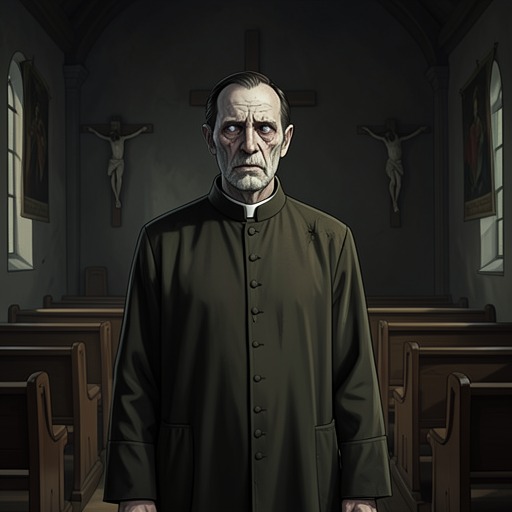
Faith operates as an active supernatural force rather than merely a private consolation. Father Callahan’s encounter with Kurt Barlow makes the principle explicit: Christian symbols are effective only when the person using them genuinely believes in what they represent. Barlow argues that the cross, the flag, bread, and wine are materially ordinary objects when detached from belief. The cross therefore does not function as an automatic magical device. Its power passes through the believer, and the believer’s inward state can strengthen, weaken, or restore it.
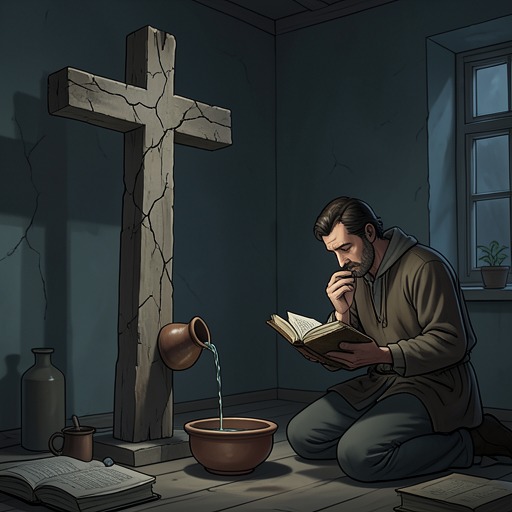
This rule gives religious ritual a concrete place in the novel’s action. At the Marsten House, Father Callahan approaches the entrance with an eagerness he had believed lost, commands the evil to depart in the name of God, and strikes the door with his crucifix. The response is physically violent: light flashes, ozone fills the air, the fanlight explodes outward, the bay window sheds its glass, and the new Yale lock is welded into an unrecognizable mass. The scene turns faith into an observable force. The house is not merely symbolically evil, and the crucifix is not merely psychologically reassuring; conviction produces material consequences.
Faith Against Modern Disbelief
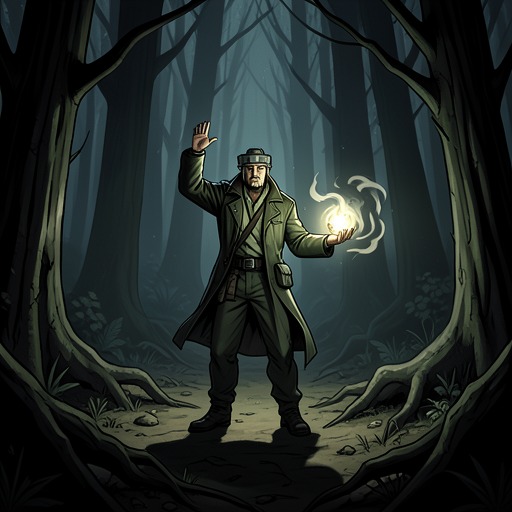
The power of faith is set against a modern environment that makes supernatural belief difficult to sustain. In the novel’s inverted relation to Dracula, electric lights and modern inventions do not automatically protect humanity. Instead, modernity helps the vampire by making belief in him seem impossible. Even a man of God can fail to believe in Mr Barlow when evidence appears before his eyes. Faith is therefore not simple possession of religious knowledge. It is the capacity to act on that knowledge when ordinary explanations, social habits, and technological confidence all encourage denial.
The narrative repeatedly stages this conflict through contrasts between clinical observation and supernatural recognition. Daniel Francis Glick is formally recorded in a dated medical-style entry, while later scenes place bodies under examination and compare physical conditions. Parkins Gillespie asks whether a corpse is truly dead, and James Cody observes that the body lacks ordinary signs of rigor. The stolen bodies from the Cumberland County Morgue intensify the crisis by presenting vampirism as something that has entered public reality, yet the language of institutions initially struggles to name it. Faith becomes a means of recognition as well as defense: it allows the characters to interpret abnormal evidence as part of a coherent supernatural threat.
The Crisis of Father Callahan
Father Callahan embodies the strength and fragility of this system. His inherited religious vocabulary includes an old credo about accepting what cannot be changed, changing what can be changed, and avoiding failure; that formulation returns while he stands before Danny Glick’s mourners. The recurrence links ordinary pastoral responsibility with the larger battle against the undead. His task is not only to comfort the living but to decide whether the religious force he represents can still operate in a world where death has ceased to be final.
During the confrontation with Barlow, Callahan’s faith is attacked directly. Barlow dismisses love—the “talisman of White”—as empty language and physical appetite, then insists that goodness requires an act of faith while evil requires only waiting. The claim transforms the conflict from a contest of strength into a contest over human inward action. Evil can remain passive and omnipresent; goodness must be enacted despite uncertainty. Barlow’s argument is especially dangerous because it addresses the weakness Callahan already carries: the priest does not merely face an external monster but doubts the worth of the flame he is supposed to guard.
That doubt has an immediate material effect. When Callahan’s cross loses its light, it becomes only a piece of plaster bought by his mother in a Dublin souvenir shop. The power that had seemed capable of smashing walls and shattering stone disappears, leaving behind only the memory of its former vibration. The loss demonstrates the operating law of faith with brutal clarity. The object has not changed in substance; Callahan’s relation to it has changed, and the supernatural force vanishes with that inward failure.
Defeat, Resistance, and Partial Recovery
Barlow treats Callahan’s collapse as proof that faith has failed, but the scene does not leave the priest wholly passive. After dropping the cross, Callahan searches for the knife used by Mrs Petrie to cut sandwiches. When Barlow wounds his forehead and threatens him, Callahan plunges the blade into his own chest rather than allow the vampire to approach and complete the spiritual victory. He strikes himself again, recognizing as thought ebbs that some of his faith has returned and that the act may have denied the vampire’s claim over his soul.
The recovery is incomplete and morally troubling. Callahan does not defeat Barlow through a restored miracle, and his final act cannot be cleanly celebrated as triumph. He suspects that renewed faith might have enabled a different victory, while also realizing that his desperate self-destruction may itself be another denial of faith. His ending preserves the principle’s complexity: faith is real enough to destroy a vampire’s access to a sacred defense, real enough to return in a final instinct of resistance, but not simple enough to guarantee salvation or victory.
Thematic Significance
Faith as supernatural power organizes the novel’s central opposition between belief and disbelief, life and undeath, human solidarity and predatory isolation. Barlow possesses age, cunning, knowledge of charms and potions, and the strategic advantage of operating in a society that doubts what it sees. The human characters can answer him only by making belief collective and practical. A blessing, a crucifix, an act of courage, or the refusal to surrender one’s soul becomes effective when it is embodied rather than merely professed.
The concept also explains why the novel’s evil is so difficult to resist. The vampires do not need to persuade humanity that they are good; they need only wait while human certainty decays. The repeated movement from medical description to supernatural recognition, from ordinary object to charged symbol, and from ritual confidence to spiritual collapse makes faith a form of knowledge tested in action. Its force is neither automatic nor abstract. It exists at the instant a person accepts the reality of evil, commits to the reality of goodness, and acts before certainty is complete.