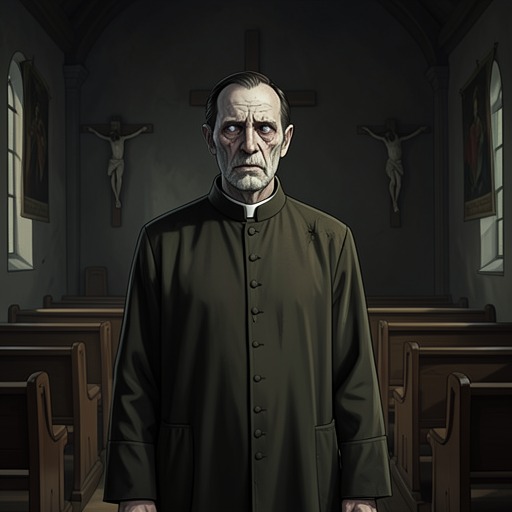
Father Callahan and St Andrew's Church
'Salem's Lot: A NovelFather Callahan and St Andrew's Church are bound by a relationship that begins in institutional faith and ends in exclusion. As pastor of the Jerusalem's Lot parish, Callahan represents St Andrew's Church at funerals, in theological practice, and in the community's attempts to distinguish ordinary death from supernatural evil. His eventual rejection by the church is therefore more than a private spiritual defeat: it turns the sacred institution that once authorized his actions into the closed boundary against which his corrupted body is cast.
The Church as an Active Force
Callahan does not regard the church as a decorative system of beliefs or merely a source of comforting symbols. When Matt Burke asks him to investigate strange events with holy water and the Host, Callahan hesitates because accepting those objects would mean acting as an official representative of the Catholic Church rather than casually indulging another person's fears. He distinguishes himself from younger priests who might treat such implements as symbolic props and proceed without serious theological concern. For Callahan, carrying the Host would activate the authority of the institution behind it: “The church is a Force…and one does not set a Force in motion lightly.”
This seriousness gives St Andrew's Church a practical, almost material presence in the relationship. Callahan is uncertain about his own fitness, describing himself as jaded, cynical, and caught in a crisis involving faith and identity, but he still believes that the church possesses “awesome, mystical, and apotheotic power.” His uncertainty does not erase the institution's authority; it makes his dependence on that authority more exposed. The church stands behind him as a source of rites, sacred objects, and protection, while he must decide whether he can honestly set that power in motion.
Callahan as Parish Priest
Callahan's connection with St Andrew's is also enacted through ritual. At Danny Glick's funeral, the burial service proceeds through the town's established three stations: the house of the deceased, the small Catholic church of St Andrew's, and Harmony Hill Cemetery. Callahan waits at the grave wearing a stole and holding the open book for the children's burial service. The church thus extends beyond its building into a sequence of public ceremonies that organize grief, death, and communal memory.
That ritual order contrasts with the institutional procedures surrounding Danny's condition. Danny is admitted to Central Maine General Hospital at twelve years old after his father, Anthony H. Glick, brings him in; the record lists shock, partial memory loss, nausea, loss of appetite, constipation, and general lethargy. Later investigations draw in medical examiners, mortuary workers, police officers, and photographs, while Callahan's presence supplies a different framework for interpreting what medicine and administration cannot explain. His pastoral role is not simply adjacent to those systems: it becomes increasingly responsible for addressing the possibility that the dead may return in altered form.
Theological Crisis and Confrontation
Callahan's willingness to help Matt is qualified by an awareness that evil has become theologically difficult for him. His former interest in occult subjects once belonged to a boy's curiosity and was even intensified by his priestly calling, but questions about the nature of evil have spoiled that earlier sense of intellectual adventure. St Andrew's therefore represents both the tradition he still invokes and the burden of belief he can no longer carry without hesitation.
The conflict becomes explicit after Callahan confronts Kurt Barlow. Barlow forces him to drink vampire blood, and Callahan survives the encounter in a state of spiritual contamination. He believes that the Master has marked him and that he may move freely until the Master claims him, yet he still turns toward St Andrew's. His movement is a desperate return to the institution whose power he had treated as real even while his faith was failing. He intends to pray through the night, appealing to an older, more punitive and miraculous conception of God and asking for another chance.
Exclusion from St Andrew's
Callahan reaches the church in the rain wearing a muddy, disordered gown, with Barlow's blood smeared across his mouth. The image makes his changed status visible before the church responds. He is still recognizably the priest who belongs to St Andrew's, but he now approaches it carrying the evidence of the vampire's power within him. When he touches the middle door, a blue flash throws him backward down the granite steps. The force burns his hand, and he lifts it before his eyes to see that it has been scorched.
Callahan interprets the rejection through the language of ritual impurity, muttering “Unclean, unclean, O God, so unclean.” The church looms behind him with its doors shut, converting sacred space into a barrier. Its refusal does not merely prevent entry; it declares that the authority Callahan trusted can no longer recognize him as an authorized agent. The same institution that might have empowered him against supernatural evil now excludes him because of what he has received from Barlow.
This reversal gives the relationship its decisive meaning. Callahan's faith in the church as a Force is not simply disproved, because the church's power is demonstrated by the flash, the wound, and the closed doors. Yet that power operates against him. St Andrew's remains sacred precisely by refusing the contaminated priest, while Callahan becomes the displaced figure outside the threshold, still seeking recognition from the institution that has marked him as unclean.
The Relationship’s Institutional Reversal
The relationship between Father Callahan and St Andrew's Church is defined by a reversal in the meaning of authority. Earlier, Callahan understands ecclesiastical power as something that must be invoked responsibly: sacred objects are not theatrical conveniences, and the Host would make him act as Christ’s representative on earth. After Kurt Barlow’s assault, however, the church’s authority no longer functions through Callahan. The priest approaches St Andrew's seeking restoration, but the institution answers him without speech or human mediation. The blue flash at the door transforms doctrine into physical judgment, making the church’s exclusion both supernatural and administrative: Callahan is no longer merely a troubled priest who doubts himself, but a body that sacred space refuses to admit.
Institutional Reversal and Narrative Significance
The relationship between Father Callahan and St Andrew's Church is defined by a reversal in the meaning of authority. Earlier, Callahan understands ecclesiastical power as something that must be invoked responsibly: sacred objects are not theatrical conveniences, and the Host would make him act as Christ's representative on earth. After Kurt Barlow's assault, however, the church's authority no longer functions through Callahan. The priest approaches St Andrew's seeking restoration, but the institution answers him without speech or human mediation. The blue flash at the door transforms doctrine into physical judgment, making the church's exclusion both supernatural and institutional: Callahan is no longer merely a troubled priest who doubts himself, but a body that sacred space refuses to admit. The episode also gives concrete form to his earlier claim that the church is a Force. That Force is real enough to repel him, yet its reality offers no immediate reconciliation, leaving him outside the building in the rain, burned, trembling, and condemned by the very power he had hoped might grant him a second chance.