Father Callahan’s Confrontation with Barlow
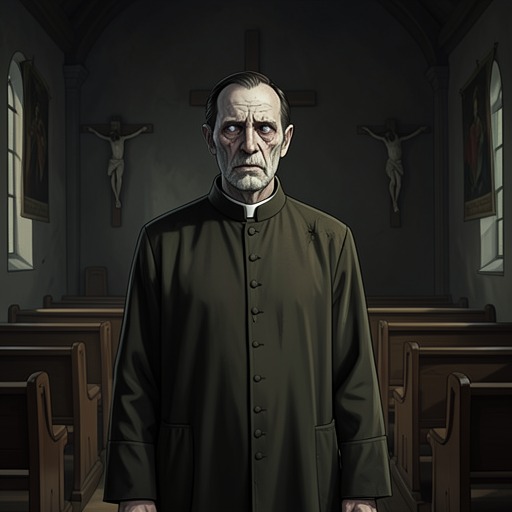
'Salem's Lot: A NovelFather Callahan’s Confrontation with Barlow is the climactic test of Father Donald Callahan’s religious authority and personal faith. Cornered in the Petrie kitchen by Barlow, Callahan discovers that the crucifix he has depended upon is powerless when his belief no longer carries genuine conviction. The confrontation reverses the expected pattern of priestly protection: the vampire dominates the room, mocks the priest’s doctrine, and leaves Callahan to recover faith through an improvised, self-destructive act rather than through a confident ritual victory.
Background and Stakes
The encounter belongs to the larger struggle between Father Donald Callahan and Kurt Barlow, a conflict framed as a contest between religious faith and supernatural evil. Callahan once possessed an eager, active sense of spiritual vocation, but that confidence has been damaged by the pressures of the vampire outbreak and by his own crisis of faith. The confrontation therefore places more than his physical survival at stake. It tests whether his religious symbols still possess power, whether his prayers can reach beyond his own mind, and whether he can resist Barlow without surrendering his moral and spiritual identity.
The scene also draws on Callahan’s long-standing awareness that ritual objects are not automatically sacred weapons. During his seminary years, a grotesquely humorous religious sampler had seemed blasphemous, but its appeal lay in the practical demand that a person accept what cannot be changed while showing the tenacity to change what can be changed. That old credo returns at the funeral of Danny Glick, where Callahan stands before mourners confronted by a death that resists ordinary explanation. In the later confrontation, the same problem becomes immediate and personal: Callahan must act within a situation he cannot control, but his ability to act depends on whether faith remains more than a remembered formula.
The Collapse of Callahan’s Defense
When Barlow corners Callahan, the cross’s glow begins to die. Callahan retreats and commands Barlow to stay back in the name of God, but the command no longer carries the force it once did. The light dwindles to a thin, guttering cruciform shape, and the vampire’s face disappears again into shadow. Callahan’s retreat ends when he strikes the kitchen table, leaving him physically trapped as well as spiritually cornered.
The crucifix then becomes merely a piece of plaster bought by Callahan’s mother in a Dublin souvenir shop. The power that had once seemed capable of smashing walls and shattering stones has vanished; Callahan’s muscles remember its former vibration, but he cannot reproduce it. His prayer becomes equally ineffective. He begs God to save him, not for himself but for others, yet his thoughts lack the intensity that once made prayer feel like a transmission. The words remain imprisoned within his skull, separated from the living faith that could have made them effective.
Barlow exploits this failure by turning doctrine into a weapon against its defender. After Callahan drops the cross, Barlow explains that the cross, the flag, the bread and wine, and other sacred forms are only material symbols without faith. His argument is not that sacred objects are always powerless; it is that their force depends on the believer’s inward participation. Callahan’s defeat is thus not caused by the destruction of the object but by the separation of symbol from conviction. The value at stake shifts from protection to abandonment: the cross remains in the room, but its meaning has deserted the man holding it.
The Knife and the Reversal
With the cross useless and Barlow moving silently around him, Callahan searches the table for a knife. His hands pass over breadcrumbs, a plate, and the rim of a coffee cup before finding the wooden handle. The ordinary kitchen object becomes the means by which the failed religious defense is replaced with an instinctive physical attack. Barlow tells him that conversation must end, and Callahan answers by invoking God as he swings the knife upward.
The blade unexpectedly shines with intense light. Barlow’s words break into a jagged scream, and for an instant Callahan sees the blazing blade reflected in the vampire’s eyes. The knife grazes Barlow’s forehead, drawing blood and proving that the spiritual power Callahan thought he had lost has not entirely disappeared. The reversal is brief but crucial: Barlow is wounded, and his contempt changes into fury. The sacred force does not return through a formal blessing or a recovered ceremony; it reappears through an unplanned act whose urgency exceeds Callahan’s conscious control.
Barlow immediately reframes the wound as punishment for Callahan’s flawed belief and audacity. Yet the vampire still does not approach. That hesitation confirms that Callahan’s last act has altered the balance, even though it has not defeated Barlow. The scene therefore refuses a simple victory. Faith returns sufficiently to make resistance possible, but not sufficiently to restore Callahan’s former confidence or save his life.
Callahan’s Death and Spiritual Ambiguity
After wounding Barlow, Callahan plunges the knife into his own chest. He acts without deliberation, driven by the recognition that Barlow’s fury is impotent while the vampire remains unable or unwilling to come near him. He withdraws the blade and strikes again with the strength still available to him. The act is both self-destruction and refusal: Callahan denies Barlow the final control of killing or transforming him, even as he destroys the body that can no longer sustain his resistance.
As his thoughts fade, Callahan realizes that some of his faith has returned. That recognition complicates the meaning of his death. He may have deprived himself of a more complete victory through the final instinctive effort to save his soul from the Undead, and he understands that this may constitute the most serious denial of faith of all. His last consciousness is therefore not triumphant certainty but painful self-judgment. He dies after recovering enough belief to wield the knife, yet he remains uncertain whether the recovery came soon enough or whether his own act has prevented a fuller spiritual victory.
Callahan then falls forward onto the knife’s haft, closes his eyes, and gives himself over to whatever gods await him. The ending turns the confrontation into a tragic passage rather than a conventional exorcism. Callahan neither defeats Barlow nor survives to interpret the meaning of his sacrifice. His death preserves the conflict’s central ambiguity: faith can empower resistance, but spiritual authority is fragile, and the return of belief may arrive only at the instant when it can no longer undo the consequences of doubt.
Narrative Significance
The confrontation gives concrete form to the novel’s recurring principle that religious symbols derive their power from faith rather than from matter alone. Earlier, a makeshift cross must be blessed before it can serve as protection, and entry into the evil house becomes possible only when Callahan’s old eagerness impels him forward. At the Marsten House, he commands the evil to depart and strikes the door with his crucifix; light flashes, ozone fills the air, windows burst outward, and the new lock welds into an unrecognizable mass. That earlier act presents Callahan as a priest whose faith can still produce spectacular effects. The later kitchen scene deliberately inverts it: the same kind of object becomes dead plaster when Callahan’s inward power fails.
The knife’s sudden radiance prevents that inversion from becoming a final statement of total defeat. Callahan’s faith is damaged, not wholly extinguished. Its return is involuntary, violent, and costly, appearing only when he acts without time to construct a proper ritual. In this sense, the event combines confrontation, sacrifice, and failed return. Callahan crosses the threshold into direct combat with Barlow, gains a momentary sign of restored power, and then cannot return to ordinary life or fully reintegrate the experience. His death leaves the struggle unresolved at the level of doctrine even while it exposes the condition under which sacred power operates.
The scene’s retrospective framing further emphasizes its instability. The account explicitly identifies this version as the original sequence, contrasting it with the published novel’s different treatment of Barlow cornering Callahan in the Petrie kitchen. That distinction makes the confrontation part of the work’s self-conscious history as well as its supernatural plot: the scene records an alternate dramatic resolution in which Callahan’s spiritual defeat, sudden resistance, and self-inflicted death are made unusually explicit. Its lasting force lies in that convergence of theological argument and bodily action, where a dying light, a dropped cross, a found knife, and a final wound transform an abstract crisis of belief into an irreversible ending.