Hubert Marsten
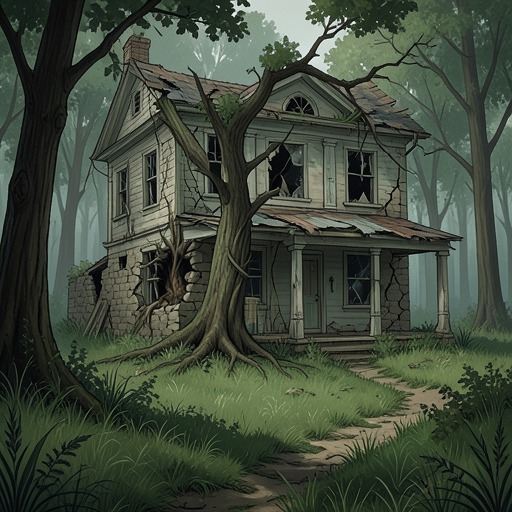
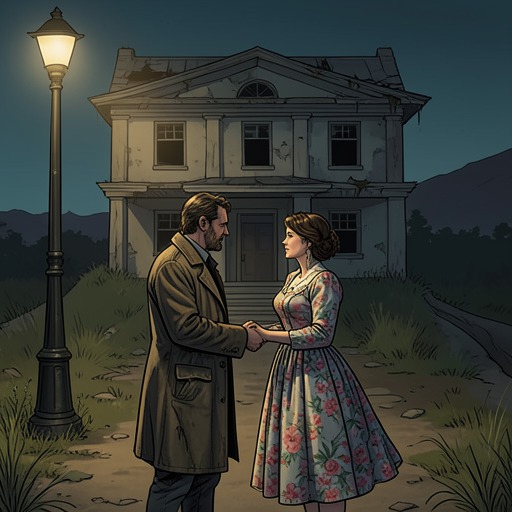
'Salem's Lot: A NovelHubert Marsten, also known as Hubie Marsten and recorded on his gravestone as Hubert Barclay Marsten, is the dead criminal whose history turns the Marsten House into more than an abandoned building. Once a wealthy New England trucking executive, he retired with Birdie Marsten to Jerusalem’s Lot, where his murder of his wife and subsequent suicide became the town’s defining secret. The house preserves his violence in physical form, while the unanswered questions surrounding his crimes allow later supernatural evil to appear as an inheritance rather than an intrusion.
Identity and Arrival in Jerusalem’s Lot
Hubert Marsten had been president of a large New England trucking company during the 1920s. Publicly, the company transported goods; local rumor held that its most profitable work took place after midnight, when it ran Canadian whisky into Massachusetts. He and Birdie retired wealthy to Jerusalem’s Lot in 1928, but the stock-market crash of 1929 consumed a substantial, though unknown, portion of their fortune. The respectable image of a retired business executive therefore concealed a past already marked by organized crime, illicit commerce, and the unstable power that money had given him.
Research later presented by Ben Mears makes the hidden biography more explicit. According to records and the testimony of Minella Corey, Birdie Marsten’s sister, a Boston criminal organization became increasingly nervous about Hubert in 1927. He was questioned twice, once by the Boston city police and once by the Malden police. The Boston inquiry concerned a gangland killing, and Hubert returned to the street within two hours; the Malden case concerned the murder of an eleven-year-old boy whose body had been eviscerated. His employers secured his release, apparently because Hubert knew enough about their crimes to make him dangerous as a witness. After that, he quietly moved to Jerusalem’s Lot under the harmless description of a retired trucking official who received a monthly check.
Hubert’s arrival thus brought an already buried history into a town whose social life depends on preserving appearances. He rarely went out, and the public knew him chiefly as the strange man who occupied the finest house built in Jerusalem’s Lot before he “went soft in the attic.” The town’s later folklore reduced him to a frightening local eccentric, but the fuller account shows a man whose violence had been organized, profitable, and protected by institutions before it became private and domestic.
The Marsten House Murders and Suicide
The Marsten House became Jerusalem’s Lot’s “skeleton in its closet” because the crime connected with it occurred before most living residents were born yet was transmitted ceremonially from one generation to the next. In the summer of 1939, Larry Crockett discovered that five days’ worth of newspapers had accumulated in the mailbox. The August grass stood calf-high in the front yard, honeysuckle had overgrown the west trellis, and the house still looked handsome despite its neglect. That ordinary summer setting made the discovery more disturbing: the house retained the outward shape of domestic respectability while concealing a scene of extreme violence.
Larry first smelled something like spoiled meat halfway up the walk. He received no answer at the front door, looked through the gloom, and then went around to the back. The odor was stronger there. The unlocked back door led into the kitchen, where Birdie Marsten lay sprawled in a corner with her bare feet exposed and half her head destroyed by a close-range shot from a thirty-ought-six. Town recollections added the flies: Larry reportedly found the kitchen full of them, buzzing around the body. The detail became part of the ritual retelling, repeated with calm authority by older residents and enlarged by children who frightened one another with increasingly grotesque versions of the story.
The house was also prepared to injure anyone who entered it. A loaded shotgun had been rigged as a lethal trap, and other devices included a forty-pound bundle of newspapers suspended over the dining-room door and a hinged stair riser capable of breaking an ankle. These preparations made Hubert’s violence seem methodical even after his death. He was not merely a disturbed husband who acted once in a moment of rage; he had turned the house into a mechanism of threat, extending his hostility toward whoever might investigate the crime.
The search party found Hubert in the bedroom at the end of the upstairs hall, dangling from a rafter. That room became the house’s most charged interior space. Twenty-four years later, Ben Mears would remember entering it as a boy on an initiation dare, when he had been required to enter the Marsten House and bring something out. Before leaving, Ben opened the bedroom door and saw Hubert hanging there; Hubert opened his eyes, and Ben ran. The experience remained psychologically active for decades and helped bring Ben back to Jerusalem’s Lot, where he attempted to write the memory out of his system.
The graveyard preserves Hubert’s identity in a colder, more factual form. While preparing for a funeral, Mike Ryerson stopped near the rear wall to examine a slate headstone that had fallen forward. After standing it upright and brushing away the dirt, he read the inscription “HUBERT BARCLAY MARSTEN,” followed by the date October 6, 1889. The gravestone supplies a precise name and birth date to a figure otherwise surrounded by rumor, but it cannot resolve the central mystery of his final crime: what happened between Hubert and Birdie in the kitchen before the shot.
Hidden Rituals and Unanswered Crimes
The town knows that Hubert Marsten killed his wife, but its knowledge stops at the threshold of the kitchen. It does not know what Birdie made him do first, or what passed between them in the heat and sweetness of that room before he fired. The suggestion that Birdie begged him to kill her transforms the murder from a simple act of domestic execution into an obscured final scene whose motive remains inaccessible. The narrative preserves that absence deliberately: the public version contains a corpse, a weapon, and a monstrous husband, while the private sequence that might explain the violence has vanished into the house’s sealed history.
The upstairs fireplace held another fragment of that hidden history. Older residents remembered that Larry Crockett found charred papers there, but they did not know that the ashes represented twelve years of correspondence between Hubert and Breichen, an antique Austrian nobleman. Their relationship had begun through a peculiar Boston bookseller who later died an extremely violent death, and Hubert burned every letter before hanging himself, feeding the pages into the fire one at a time. The destruction was not careless disposal: he watched the flames blacken the thick cream-colored paper and erase the elegant, spider-thin handwriting, reportedly smiling as he did so. The letters therefore connect Hubert to an international, occult-tinged network whose meaning the town never recovered, while the act of burning them makes the fireplace a second concealment chamber alongside the bedroom and kitchen.
Ben’s research also places Hubert’s household beside four unexplained child disappearances between 1928 and 1939, the eleven years during which Hubert and Birdie lived in the house. In a rural community, an individual child might plausibly be lost, die of exposure, or vanish in a gravel-pit collapse; the disturbing pattern is that none of these four children was ever found. No later hunter discovered a skeleton, and no contractor unearthed remains while collecting gravel. The disappearances do not prove Hubert’s guilt, but they make the earlier Malden murder of an eleven-year-old boy impossible to treat as an isolated rumor. The house becomes a point where separate violences appear to converge without yielding a complete legal explanation.
The image of Hubert’s suicide continues to govern the building long after his body has disappeared. When Mark Petrie enters the upstairs room, his fear does not vanish; instead, it ceases to block thought, and his mind races through symbolic impressions with the force of an unexplained surge. The room itself is almost offensively ordinary: stripped wallpaper exposes plaster and Sheetrock, dust covers the floor, two stacks of magazines sit near a cast-iron cot without a mattress, and a small tin plate blocks the chimney opening. Only one set of footprints marks the dust, and an aura of old nastiness remains. The contrast makes the room more frightening than a visibly supernatural chamber would be, because the prosaic objects leave the remembered hanging body as the space’s dominant fact.
Ben’s later return to the room fuses the childhood memory with the adult crisis. Approaching the door, he feels the old terror rise again; when it opens, Hubert is absent, but the scene has not been emptied of him. Richard Straker has been hung upside down like a slaughtered pig, his throat torn open and his body drained of blood. For Ben, the substitution is psychologically devastating: childhood horror and present horror merge, and the imagined green, swollen face of the hanging man acquires fangs. Hubert’s corpse is no longer there, yet his posture, room, and violence continue to dictate how later deaths are perceived. His suicide thus becomes not an ending but a template through which the Marsten House repeatedly stages its power over the living.
The House as a Supernatural Inheritance
Hubert Marsten’s history matters beyond the crimes that can be reconstructed from police records, family testimony, and town memory because the Marsten House becomes the material bridge between human violence and later supernatural occupation. When Ben Mears explains his book to Susan Norton, he admits that he had intended to write about Jerusalem’s Lot but increasingly suspects that the real subject is the house. His research identifies Hubert not simply as a brutal recluse but as a man whose criminal past, suspected devil worship, correspondence, and unexplained household history have made the building a concentrated symbol of evil. The house is therefore not merely a setting in which later events occur; it is the inherited structure through which the past continues to organize the present.
The building’s public reputation is repeatedly challenged by its physical transformations. To Mark Petrie and Susan Norton, glimpses through broken shutters reveal a Victorian interior with wine-colored silk wallpaper, wing chairs, a deep green velour sofa, a mahogany rolltop desk, a framed reproduction of Rembrandt’s Boy at his Studies, sliding doors, and a crystal chandelier. This sumptuous interior is radically unlike the decayed haunted house preserved in local rumor, and the invisibility of its changes makes the contrast more disturbing. The house can present itself as ruin, mansion, memory, or trap without surrendering its identity. Its surfaces conceal rather than resolve Hubert’s history, turning domestic architecture into an instrument of uncertainty.
The underground rooms make that concealed history explicit. Beneath the house lies an extensive wine cellar containing dusty casks, crossed wine racks, ancient magnums, and bottles that have burst, soured into vinegar, or perhaps remained drinkable after decades. The cellar’s commercial evidence recalls Hubert’s alleged bootlegging career, but the space extends beyond illicit business into ritual. An underground dais is surrounded by circular velvet drapes and unlit black tapers; a cross with broken arms hangs upside down, obscene statues flank the podium, and a huge banded-oak coffin bears a wolf coat of arms and the name SARLINOV. The cellar thus joins the respectable surface of wealth to a deliberately profaned religious environment, suggesting that the house’s evil is both accumulated through Hubert’s life and prepared for a successor.
That successor is Kurt Barlow, whose message to Ben Mears, Jimmy Cody, Mark Petrie, and Father Callahan treats the house as a place of hospitality and menace at once. Barlow invites them to enjoy Médoc obtained for him by the late owner of the house, a pointed reference to Hubert, while promising that they will meet again in person after completing their work. The wine turns Hubert’s old cellar into a ceremonial extension of the vampire’s power: a remnant of the dead man’s wealth is repurposed as an offering from the new inhabitant. Barlow’s letter also confirms that Hubert’s former residence has not merely been occupied but incorporated into a continuing chain of predation.
The most severe reversal comes when the house appears to repeat Hubert’s death through Richard Straker. After the vampire conflict reaches its crisis, Ben, Mark, and Father Donald Callahan approach the upstairs bedroom expecting the old terror of Hubert’s hanging body. Ben’s scream rises before he can control it, but the figure suspended from the beam is Straker, hanging upside down with his throat ripped open and his body bled white. The substitution preserves the room’s ritual grammar while changing its victim: Hubert’s suicide remains the governing image, yet the later body reveals that the house has become an active theater of supernatural violence. Hubert’s crime is consequently not erased by Barlow’s arrival. It is repeated, transformed, and absorbed into the house’s larger history of evil.
Narrative Role and Critical Significance
Hubert Marsten is defined less by direct participation in the present than by the afterlife of his actions in memory, architecture, and recurring fear. Jerusalem’s Lot remembers him as a murderer and suicide, but its collective memory is incomplete: it preserves the bodies, the traps, the flies, and the hanging corpse while losing the motives, correspondence, and possible victims that would make the history fully legible. That gap gives Hubert an unusual narrative force. He is both a character and an absence, a human source of violence whose missing explanations allow rumor, childhood fantasy, and supernatural interpretation to occupy the same space.
The Marsten House accordingly functions as Hubert’s enlarged psychological and historical body. Its kitchen contains the unresolved murder of Birdie Marsten; its upstairs bedroom contains the image that traumatized Ben Mears; its fireplace contains the ashes of twelve years of correspondence; and its cellar joins bootlegging wealth to occult spectacle. These spaces do not simply store information about Hubert. They make the past physically recurrent, so that later characters encounter his violence as atmosphere, ritual, and expectation rather than as a closed case. Even the house’s outward transformations—from neglected ruin to richly furnished Victorian interior—reinforce the instability of what can be known about him.
Hubert’s crimes also establish the moral and supernatural scale against which later events are measured. His suspected contract killings, the eviscerated eleven-year-old in Malden, the unexplained disappearances of four children, Birdie’s murder, and his self-inflicted death form a continuum in which public respectability repeatedly conceals predation. Yet the narrative does not reduce every mystery to a solved biography. The child disappearances remain unproven, Birdie’s final plea remains unexplained, and the burned letters leave only the outline of a connection to Breichen and the dead Boston bookseller. Hubert’s power therefore lies partly in the unresolved: the town’s certainty that he was evil coexists with its inability to say exactly what he did.
His story further complicates the boundary between human depravity and supernatural evil. Ben Mears returns to Jerusalem’s Lot believing that writing about the Marsten House may help him master the childhood vision of Hubert opening his eyes while hanging. Instead, the house becomes the center of a new vampire crisis, and Hubert’s former residence is occupied by Kurt Barlow. Barlow’s use of Hubert’s wine and cellar makes the transition almost material: the wealth, objects, and spaces accumulated by a criminal predecessor become instruments in the reign of a supernatural successor. The evil associated with Hubert is not presented as a simple cause that ends with his suicide; it is a prepared environment, capable of receiving and amplifying another form of predation.
The repeated image of the hanging body provides the clearest expression of that continuity. Hubert hangs from the bedroom rafter in 1939; decades later, Ben sees the same room through the terror of memory; and finally Richard Straker occupies the space in a grotesque inversion, suspended upside down and drained by the forces he served. The substitution preserves Hubert’s position in the house even when Hubert himself is absent. His death becomes a pattern that later violence reenacts, proving that the Marsten House’s most enduring inhabitant is not a ghost with a speaking role but the structure of fear created by his life, his crimes, and everything the town still cannot know.