Marjorie Glick's vampiric resurrection
'Salem's Lot: A NovelMarjorie Glick's vampiric resurrection is the moment when private grief in Jerusalem’s Lot becomes unmistakable predation. The mother who has been mourning Danny Glick does not simply die from shock or illness: her body returns as an animated, hungry presence, attacks Jimmy Cody in the mortuary, and is repelled but not destroyed by Ben Mears’s cross. The event joins bereavement, medical uncertainty, religious ritual, and bodily horror, while revealing that the vampire outbreak is converting the town’s dead into active agents of its spread.
Grief Before Resurrection
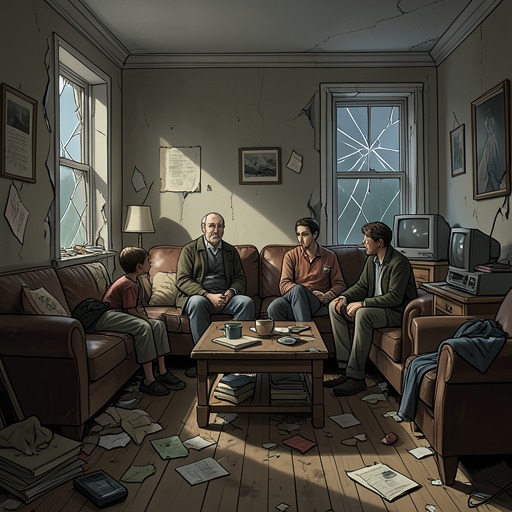
Marjorie’s transformation is prepared through the Glick family’s disordered mourning. Tony Glick wakes on Saturday morning when Marjorie falls in the living room, and her collapse follows several nights of an intensely vivid dream in which Danny comes back to her, calls her mother, and becomes her baby again. The dream returns her son to an intimate maternal state, but its sweetness carries a bitter undertone: the imagined nursing is mixed with the memory of a child beginning to bite. The language of affection therefore already contains the shape of vampiric feeding. Marjorie’s grief does not remain a memory of the dead; it becomes the medium through which the dead child appears to reclaim her.
Her physical condition also unsettles ordinary distinctions between illness, death, and disappearance. Marjorie says that she looked scarcely present in the bathroom mirror, as if the bathtub could be seen through her, and Tony responds by wanting Dr. Reardon to examine her. The uncertainty surrounding her decline echoes the earlier difficulty of interpreting Mike Ryerson’s body. Jimmy Cody later observes that Marjorie’s condition resembles Mike’s: there is no surface lividity and no sign of rigor or incipient rigor. The medical vocabulary identifies an abnormal corpse without yet possessing an explanation for it, placing clinical observation at the threshold of supernatural knowledge.
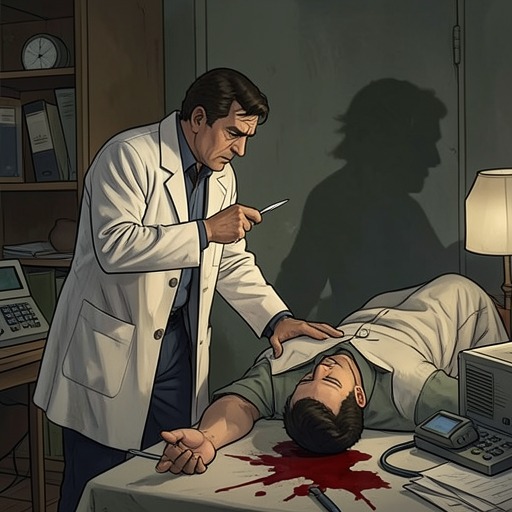
The family’s tragedy is widened when Mrs Glick dies early in the morning and Tony is taken to Central Maine General Hospital in shock. Her body is brought to Green’s workroom, where it lies on a stainless-steel mortuary table equipped with gutters and foot stirrups. She is still dressed in the burgundy quilted housecoat and knitted slippers she wore at home, and a small Band-Aid remains on her left shin. These ordinary details preserve the domestic woman inside the corpse even as the investigators begin to suspect that the body is governed by something other than death. The mortuary becomes a threshold space: part medical workplace, part ritual chamber, and part stage on which the town’s hidden condition is finally exposed.
The Corpse Awakens
Jimmy makes a brief examination but refuses to commit himself, believing that a few more hours may settle whether Marjorie’s condition is natural. His hesitation belongs to a world still trying to preserve diagnostic procedure. Yet the investigators have already learned that bodies have been taken from the Cumberland County Morgue in Portland, a fact that makes the handling of Marjorie’s corpse part of a wider pattern rather than an isolated family catastrophe. The disappearance of bodies implies that death in the region is no longer final, while Marjorie’s presence in Green’s workroom supplies the pattern with a living—or undead—form.
When the sheet begins to tremble, the first visible sign is not a full figure but a hand. It falls from beneath the covering, and its fingers dance jaggedly in the air. Ben Mears and Jimmy are already attempting a religious response: Jimmy asks Ben to bless a makeshift cross made from two tongue depressors bound together with Red Cross tape. Ben cannot rely on a prepared formula or established authority; Jimmy tells him to make it up, insisting that the writer must become the metaphysician. Their improvised object marks a transition from observation to ritual action, while also testing whether faith can confer power on an ordinary piece of wood.
A voice then rises from the body, slow and choked, calling for Danny. The sheet falls from Marjorie’s face, revealing a pallid, moonlike head punctured by black eyes. The image converts maternal recognition into monstrous misrecognition: she is still seeking her son, but the face that calls for him is no longer the face of a grieving mother. She swings her legs from the table, loses one slipper, and advances. The domestic remnants of her former identity remain visible, but they now accompany an inhuman appetite.
Attack in Green's Workroom
Ben raises the cross, and it flashes with brilliance. Marjorie hisses and throws up her hands; her features draw together and writhe, and she steps backward unwillingly. The reaction establishes that the object’s force does not come from craftsmanship alone. The improvised tongue-depressor cross becomes effective through the faith and urgency invested in it, and Marjorie’s fear of it gives the investigators their first immediate evidence that religious symbols can oppose the returning dead.
Jimmy attempts to exploit the opening. He circles the mortician’s table and throws both arms around Marjorie’s neck, but she twists with extraordinary strength. His nails tear a flap from the skin at her shoulder, yet the wound produces no blood; it resembles a lipless mouth. The detail makes her body materially wrong before it becomes openly predatory. She can be cut, but ordinary anatomy no longer answers for her. She throws Jimmy across the room, knocking Maury Green’s portable television from its stand, and then moves over him in a hunched, nearly spiderlike run.
Marjorie attacks Jimmy as a feeder rather than as a recognizable enemy. She rips at his collar and lunges at his neck, while the sound of her smacking lips reveals that she is already drinking his blood. Jimmy’s scream is described as the cry of someone utterly damned, and Ben intervenes by seizing the collar of her housecoat. Her eyes are dilated and glittering; her mouth and chin are slick with black blood, and her breath carries the foulness of tombs. The attack therefore collapses the boundary between corpse and predator, turning the mortuary table into the site of a new death that may itself produce another vampire.
Ben brings the cross up as Marjorie pulls him toward her. Its rounded wooden point strikes beneath her chin and continues upward without meeting normal flesh. Burning flesh gives off a hot, porcine odor, and the cross inflicts an agonized scream, blackening the lower jaw. Yet the wound does not end the attack. Marjorie rises again with wolflike agility, still hungry, and retreats only as the cross forces her backward. The symbol can repel and injure her, but at this stage it cannot permanently destroy her.
Marjorie’s final movement makes the event more than a conventional escape. Pressed against the narrowing walls, she laughs in a high, squealing voice and declares that the circle is becoming smaller. Her body elongates and turns translucent; then it seems to seep into the pores of the wall like smoke. She vanishes, leaving Ben and Jimmy without a corpse to restrain and Jimmy still screaming. The disappearance confirms that the threat is not confined to a body that can be secured, examined, or buried. Marjorie has crossed from the mortuary into the architecture itself, and the investigators are left with direct knowledge of a supernatural force that remains mobile, invasive, and unfinished.
Ritual, Authority, and the Expanding Threat
The mortuary encounter gains its full significance from the story’s repeated opposition between formal knowledge and improvised ritual. Father Callahan’s earlier seminary memory of a blasphemous sampler—asking for serenity, tenacity, and luck not to fail too often—quietly anticipates the practical problem facing Ben Mears and Jimmy Cody: neither possesses complete certainty, yet both must act before certainty arrives. Jimmy’s makeshift cross, assembled from tongue depressors and Red Cross tape, is therefore not a substitute for knowledge so much as an emergency instrument created at the point where medical procedure breaks down. The same pattern later governs the assault on Marsten House, when Father Callahan advances with a crucifix, commands the evil to depart in the name of God the Father, and strikes the door. The resulting flash, odor of ozone, explosion of the fanlight and bay window, and welding of the Yale lock transform religious authority into a physical force. Marjorie’s recoil similarly establishes that faith, embodied in an ordinary cross, can alter the behavior of the undead even when it cannot yet finish the destruction.
The event also belongs to a broader sequence of violated funerary and civic boundaries. Before Marjorie rises, Mike Ryerson has opened Danny Glick’s coffin and found the boy’s eyes open, his face still rosy and apparently alive rather than pallid with death. The theft of bodies from the Cumberland County Morgue in Portland extends that disturbance beyond a single grave, suggesting an organized traffic in corpses. Marjorie’s resurrection then supplies the most immediate proof that the dead are not merely being hidden or desecrated: they are being returned to the town as predators. Her escape through the wall makes the danger spatial as well as biological. It can leave the mortuary, penetrate domestic interiors, and continue the outbreak without respecting doors, tables, locks, or the normal separation between the living and the dead.
Consequences for Jimmy Cody and the Investigation
Jimmy survives the immediate attack only because Ben intervenes with the cross, but the scene leaves him in a state of terror rather than restoring control. His scream continues after Marjorie disappears, and the earlier confidence of the physician who brought equipment and examined bodies has been replaced by direct witness to a corpse’s movement, impossible wound, feeding, and vaporous escape. The investigation consequently changes character. Jimmy can no longer treat the Glick deaths as an unusual medical case, while Ben can no longer regard supernatural testimony as merely material for a writer’s theory. Their partnership is forced into an action-based understanding: the question is no longer whether the town’s dead are abnormal, but how many have returned and how they can be stopped.
Marjorie’s attack also raises the stakes of every subsequent encounter. She has demonstrated that a newly risen vampire can overpower Jimmy physically, move with sudden animal speed, drink from a living human being, and endure a direct blow from a consecrated symbol. The blackened jaw and agonized scream show that the cross has real destructive effect, yet her recovery and disappearance show the limits of partial victory. The investigators must therefore distinguish between repelling a vampire and killing one. That distinction becomes decisive when Ben, Mark Petrie, Jimmy, and their allies confront the larger occupation of Jerusalem’s Lot: the town cannot be secured merely by driving individual revenants away from a room.
The event further clarifies the contagion’s emotional mechanism. Marjorie is not presented as a stranger transformed into a monster but as a mother whose mourning has been invaded by the image of Danny. Her recurring dream gives the vampire condition an intimate route into the family, using maternal love as an opening and childhood feeding as a grotesque prefiguration of blood consumption. The result is especially destructive because it turns recognition against itself: the call for Danny sounds like a continuation of family attachment, but it leads to hunger, attack, and the prospect of another victim. Private grief thus becomes one of the outbreak’s means of reproduction.
Narrative and Thematic Significance
Marjorie’s resurrection is the story’s clearest conversion of domestic mourning into supernatural violence. Her housecoat, knitted slippers, lost slipper, and remembered role as Danny’s mother do not disappear before the horror begins; they remain attached to it. That persistence makes the transformation more disturbing than a simple replacement of one identity by another. The familiar body survives as a surface while appetite, movement, blood, and physical law have changed underneath. The mortuary’s stainless-steel table, medical instruments, portable television, and ordinary clothing place the scene inside recognizable modern life, only for those objects and procedures to become inadequate when the corpse sits up.
The event also develops the novel’s recurring imagery of thresholds and enclosure. Marjorie rises from a table intended to contain the dead, advances through the narrow hall, and finally seems to dissolve into the wall. Earlier, the vampire’s presence has been associated with graves, coffins, cemeteries, and sealed rooms; here, the wall itself ceases to be a reliable boundary. The supernatural does not merely cross a threshold between life and death. It makes the threshold unstable, allowing a body to become smoke and architecture to become a passage. The investigators’ later dependence on crosses, locked rooms, sunlight, and physical destruction is shaped by this lesson that ordinary barriers are provisional.
The scene’s place in the chronology of September 1975 is equally important. The date attached to Danny Glick’s record gives the outbreak an administrative surface—name, address, and a documented child—while Marjorie’s return exposes what such records cannot contain. Medical files, morgues, funeral practices, and hospital admissions continue to classify the dead, but the story repeatedly shows those institutions arriving after the crucial change has occurred. Tony is taken to Central Maine General Hospital in shock, bodies disappear from the Cumberland County Morgue, and Jimmy examines Marjorie without being able to name her condition. The supernatural crisis therefore advances through the language of public health and bereavement until direct encounter forces a different explanation.
Marjorie is repelled, not redeemed or restored. Her disappearance leaves no secure body for burial, no medical conclusion, and no completed ritual of mourning. The event’s ending is consequently a failed reintegration: the dead woman cannot return to the family as Marjorie, and the living cannot return to the older confidence that death is final. Her unfinished escape foreshadows the vampire occupation’s larger consequence. Jerusalem’s Lot is no longer confronting isolated deaths but a multiplying population of returning dead, and the cross’s temporary success becomes both a weapon and a warning. Faith can open a path through the immediate danger, but the circle will continue to contract until the source of the outbreak is confronted.