Marsten House haunting
'Salem's Lot: A NovelMarsten House haunting names the persistent supernatural and psychological presence associated with the Marsten House, the ruined hilltop residence whose history turns architecture into a vessel for violence. The house’s decisive significance is that it binds past crime to present perception: its murders and suicide are remembered by Jerusalem’s Lot as inherited communal knowledge, while Ben Mears’s childhood encounter makes the building a private source of recurring terror. Whether the house literally manifests the dead or acts through memory, imagination, and accumulated evil remains deliberately uncertain, and that uncertainty gives the haunting its force.
A House Made Sinister
The Marsten House first appears as a structure that seems unchanged across decades. When Ben Mears returns to Jerusalem’s Lot, he sees the same overgrown property he remembers: witch grass has swallowed the frost-heaved flagstones, crickets chirr in the yard, and grasshoppers leap through the weeds. The house is huge, rambling, sagging, and gray from weather, with windows boarded in disorder, shingles torn away by storms, and a heavy snowfall having punched in the west corner of the roof. Its hunched outline and tattered no-trespassing sign make physical decay feel like an outward expression of something more malignant.
The house faces the town from Marsten’s Hill, giving it both an elevated position and a commanding view. Ben can look from the hill down into the town proper, while the house itself appears to look toward the community below. This arrangement makes the building more than an isolated ruin: it is a visible presence over Jerusalem’s Lot, a fixed point from which the town’s history seems to be observed. Its prominence also explains why the haunting cannot remain private. Even when empty, the house occupies the town’s sightline and imagination.
Ben feels an immediate urge to cross the overgrown path, climb the porch, look through the boards, test the front door, and enter if it is unlocked. The desire is not simple curiosity. He is almost hypnotized, staring upward while the house seems to stare back with what the narration calls “idiot indifference.” He ultimately turns away, deciding that he may return later but will not yet go upstairs. The restraint is temporary rather than definitive: he considers leasing the property, using the kitchen as a writing room and sleeping in the front parlor, while preserving the upstairs as a forbidden zone.
The imagined interior intensifies the haunting by turning spatial detail into psychological suspense. Ben envisions wet plaster, rotting wallpaper, mice moving inside the walls, accumulated junk, and plaster dust sifting onto fourteen stairs. The top stair is smaller and oddly proportioned, as if it had been added to avoid an evil number. At the landing, a closed door waits at the end of the hall; the tarnished silver knob becomes the focal point of an approach that feels both voluntary and compelled. The house’s corridors do not simply contain fear. They organize it, drawing the imagination toward a threshold where memory, fantasy, and supernatural possibility converge.
Violence Preserved in Communal Memory
The town’s fear of the house rests on the story of Hubert Marsten and Birdie Marsten, whose history functions as Jerusalem’s Lot’s closest equivalent to a hidden skeleton. Hubert had been president of a large New England trucking company and was rumored to have made some of its most profitable business by running Canadian whisky into Massachusetts after midnight. He and Birdie retired wealthy to the town in 1928, lost much of their fortune in the 1929 stock-market crash, and then lived as hermits during the decade between the crash and the rise of Hitler. Their isolation transformed them into objects of speculation long before their deaths were discovered.
Larry McLeod found Birdie in the summer of 1939 after five days of newspapers and magazines had accumulated in the mailbox. He first noticed a smell like spoiled meat, then entered through the unlocked back door rather than the front. Birdie was sprawled in the kitchen, half her head destroyed by a close-range shot from a thirty-ought-six. The flies that filled the kitchen became part of the town’s retelling, repeated with the calm authority of local gossip and preserved as a sensory emblem of the crime.
Hubert’s death revealed that the violence had been prepared in advance. The rifle used to kill Birdie had been lashed to a chair, aimed chest-high at the front door, cocked, and connected by string to the doorknob. A forty-pound bundle of newspapers had been rigged above the dining-room door, and a hinged stair riser threatened anyone climbing to the second floor. The house therefore contained not only the aftermath of a murder-suicide but an apparatus designed to extend violence beyond its original act. The booby traps make the building seem hostile even before any explicitly supernatural event occurs.
Hubert was found dangling from a rafter in the bedroom at the end of the upstairs hall. The location matters because it connects the documented death to the house’s most dreaded interior threshold. In the town’s inherited version of the story, the bedroom, the staircase, the door, and the hanging body become inseparable images. Children repeat and embellish the account, turning Hubert’s swollen face, black tongue, and flies into a ritual horror tale. Susan Norton remembers girls locking themselves inside a backyard playhouse, holding hands in the dark while retelling what their elders had told them. The haunting is thus transmitted socially as well as psychically: each generation receives the house as a narrative before encountering it as a place.
Ben Mears’s Childhood Encounter
Ben’s personal haunting begins when he enters the Marsten House as a nine-year-old boy with other children waiting outside. He climbs the stairs while the house creaks and settles around him, hearing imagined or actual movement behind the plaster and fearing that Hubert Marsten will follow with a hangman’s noose and blackened face. His fear is not abstract; it is tied to the bodily experience of ascending toward the closed room at the end of the hall.
At the top, Ben forces himself to run toward the door, intending to grab an object and escape. The door seems to grow closer as he approaches. Its hinges have settled, its bottom edge rests against the jamb, and the tarnished knob bears the visual trace of previous hands. When he pulls, the door gives a scream against the wood “like a woman in pain.” Inside, Hubert hangs from the beam, silhouetted against the window light. The scene fulfills the story already circulating through the town, yet it also exceeds the known facts: Hubert’s face is green rather than black, his eyes are puffed shut, his hands are livid, and then he opens his eyes.
Ben screams, falls halfway down the stairs, and runs out of the house and down the road to the waiting children. Only after escaping does he realize that he is still holding a glass snow globe taken from the house, an object he says he has kept ever since. The snow globe makes the encounter material rather than purely dreamlike. At the same time, the surviving object cannot prove that Hubert opened his eyes. The experience remains poised between an ordinary child’s misperception and an encounter with an active presence.
As an adult, Ben refuses to settle the question. He allows that adrenaline may have caused him to hallucinate the entire manifestation, but he also considers the possibility that houses absorb the emotions spent within them and retain a kind of “dry charge.” In his theory, an imaginative boy might act as a catalyst, causing that charge to produce a three-dimensional psychic manifestation—perhaps even something alive, a monster rather than a ghost. This explanation gives the haunting a speculative mechanism without reducing it to a simple ghost story. The house may be a recording medium, an amplifier, or a source of independent agency; the narrative keeps all three possibilities in play.
The encounter continues through repetition. Ben sleeps with the light on for weeks afterward, and the dream of opening the upstairs door returns throughout his life whenever he is under stress. Its recurrence links the Marsten House to the delayed return of trauma: the childhood event is not finished when the child escapes, because the door continues to open in memory. After Ben comes back to Jerusalem’s Lot, he chooses a room at Eva Miller’s boardinghouse specifically because its window faces the Marsten House. The decision combines deliberate observation with self-exposure. He can keep the house in sight, but he also places the source of his fear directly within his nightly field of vision.
The Haunting in the Present
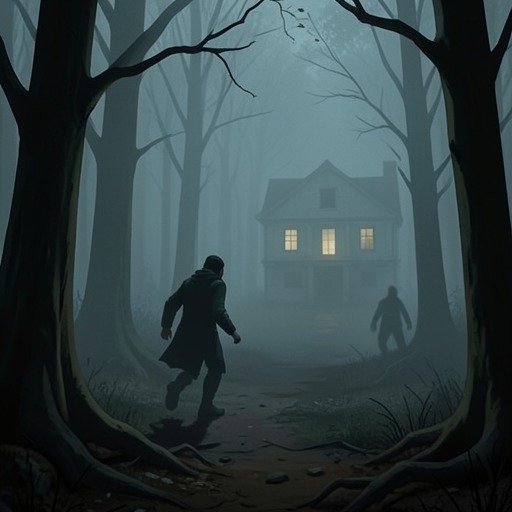
The house’s reappearance in Ben’s adult life is marked by a concrete disturbance: a light is burning inside. Ben and Susan Norton have been discussing the building when her attention is pulled toward the last hill before town. She tells him to look, and he sees the light on in the Marsten House. Later, from his room at Eva Miller’s boardinghouse, he sees that the lights are still on. The occupied-looking house contradicts its visible decay and apparent abandonment, turning the earlier memories into present-tense suspense.
The light also alters the meaning of Ben’s proposed return. He had imagined leasing the house for practical reasons, planning to write in the kitchen and sleep in the front parlor while avoiding the upstairs. Yet the possibility of someone living there transforms the property from a ruin associated with the past into an active location in the town’s present. The house is no longer merely waiting as a memory. It has become a sign that something has changed, even before Ben understands what that change is.
That night, Ben has the old dream for the first time since arriving in Jerusalem’s Lot, with a vividness comparable to the terrible period after Miranda’s death in the motorcycle accident. The dream repeats the hallway run, the door’s horrible scream, the dangling figure opening its puffed eyes, and the slow panic of turning toward the exit. Its final reversal is crucial: the door is locked. In childhood, Ben escaped through the house; in the recurring dream, the threshold no longer permits escape. The haunting therefore operates as both external mystery and internal enclosure, making the house a structure in which past violence repeatedly traps the survivor.
The narrative does not require the reader to choose between a ghost and a traumatized imagination. Ben’s uncertainty is itself part of the haunting’s design. He does not confidently claim to have seen Hubert, but neither can he dismiss the possibility that the house produces something more than memory. His theory of stored emotional charge gives formal shape to the novel’s broader sense that violence remains active after the people who committed it have died. The house remembers through its physical spaces, through the town’s stories, through Ben’s dreams, and perhaps through manifestations that possess an independent life.
Gothic and Narrative Significance
The Marsten House haunting uses Gothic architecture to make suppressed history visible. The boarded windows, rotting interior, dangerous stairs, closed bedroom door, hanging body, booby traps, and hostile elevation all convert secrecy into space. The building’s rooms are not neutral containers for events; they are the form in which those events continue to confront later generations. The forbidden upstairs functions like a psychological and historical depth that Ben can approach but cannot master.
The house also joins private trauma to collective memory. Susan and Ben share knowledge of the Marstens even though the crime occurred before their births, because Jerusalem’s Lot preserves horror ceremonially through gossip, family testimony, children’s games, and repeated embellishment. The town’s long memory gives the haunting a social body. Ben’s dream then individualizes that inherited story, showing how a public legend can become a private compulsion whose images return under stress.
The recurring door is the haunting’s central motif. It is first approached by a frightened child, later reconstructed in Ben’s adult account, and finally encountered in a dream where it is locked. Each version delays revelation while intensifying the act of approaching. The narrative makes the familiar architecture of a hallway and door strange again, forcing attention onto hinges, plaster dust, the silver knob, and the exact fourteen steps. This prolonged approach produces both fear and fascination: the reader is drawn toward the room for the same reason Ben is, even though the remembered result is already known.
Ultimately, Marsten House haunting describes a condition of unresolved recurrence. The house remains physically damaged, historically notorious, visually commanding, and apparently active. Ben’s return does not close the childhood episode; it reopens it through the lighted windows, the renewed dream, and his continuing temptation to enter. The haunting’s deepest power lies in that convergence of evidence and doubt. A murder-suicide has undeniably occurred there, but the house’s further life cannot be contained by the historical record. It waits in the town’s stories, in Ben’s kept snow globe, in the upstairs room, and in the locked door that keeps opening whenever the past demands to be seen.