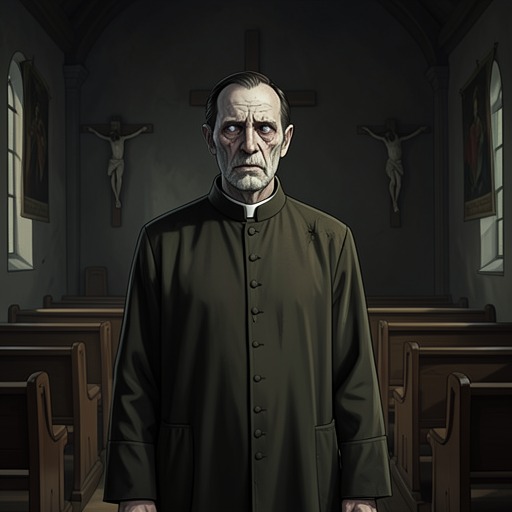
Matt Burke and Father Callahan
'Salem's Lot: A NovelMatt Burke and Father Callahan are joined by a faith-based anti-vampire alliance that links Matt’s rational, evidence-seeking investigation with Callahan’s troubled but still formidable belief in the Catholic Church. Their relationship becomes decisive when the strange deaths and bodily abnormalities surrounding Jerusalem’s Lot cease to look like isolated medical cases and begin to demand a supernatural explanation. Matt does not simply recruit a priest for reassurance; he asks the Church to risk its authority in the face of an evil that ordinary diagnosis cannot contain.
From Testimony to Investigation
Matt’s approach to Callahan follows a night of accumulated evidence. He tells the priest the story from beginning to end, incorporating the additions of Ben Mears, Susan Norton, and Jimmy Cody rather than withholding the most disturbing details. The account includes the investigation of a corpse whose condition recalls the Glick boy, the unexplained absence of normal bodily changes, and the larger pattern of death and disappearance surrounding Jerusalem’s Lot. The method matters: Matt presents a chain of observations, comparisons, and witness accounts, asking whether the apparent impossibility lies in the events or in the people trying to interpret them.
Matt’s own uncertainty is explicit. After finishing the account, he asks whether he is crazy, exposing the psychological cost of trying to make supernatural facts intelligible within ordinary categories. Father Callahan does not dismiss him. He answers that Matt has persuaded both Mr Mears and his own doctor, and identifies his own priestly vocation as a professional engagement with the supernatural. In this exchange, Matt’s investigation acquires a second form of validation: medical and rational testimony is joined by religious expertise without being replaced by it.
Callahan’s Crisis and the Meaning of Sacred Force
Callahan is not a simple embodiment of confident clerical authority. He explains that his youthful interest in the occult and the outré developed alongside, rather than against, his vocation to the priesthood. Yet that knowledge has led him into increasingly difficult questions about the nature of evil. His faith is therefore active but wounded, and his alliance with Matt begins at the point where belief must confront the possibility that the world is genuinely more terrible than doctrine or professional habit can comfortably explain.
Matt asks whether Callahan will investigate with holy water and a portion of the Host. Callahan treats the request with grave theological seriousness. For him, these objects are not decorative symbols or psychological aids. A younger priest might carry them as harmless ritual equipment, regarding the Church’s trappings as symbolic; Callahan insists that accepting the Host would mean acting as an agent of the Holy Catholic Church and as Christ’s representative on earth. He describes the Church as more than a collection of ideals or a spiritual social club: it is a force, and a force should not be set in motion lightly.
That distinction gives the alliance its particular tension. Matt wants practical confirmation and practical protection, while Callahan must decide whether his faith can be operational rather than merely interpretive. The request threatens to expose the gap between religious language and religious power. Callahan’s hesitation is not cowardice alone; it is an acknowledgment that invoking the Church against supernatural evil would test the institution, the ritual, and the priest himself.
Agreement Under Conditions
Callahan ultimately agrees to help, but only after rejecting what he considers an abomination: the Church’s way of suggesting that God is not dead, merely senile. His consent is consequently neither uncomplicated devotion nor easy acceptance of Matt’s theory. It is a bitter wager that the Church’s claims can be tested in action. Matt turns that wager back upon him, arguing that the expedition may be Callahan’s opportunity to put his church to the test.
Callahan imposes a condition designed to preserve both caution and accountability. Before the group proceeds, Matt Mears, Dr. James Cody, and Callahan must visit the shop managed by Richard Straker. Matt, as spokesman, is to speak frankly about the entire matter; the group will observe Straker’s reaction, and Straker will have the opportunity to laugh in their faces. The procedure treats skepticism as a legitimate safeguard rather than an enemy. It also creates a final threshold: if Straker’s response fails to disprove the investigators’ suspicions, the three men will still be able to move forward together.
Matt accepts the condition subject to the approval of Ben and Jimmy Cody. By the time he reports the arrangement to the others, Callahan has agreed to join the expedition provided that they, along with Mark Petrie, first confront Straker. The alliance thus becomes collective rather than private. Matt supplies the organizing pressure, Callahan supplies religious legitimacy, and the doctors and witnesses help anchor the investigation in observable consequences.
Shared Action and Consequences
Callahan’s involvement moves beyond conversation. When Ben insists that the Catholic Church must be included and says he will proceed alone if necessary, Callahan rises and tells the men to follow him across to the church, where he will hear their confessions. The gesture changes the expedition from an improvised investigation into an undertaking entered through religious preparation. Confession does not erase the danger, but it places the participants under a ritual discipline before they confront it.
The alliance also develops against a background in which medical knowledge repeatedly identifies abnormality without fully explaining it. A body is examined for ordinary signs of death; Marjorie Glick’s corpse shows no surface lividity and no sign of rigor or incipient rigor, recalling Mike Ryerson’s condition. Elsewhere, the theft of bodies from the Cumberland County Morgue makes the supernatural crisis visible through a public institution. Jimmy Cody’s clinical examination and Matt’s comparative reasoning help establish the facts, while Callahan supplies a framework capable of treating those facts as manifestations of evil rather than merely unusual pathology.
This convergence is especially important because the group’s danger escalates from isolated corpses to organized predation. The removal of bodies from the morgue implies that death itself is no longer a stable boundary, and the later rescue of Roy McDougall demonstrates how a body reacts when exposed to sunlight: it writhes, steams, changes color, and retreats into shadow. Matt’s alliance with Callahan stands at the center of this widening recognition. Investigation names the physical pattern; faith confronts the force behind it.
Narrative and Thematic Significance
Matt Burke and Father Callahan embody two different responses to the same epistemological crisis. Matt begins with testimony, comparison, and the fear of appearing insane. Callahan begins with doctrine, ritual, and a crisis of faith. Neither mode is sufficient in isolation. Matt needs Callahan because the evidence points beyond ordinary explanation, while Callahan needs Matt because religious authority cannot act responsibly without concrete testimony and corroborated observation.
Their alliance also turns belief into a form of risk. Callahan hopes that Straker will laugh at them and thereby prove that the horror exists only in Matt’s mind, yet he agrees to proceed if the evidence survives that test. Matt, for his part, does not ask for blind faith; he asks the Church to stand beside an investigation and accept the consequences of being right. The relationship therefore resists both easy skepticism and easy religiosity. It makes faith answerable to events, and makes investigation aware that its conclusions may require moral and spiritual action.
The partnership’s deepest significance lies in its contrast between institutional uncertainty and communal resolve. Callahan is jaded, cynical, and unsure of his identity as a priest, but his uncertainty does not prevent him from acting. Matt’s confidence is likewise incomplete, marked by his question about madness and by the need to assemble witnesses. Together they create a temporary bridge between modern professional knowledge and ancient ritual protection, a bridge made necessary by an enemy that invades the categories used to understand it. Their alliance is therefore not merely tactical; it is the novel’s effort to discover whether reason and faith can recognize the same evil before the town is lost to it.