Matt Burke and Jimmy Cody
'Salem's Lot: A NovelMatt Burke and Jimmy Cody are linked by more than the ordinary obligations of physician and patient. As the supernatural crisis overtakes Jerusalem’s Lot, their relationship becomes an anti-vampire alliance in which Cody cares for Burke’s failing body while Burke contributes knowledge, testimony, and judgment that the younger doctor cannot afford to lose. Their partnership gives the resistance both medical competence and the hard-won authority of an educated witness who has been forced to revise his understanding of reality.
The Doctor-Patient Relationship
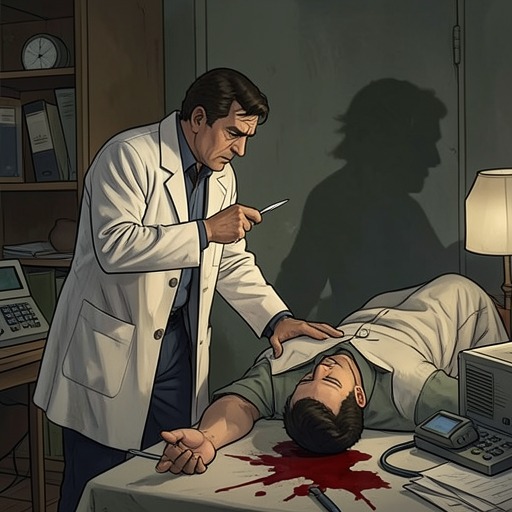
Jimmy Cody’s medical role initially places him in charge of Matt Burke’s physical condition, but the crisis steadily complicates that hierarchy. Burke suffers a heart attack or mild occlusion during the strain of the vampire outbreak, and Cody monitors him with clinical attention that is also plainly affectionate. When Cody takes Burke’s hand and gently checks his pulse, the examination becomes an act of personal care as well as professional duty. Cody understands that Burke’s condition is not merely an incidental illness: the continuing destruction of the town may kill him even if the next attack is not immediately supernatural.
The relationship therefore runs in both directions. Cody treats Burke as a patient who must rest, take prescribed pills, and conserve his strength, while Burke remains one of the group’s most important sources of understanding. Cody explicitly warns that another attack will be major and that the ongoing business will kill Burke unless it ends quickly. His concern is practical but emotionally charged; keeping Burke alive is necessary both because Cody loves him and because Burke’s knowledge is indispensable to the struggle.
From Doubt to Common Action
Burke’s usefulness emerges from his capacity to interpret disturbing evidence. He has been forced backward toward belief by a chain of events that ordinary explanations cannot contain. The punctures on Jimmy’s neck, rather than scratches, and the testimony surrounding Danny Glick’s case help move the older man beyond the assumption that the impossible must be madness. His resistance to belief is presented as an intellectual habit rather than simple cowardice: the word “can’t” has blocked his judgment, yet the evidence leaves no adequate escape.
Cody operates as the medical counterpart to that process of recognition. His professional knowledge does not give him a complete explanation of vampirism; indeed, while discussing aspirin, he admits that medicine understands surprisingly little about the brain and compares medical practice to a form of white magic. This humility makes him especially capable of responding to an anomaly that conventional science cannot absorb. He does not surrender reason, but he refuses to use reason as a pretext for ignoring what has happened.
Their shared movement from skepticism toward action becomes explicit when the group considers confronting Richard Straker. Father Donald Callahan proposes that Ben Mears, Cody, and himself first visit the shop and observe Straker’s reactions. Cody’s agreement is not passive acceptance of another man’s theory. By joining the plan, he accepts that the medical and empirical evidence already warrants confronting a danger that the town’s ordinary institutions have failed to recognize.
Care Under Immediate Threat
When Susan Norton disappears, Cody is present with Burke at the hospital. The news confirms the catastrophe in personal terms, and Ben Mears immediately identifies Susan as a vampire. Cody responds by preparing to act: he has canceled his calls and contacted the county sheriff’s office, only to learn that McCaslin has disappeared as well. His medical practice is thus subordinated to emergency resistance; the doctor redirects every available resource toward the outbreak.
Cody also examines the wounds on his own patient’s neck with exacting attention. He identifies them as punctures, notes that they have scabbed over, and asks about pain and itching. The scene preserves the language of ordinary medicine even as the wound points toward a supernatural infection. Cody’s judgment that Jimmy has been lucky acknowledges the danger without pretending that examination alone can explain it.
At the same time, Cody gives practical instructions for survival. He warns the expedition members not to look into the enemy’s eyes and supports the use of white roses as a protective sign. His medical authority is joined to the group’s developing knowledge of vampire behavior, creating a field practice in which diagnosis, ritual, observation, and courage must work together.
Burke’s Decline and Cody’s Command
The hospital scenes reverse the expected power arrangement between the two men. Burke is intellectually and strategically essential, but his body is becoming a liability. When he insists that he will take the pill Ben Mears had refused, Cody agrees to have a nurse provide it, then tells Burke that he will sleep while the others continue their work. Burke’s reply that there is another matter to discuss shows how unwilling he is to surrender responsibility, but Cody’s role is to impose a limit on that self-destructive dedication.
Later, Cody opens his black bag and produces a small bottle of pills, ordering Burke to take two with water immediately. Burke protests that there is too much to review, yet Ben Mears reinforces Cody’s command: if Father Callahan is gone, Burke is the most important member of the group. Cody’s treatment is consequently not a retreat from the conflict but an attempt to preserve Burke for its conclusion. The alliance depends on recognizing that resistance requires endurance as much as bravery.
Burke’s distress is inseparable from his civic identity. He cannot accept Cody’s demand for sleep because his town is disintegrating before his eyes. Cody answers as a physician, insisting that Burke must save something of himself if he wants to be present at the finish. The exchange dramatizes their central tension: Burke is drawn toward total identification with the town’s suffering, while Cody tries to protect the individual whose continued consciousness and testimony are needed by everyone else.
Significance of the Alliance
Matt Burke and Jimmy Cody represent complementary forms of knowledge under supernatural pressure. Burke begins from interpretation, memory, and belief revision; Cody begins from examination, treatment, and bodily evidence. Neither is sufficient alone. Burke needs Cody’s care to remain active, while Cody needs Burke’s experience and reasoning to understand what medical instruments and conventional categories cannot capture.
Their relationship also gives the resistance an ethical center. Cody does not reduce Burke to a damaged patient, and Burke does not treat Cody as merely a subordinate practitioner. Cody’s gentle pulse-taking, insistence on medication, and concern that the next attack could be fatal coexist with his willingness to join the dangerous investigation. Burke’s trust in Cody’s commands shows that the older man accepts care even while resisting incapacity.
The alliance is therefore both practical and symbolic. Against an enemy that converts bodies and turns familiar neighbors into threats, Cody preserves the language of healing while Burke preserves the town’s capacity to remember and judge. Their cooperation does not erase fear, illness, or doubt; it makes action possible despite all three. In that sense, the doctor-patient bond becomes one of the novel’s clearest examples of ordinary human responsibility adapting to an impossible emergency.