Mike Ryerson's death and vampiric return
'Salem's Lot: A NovelMike Ryerson's death and vampiric return is the event that turns suspicion into physical knowledge: death in Jerusalem’s Lot is no longer necessarily an ending. First reported as a death at Matthew Burke’s house, Mike’s later appearance as a stitched, blank-eyed revenant exposes the supernatural mechanism behind the town’s mounting disturbances. The encounter also establishes that religious faith, invitation, and bodily terror—not ordinary medical explanation alone—govern the struggle between the living and the dead.
Death Becomes a Public Mystery
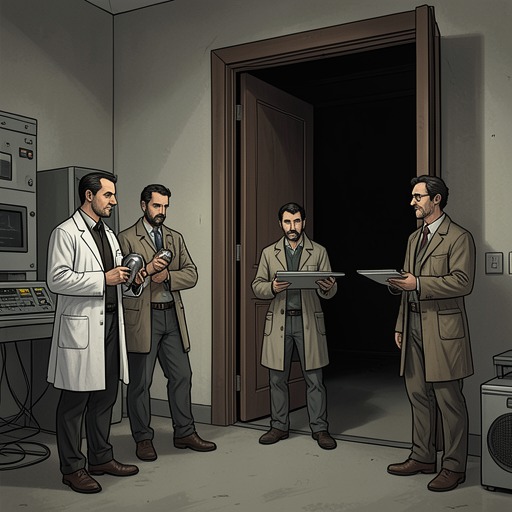
The first account reaches Susan Norton through the town’s gossip network. Mrs Norton reports that Mike Ryerson died at Matthew Burke’s house during the night, with Ben Mears present at the deathbed. The details are already being reshaped by speculation: Matthew Burke supposedly met Mike at Delbert Markey’s tavern, brought him home because he looked unwell, and then witnessed his death. No one, according to the report, understands what Ben Mears was doing there. The event therefore enters the town first as ambiguous social information, a death surrounded by unexplained associations rather than as an openly supernatural attack.
The setting gives the death an institutional and medical frame that initially competes with its true meaning. Matthew Burke’s house is an ordinary domestic interior, with an Early American Junk Shop-style living room, an ancient Motorola television, and a KLH sound system. That familiar environment makes the later return more disruptive: the horror does not emerge from an isolated crypt or visibly forbidden ruin, but from a home where supper, music, and conversation belong to everyday life. When Parkins Gillespie examines the body, he even asks whether Mike is really dead and whether anyone has tried to wake him. The question is practical on its surface, yet it becomes grimly prophetic once the corpse does wake.
The death also belongs to a developing pattern that medicine has not yet mastered. The body is treated as evidence, and the witnesses search for a recognizable diagnosis, but the ordinary vocabulary of death proves unstable. Later discoveries intensify that instability: bodies are stolen from the Cumberland County Morgue, Marjorie Glick is found without the expected surface lividity or rigor, and Roy McDougall’s body reacts violently when exposed to light. These surrounding incidents do not replace Mike’s death; they widen its implications. What first appears to be one unexplained fatality becomes part of a process in which corpses, autopsies, morgues, and daylight all reveal that the town’s biological order has been breached.
The Return in Matthew Burke’s House
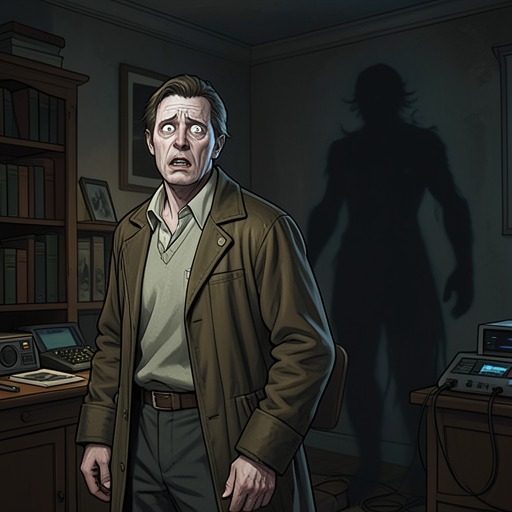
After his death, Mike Ryerson is found lying on a bed in Matthew Burke’s house. The scene briefly imitates a repetition of the previous night, as though Matthew Burke has moved backward in time and might still be able to call Ben Mears before the hospitalization. That apparent return to an earlier moment is immediately broken when Mike opens his eyes. Their red-rimmed glitter and absolute blankness present not a sick man recovering consciousness but an emptied body. The eyes are described as windows opening onto no human thought or feeling, making Mike’s return a transformation of identity as much as a violation of anatomy.
The corpse’s physical condition makes the violation unmistakable. Mike sits up while the sheet falls from his chest, revealing the heavy industrial stitching left by the medical examiner or pathologist after the autopsy. The repaired body carries the institution’s attempt to close and explain it, but the stitches now become visible proof that the thing in the bed has crossed back through a boundary that should have held. His teeth are white and sharp, while his smile is only a mechanical flexing of the muscles around his mouth; the expression never reaches his dead, vacant eyes. The familiar face remains, but the person associated with it has been displaced.
Mike then directs Matthew Burke’s attention toward himself. His command, “Look at me,” converts recognition into danger. The request is not an appeal from a dead friend but an attempt to control the living witness, and Matthew Burke’s refusal becomes the first effective resistance in the encounter. The scene shifts from uncertainty to confrontation in a few beats: the bed becomes a threshold, the returned corpse becomes an aggressor, and the witness must decide whether to accept the appearance before him as Mike or recognize the thing that has taken Mike’s form.
The Crucifix and the Revoked Invitation
Matthew Burke holds out the crucifix, and whatever remains of Mike recoils as if struck by scalding water. The reaction supplies a concrete rule where medical observation could supply none: the returned dead are vulnerable to a religious symbol when it is wielded as an instrument of conviction. The crucifix is not merely decorative. In the instant of confrontation, it becomes an active boundary between Matthew Burke and the thing attempting to enter or dominate his space.
Matthew Burke then withdraws the permission that has helped make the house accessible, crying, “Get out of here!” and adding, “I revoke my invitation!” The wording turns domestic hospitality into supernatural law. Mike’s return is therefore connected not only to burial and blood but also to the conditions under which a vampire may cross into a dwelling. The house, which had seemed to be a safe and familiar interior, becomes a contested jurisdiction: Matthew Burke’s spoken refusal reasserts ownership of the threshold, while Mike’s body is forced backward.
The expulsion is violent rather than clean. Mike screams with hatred and pain, backs four shambling steps, strikes the backs of his knees against the open window’s ledge, and falls beyond the point of balance. Before he disappears, he threatens Matthew Burke with the promise, “I will see you sleep like the dead, teacher.” The words turn sleep into a second vulnerability. They also preserve a distorted remnant of Mike’s former social identity: the returned creature addresses Matthew Burke as a teacher, but the familiar form of address has become an instrument of menace.
Mike falls backward into the night, his pallid body gleaming against the black stitches crossing his torso in a Y pattern. The image joins corpse and spectacle, making the body both horrifyingly material and almost unreal. Afterward, Matthew Burke sees only moonlit darkness and a pattern of motes suspended below the window. The particles briefly gather into a hideously humanoid form before dispersing. Mike’s disappearance thus refuses a stable physical conclusion. The returned body is seen in full, but its departure leaves behind an image that is less substantial and more disturbing: an outline of humanity without a human being inside it.
The Attack's Immediate Consequences
The encounter does not end when Mike Ryerson vanishes from the window. Matthew Burke turns to flee, still clutching the crucifix, and the terror expresses itself through his body. Pain fills his chest and travels up his arm in steady, pulsing waves; the chain of the crucifix remains caught in his right hand as he crosses his forearms before his chest. He identifies the crisis as a heart attack and names James Cody as his doctor, but the statement is made through lips cold with fear. He collapses facedown in the upper hall, leaving the supernatural attack inseparable from a medical emergency. The vampire's violence has entered the language of cardiology without being contained by it.
That collapse changes the event from a private visitation into a crisis requiring witnesses, treatment, and explanation. Matthew Burke had confronted the returned Mike with a religious object and a spoken revocation of invitation, yet the victory exacted a physical price. His knowledge is no longer merely theoretical or literary: the teacher who has observed the town's abnormalities becomes a patient whose heart has been overwhelmed by what he has seen. The event consequently binds supernatural recognition to frailty, showing that understanding the undead does not make a living observer immune to them.
From Isolated Death to Epidemic Pattern
The significance of Mike Ryerson's return expands as other bodies begin to occupy the same unstable space between corpse and living person. News reaches Ben Mears, Susan Norton, and James Cody that someone has taken bodies from the Cumberland County Morgue in Portland, an act described through the imagery of Boris Karloff and Mary Shelley. The theft makes Mike's case part of a larger assault on the institutions that should preserve, examine, and certify the dead. A morgue can store bodies, and an autopsy can stitch them closed, but neither procedure guarantees that death has remained final.
Marjorie Glick's body provides another medical comparison. In Green's workroom, Jimmy Cody examines her on a stainless-steel table and notes that her condition is strikingly similar to Mike Ryerson's: there is no surface lividity and no sign of rigor or incipient rigor. Even an ordinary detail such as the Band-Aid on her left shin becomes unnerving beside the corpse's abnormal condition, because it belongs to the routines of a living household while the body itself violates familiar postmortem change. The clinical similarities help the investigators recognize a pattern, but they also demonstrate the limits of clinical description. The bodies can be catalogued as anomalous before they can be understood as vampiric.
The same conflict between observation and explanation appears when Roy McDougall is pulled from a crawl space into weakening daylight. His body steams and sweats, the skin sags and yellows, his eyes move beneath their lids, and his breathing changes to a Cheyne-Stokes pattern; when he retreats wholly into shadow, the moisture and respiratory disturbance stop. The scene supplies an external condition that ordinary examination cannot dismiss. Light does not simply illuminate the returned body; it acts upon it. In this wider pattern, Mike's blank eyes, autopsy stitches, and resistance to the crucifix become linked symptoms of a transformation that crosses bodily, religious, and environmental boundaries.
Ritual Knowledge Against the Returned Dead
The event also clarifies why ritual matters in a town where medical and civic systems repeatedly misread the evidence. Earlier, Father Donald Callahan's remembered seminary maxim joined acceptance, tenacity, and the hope of avoiding failure; later, during the assault on the Marsten House, his renewed eagerness drives him toward the door. He commands the evil to leave in the name of God the Father and strikes the door with his crucifix. A flash, the smell of ozone, and the explosive failure of the fanlight, bay window, and Yale lock turn religious speech into a force with material consequences.
Mike's recoil establishes the same principle on a more intimate scale. The crucifix works because Matthew Burke presents it as an act of resistance, and the revocation of the invitation gives that resistance a precise legal and ritual form. The event therefore does not offer religion as vague comfort after the fact. It makes faith operational at a threshold where ordinary categories have failed. Yet its protection is conditional and costly: Matthew Burke can repel the revenant, but he cannot prevent terror from triggering the heart attack that follows.
The contrast between the cemetery and the house sharpens this ritual structure. In Harmony Hill Cemetery, a cultured voice waits inside the gate and invokes the Lord of Flies, offering spoiled meat and reeking flesh as a sacrifice and asking for a sign to begin the work. Against this profane ceremony stands Matthew Burke's improvised defense with the crucifix. One ritual seeks permission for evil to enter the town; the other seeks to revoke the access granted to it. Mike's death and return thus belong to a larger struggle over signs, invitations, consecrated ground, and the authority to define what kind of power governs the dead.
Narrative and Thematic Significance
Mike Ryerson's death and vampiric return is a decisive value reversal. At first, death appears to be a social fact that can be reported, examined, and mourned. The later opening of Mike's eyes changes death into predation: the corpse is no longer evidence of an ending but an active threat to the living. The event's horror depends on that delayed reversal. The ordinary house, the bed, the autopsy repairs, and the teacher's expectation that the dead should remain dead are all made unreliable in sequence.
The return also gives the outbreak a recognizable method. Mike retains his name, face, voice, and relation to Matthew Burke, but his human interiority has been replaced by blankness, sharp teeth, and mechanical movement. The vampire does not arrive as an entirely foreign monster; it returns through the familiar person, making recognition itself dangerous. The command to look at him, the teacher's title, and the promise of dead-like sleep all convert personal memory into a weapon.
Finally, the event prepares the larger investigation by joining three forms of evidence: gossip identifies the unexplained death, medicine records the body's abnormal condition, and ritual reveals the means of resistance. The stolen morgue bodies, Marjorie Glick's failed postmortem changes, and Roy McDougall's reaction to light confirm that Mike is not an isolated impossibility. His fall from Matthew Burke's window is the moment when Jerusalem's Lot's hidden evil becomes physically undeniable, even though the town's institutions still struggle to name what has happened.