Portland Press-Herald
'Salem's Lot: A NovelPortland Press-Herald functions as both a regional news organization and a narrative archive of Jerusalem’s Lot’s decline. It supplies the outside world with partial, increasingly alarming accounts of the town, while its old issues allow characters to reconstruct buried patterns that local memory has preserved only as gossip. The paper therefore does more than report events: it mediates the boundary between official explanation and supernatural truth.
Regional Newspaper and External Witness
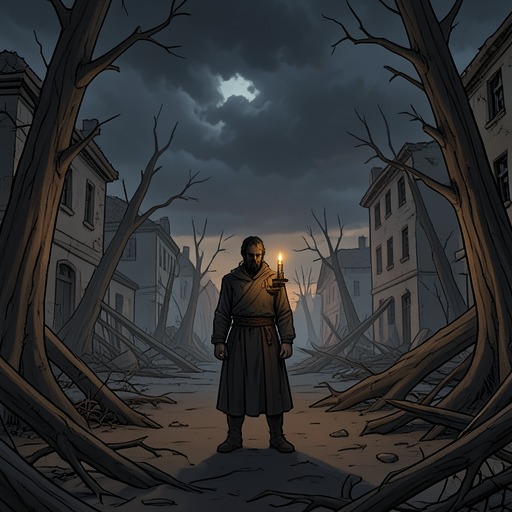
Portland Press-Herald is identified as the newspaper serving the region around Jerusalem’s Lot, a small town east of Cumberland and twenty miles north of Portland. A feature on the town, headed “GHOST TOWN IN MAINE?” and attributed to John Lewis, the Press-Herald features editor, presents Jerusalem’s Lot as an unusually complete case of civic disappearance. The article describes a place in which Spencer’s Sundries and Pharmacy, Crossen’s Agricultural Store, the hardware store, Barlow and Straker’s Furniture Shop, the Excellent Café, and the Municipal Building have all been boarded up. The grammar school and the tri-town consolidated high school are empty, their furnishings and books moved to temporary facilities in Cumberland because no children from Jerusalem’s Lot are expected to attend a new school year.
The report also records the human absence behind the abandoned storefronts. Henry Petrie, his wife, and his son are missing, along with the local mortician, librarian, and beautician; the article additionally names people whom the state police hope to locate or hear from, including John Groggins, Father Donald Callahan, Mabel Werts, Lester and Harriet Durham, and Eva Miller. The newspaper thus turns a vanished town into a list of names, institutions, and empty places. Its language remains compatible with ordinary investigative journalism, but the accumulation of absences makes the conventional account increasingly difficult to sustain.
A Paper Carried Across Distance
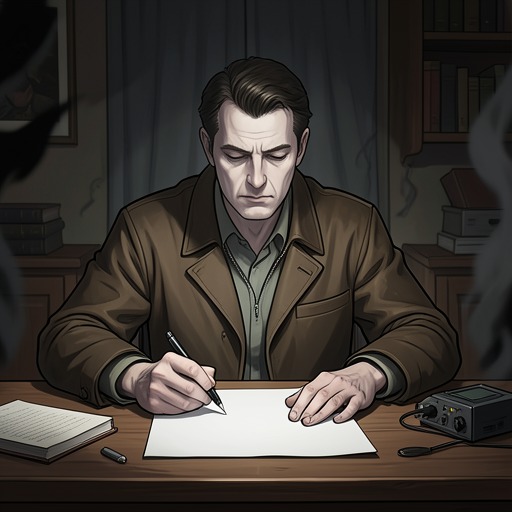
For the tall man traveling with the boy, Portland Press-Herald is a deliberate link to Maine and to Jerusalem’s Lot. Wherever they stop while crossing the country in an old Citroën sedan, he obtains the paper and watches it for items concerning the town and its surrounding area. His attention is not casual reading; it is a sustained surveillance of a place he has left but cannot abandon. The boy refuses to discuss Jerusalem’s Lot and will not look at the copies the man leaves nearby, making the newspaper an object of avoidance for one traveler and anxious investigation for the other.
After they settle near Los Zapatos, the man makes a forty-mile trip once a week to obtain the Portland, Maine, paper. The copies are at least a week old and sometimes yellowed with dog urine, a physical detail that emphasizes both their distance from current events and the stubbornness of the man’s need to know. Two weeks after the boy announces his intention to enter the local church, the man finds a featured story about Jerusalem’s Lot and Momson in which his own name appears. The article leaves him uneasy because it suggests that the disaster in Jerusalem’s Lot is not finished. When the boy finally approaches him with the paper folded open to the headline “Ghost Town in Maine?”, the newspaper becomes the instrument through which their shared past can no longer remain unspoken.
The paper continues to structure the man’s return to knowledge after he and the boy reach Portland in mid-September. At the motel, he receives fresh copies every day and watches them for reports about Jerusalem’s Lot. On the ninth day, a man disappears in Falmouth and his dog is found dead in the yard. The fresh newspaper reverses the earlier image of yellowed, delayed evidence: the danger is no longer merely a residue from an abandoned town but an active regional threat moving outward.
Reporting the Aftermath
The newspaper’s reporting repeatedly frames supernatural consequences through provisional civic language. Its account of Jerusalem’s Lot calls the town a ghost town and compares it with abandoned settlements in the American Southwest, where communities rot after their economic purpose disappears. Yet the surrounding testimony does not fit simple economic collapse. Residents circulate stories of haunting, colored lights hovering over Central Maine Power lines, unidentified flying objects, and a possible dark coven; others compare the disappearances with young men found in mass graves in Houston. The Press-Herald records these explanations without resolving them, preserving the social process by which a catastrophe becomes legend.
The paper’s later clippings extend that record beyond the original town. A November 19, 1975, report states that the Charles V. Pritchett family is leaving a farm on Schoolyard Hill because things go bump in the night; the property had been purchased only a month earlier at what was described as a bargain-basement price. A January 4, 1976, report describes a wrecked late-model sedan that struck a Central Maine Power utility pole. Blood is found on the front seat and dashboard, but no passengers are located, and police suggest that Gordon Phillips, his wife, and their two children may have wandered away in a daze. The report documents physical evidence while offering an explanation that cannot account for the missing people.
On May 29, 1976, the paper reports the suspected foul play in the disappearance of the Daniel Holloway family, who had moved onto Taggart Stream Road in April and had complained to friends and relatives about funny noises after dark. On June 4, it records that Elaine Tremont has been admitted to Cumberland Receiving Hospital after a heart attack. She says that, while watching television, she heard scratching at her bedroom window and saw a grinning face peering in; she connects her fear with the Holloway family’s disappearance a mile away. The newspaper consequently becomes a chain of linked incidents: noises, disappearances, damaged vehicles, dead animals, frightened witnesses, and medical crises accumulate across southern Maine.
The scrapbook kept by Ben Mears preserves this chain as a private counter-archive. Its clippings include the November 1975 farm report, the January 1976 crash, and the later Holloway and Tremont stories, allowing scattered newspaper items to be read as a pattern rather than as unrelated local disturbances. The paper’s ordinary chronology—November 19, January 4, May 29, June 4—quietly supplies the evidence of recurrence. What journalism presents as separate mysteries becomes, in the scrapbook, a history of contagion and territorial expansion.
Journalism, Memory, and the Limits of Explanation
Portland Press-Herald occupies an unstable position between knowledge and concealment. Its reports are concrete enough to preserve names, dates, roads, institutions, blood, wreckage, and hospital admissions, but the interpretive framework remains incomplete. Police theories, state searches, rumors of occult activity, and references to missing-person files all coexist without producing a sufficient account. The newspaper can establish that something has happened; it cannot, by its normal methods, identify the vampire outbreak behind the pattern.
This limitation mirrors the town’s own culture of partial knowledge. Jerusalem’s Lot remembers the violence associated with the Marsten House and passes its scandals ceremonially from generation to generation, but much of the truth remains hidden. The town knows that Hubert Marsten killed Birdie Marsten, yet does not know what preceded the shooting; it remembers fragments of burned papers without knowing their correspondence or occult significance. The newspaper belongs to the same economy of fragments. It externalizes collective memory, but it also shows how facts become blurred when separated from the events that produced them.
The paper’s archive nevertheless reaches further than rumor. Old issues from 1928 to 1939 reveal that four children disappeared during the years Hubert Marsten and Birdie Marsten lived in the Marsten House, and that none of the children was ever found. Later materials connect the town’s twentieth-century catastrophe with older records, including Robert Boone’s coded diary, whose entries run from June 1 to October 27, 1789, four days before the cataclysmic disappearance described by Mrs Cloris. Other documents concerning Charles Boone and Calvin McCann are later judged unreliable, with Charles Boone’s supposed journal evidence treated as forgery produced during his paranoia. Against such unstable testimony, newspaper back issues are not perfectly authoritative, but they provide dated, materially preserved traces that can be compared with oral memory and private archives.
Narrative and Thematic Significance
As a narrative device, Portland Press-Herald changes the scale of the horror. The story does not end with Jerusalem’s Lot; the paper shows families leaving, motorists vanishing, livestock being mutilated, and frightened residents in neighboring communities confronting faces at their windows. The newspaper’s regional circulation makes the outbreak visible as a widening geography rather than a self-contained town tragedy.
Its presence also complicates the novel’s treatment of modern infrastructure. The press is a technology of rational observation, just as power lines, telephones, medical instruments, automobiles, and hospitals appear to promise control over events. Yet the newspaper’s reports cannot prevent the events they describe, and sometimes their official explanations merely postpone recognition. The same modern world that distributes information also distributes delay, speculation, and false reassurance.
Portland Press-Herald is therefore both witness and symptom. It records the empty schools and boarded shops of Jerusalem’s Lot, carries the town’s name across the country to the man and the boy, preserves the chronology of later disturbances, and converts private dread into public documentation. Its clippings do not defeat the darkness, but they make recurrence visible: the horror survives in the gap between what the record can prove and what the record cannot yet name.