Randy McDougall's abduction and death
'Salem's Lot: A NovelRandy McDougall's abduction and death marks the moment when the supernatural violence spreading through Jerusalem’s Lot reaches into an ordinary family’s most vulnerable space. The event is not witnessed by the town or investigated as a clearly understood crime: Danny Glick slips through the infant’s bedroom window, feeds on him, and returns him as a dead child whose body bears no visible bruises. The horror is therefore joined to concealment. What Sandy McDougall discovers is both an unmistakable death and an impossible alteration of the evidence that might have explained it.
The Hidden Attack
The attack occurs during a period when the town’s private crimes remain largely outside public knowledge. The narration places Randy among the town’s secrets, alongside other acts of violence that some residents will eventually learn and others will never know. Danny Glick is identified as the immediate agent: he enters through the baby’s window, takes Randy from his crib, and sinks his teeth into a neck still bruised from his mother’s blows. The image joins two kinds of danger without confusing them. Randy is already a neglected and injured infant, but the supernatural predator exploits that existing vulnerability and converts a domestic space into a feeding ground.
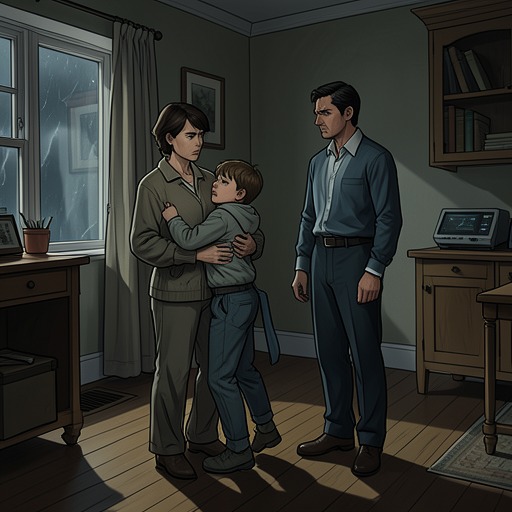
Sandy wakes with the sense that something is wrong before she can identify the cause. Roy is away fishing on his day off, nothing is burning, and she is not physically hurt; then she realizes that the morning light itself seems wrong. Her unease becomes terror when she runs down the narrow hall and sees the small bedroom flooded with submerged light from the open window. She always closed that window before bed, yet it now stands open above the crib. The empty crib is the first concrete sign that the event was an abduction rather than an ordinary death.
Discovery of the Body
Sandy finds Randy’s small body thrown into a corner, still dressed in wash-faded Dr Dentons, one leg raised grotesquely. She falls to her knees, cradles him, and feels that the body is cool. The physical detail makes the loss immediate, but the subsequent change in the corpse makes it uncanny: the bruises that had marked Randy’s face and body have disappeared overnight, leaving his features and form apparently flawless. His color is good, and Sandy finds him beautiful for the first time since his birth; that beauty becomes the source of her scream because it is the beauty of a dead child, not a sign of recovery.
Her response moves through denial, desperate caretaking, rage, and recognition. She searches the cabinets, breaks a bottle of Wesson oil, finds Randy’s favorite Gerber’s chocolate custard, and tries to feed him with a plastic Dairy Queen spoon. She calls the food by the baby’s familiar name and pushes it between his slack lips, pleading that he stop pretending. When the custard falls back out, she pushes up the corners of his mouth with trembling fingers. The failed feeding exposes the truth her hand already knows: Randy cannot wake, eat, or answer her. Her screaming is the scene’s final acknowledgment of death.
Meaning Within the Outbreak
Randy’s death demonstrates how the vampire outbreak operates through secrecy, repetition, and the corruption of ordinary signs. An open window, an empty crib, a cool body, vanished bruises, and food falling from a child’s mouth form a sequence in which each familiar domestic object becomes evidence of an inhuman intrusion. Yet the event is not publicly understood in its true form. The town keeps its secrets with what the narration calls an ultimate poker face, treating devil’s work no differently from the work of God or man. Randy’s death consequently expands the outbreak beyond the named victims whose bodies can be examined: the missing child becomes part of a hidden pattern that investigators will later struggle to reconstruct.
The event also prepares the later encounter between Danny Glick and Mark Petrie. When Danny appears at Mark’s window with grave-pale skin, reddish eyes, blood around his mouth, and lengthened teeth, his earlier attack on Randy is retrospectively clarified. The infant’s death is no isolated household tragedy but an early act in Danny’s transformation into an active vampire. Its discovery helps establish the stakes of the conflict that follows: children are not merely witnesses to the Lot’s crisis, and nurseries and bedrooms offer no protection once the dead begin returning to prey upon the living.
Meaning Within the Outbreak
Randy’s death demonstrates how the vampire outbreak operates through secrecy, repetition, and the corruption of ordinary signs. An open window, an empty crib, a cool body, vanished bruises, and food falling from a child’s mouth form a sequence in which familiar domestic objects become evidence of an inhuman intrusion. Yet the event is not publicly understood in its true form. The town keeps its secrets with what the narration calls an ultimate poker face, treating devil’s work no differently from the work of God or man. Randy’s death consequently expands the outbreak beyond the named victims whose bodies can be examined: the missing child becomes part of a hidden pattern that investigators will later struggle to reconstruct.
Consequences and Narrative Significance
Randy’s death also exposes the limits of ordinary investigation. Later, when Ben Mears and his allies attempt to understand what has happened in Jerusalem’s Lot, Danny Glick is the only vanished child whose burial place provides a fixed point of inquiry; the other missing bodies have disappeared without trace. Randy’s case belongs to that larger absence. No official observer sees Danny enter the room, and Sandy’s discovery supplies only a sequence of domestic anomalies rather than a comprehensible explanation. The result is a crime that leaves grief behind while withholding the evidence needed to name its perpetrator. This pattern helps explain why the vampire outbreak can advance through the town before its human defenders recognize its scale: each household experiences a private catastrophe, while the community’s habits of silence and disbelief keep those catastrophes separated from one another. Randy’s abduction therefore functions as both a child’s death and an early structural demonstration of how the Lot is conquered—one concealed bedroom at a time.