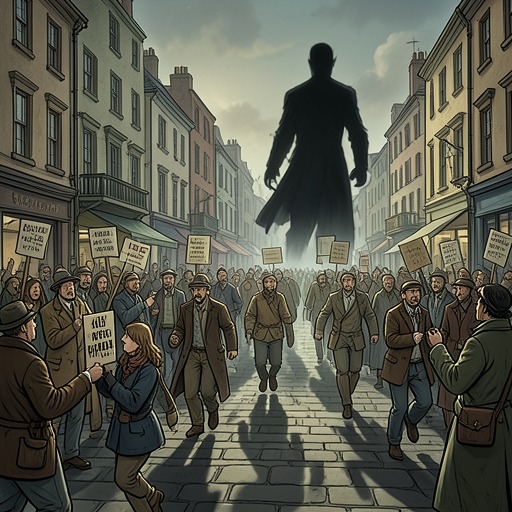
Small-town gossip and surveillance
'Salem's Lot: A NovelSmall-town gossip and surveillance are not mere background color in Jerusalem’s Lot; they are the town’s informal governing system. Information travels through party-line telephones, windows, roads, cafés, funerals, shops, and habitual observation, binding residents together while also policing their behavior. The same network that preserves local memory and detects disturbances converts uncertainty into rumor, mistakes supernatural danger for more familiar scandals, and finally becomes strangely useless when the town’s inhabitants confront a threat they cannot name.
The Town as a Communications Network
In Jerusalem’s Lot, sociability is built into infrastructure. Most telephone lines are two-, four-, or six-party connections, so residents routinely have someone else to discuss. Scandal is described as always simmering, with the Bend producing most of it while people of higher status occasionally add their own contributions. The town’s physical layout reinforces this circulation: Brock Street crosses Jointner Avenue at right angles through a nearly circular township, while the rougher trailers and shacks of the Bend occupy the southwest area and the more wooded north Jerusalem rises toward the Marsten House. Gossip therefore moves through a mapped social space, passing between neighborhoods, businesses, families, and institutions rather than remaining private. The telephone wires make the network almost material. Their humming is associated with voices traveling through space, and the leaning wooden poles appear to carry not only messages but the accumulated sense of the town’s past. Conversation, memory, and surveillance are joined in the image of a community whose stories seem imprisoned in its infrastructure and continually struggling to get out. This is why the town can function as a collective observer even when no official authority has assembled a complete account.
Mabel Werts and the Practice of Watching
Mabel Werts embodies the network most completely. A seventy-four-year-old widow, she is a repository of more than five decades of local history, including deaths, adultery, theft, and insanity. Her physical limitations keep her close to home, but they do not isolate her: a telephone rests at her right hand and powerful Japanese binoculars at her left. From her window, these tools make her a central node in a communications web stretching from the Bend to east Salem. She does not present herself as deliberately cruel; she lives through the town and regards its knowledge as a form of belonging. Yet her benevolent self-image does not remove the intrusive power of her attention. Her surveillance of the Marsten House demonstrates both the pleasure and the limits of this role. She watches the house because there is little else to watch, then sees a shutter open and a golden square of light that does not resemble the steady glow of electricity. A possible man’s head and shoulders appear briefly against it before the house becomes still again. The glimpse excites her precisely because it withholds enough information to invite speculation. She then places a telephone call, identifies Harriet Durham and Glynis Mayberry as the speakers on the line, and silently listens to their discussion of Mike Ryerson finding Irwin Purinton’s dog. Mabel’s power lies not only in speaking but in remaining invisible while other people speak. The pattern recurs in the town’s talk about the newcomers. Mabel is known to spend the day with binoculars, and Lawrence Crockett warns that local people will talk about Richard Straker and his partner. Straker dismisses the townspeople as being no different from magpies on telephone wires, confident that they will eventually accept the pair. His contempt recognizes the network’s persistence even as he assumes it can be managed. The transaction’s secrecy depends on that confidence: he demands that Crockett say nothing about the arrangement by which the Marsten House and the business establishment are acquired for one dollar, while also threatening to ruin him if he reveals the deal. Gossip is thus treated as both an unavoidable public force and a danger that can be temporarily contained by intimidation.
Rumor, Moral Panic, and Misrecognition
The first public interpretations of the town’s disappearance show gossip converting absence into competing stories. Surrounding communities begin a whispering campaign that gives ’Salem’s Lot the reputation of a ghost town. Reports of colored lights over the Central Maine Power lines encourage talk of UFOs, while other people imagine a dark coven of young people practicing black mass and bringing divine punishment upon the town. A less supernatural explanation recalls young men who disappeared near Houston and were later found in mass graves. These theories differ in content but share a common process: unexplained losses are made intelligible by attaching them to familiar cultural fears, from alien abduction to satanic youth culture to organized murder. The same process appears in conversation at Dell’s. When the dead dog associated with Mike Ryerson is discussed, one speaker insists that children are responsible but suggests the matter may be more serious than a prank. A newspaper report about young people desecrating a Catholic church in Clewiston, Florida, complete with obscene writing and human and animal blood, supplies a ready-made vocabulary of devil worship. The local question is not investigated through reliable evidence so much as shaped by an imported story. Gossip acts like a filter: it selects a dramatic explanation before the town has understood what has actually happened. This misrecognition is sharpened by the town’s self-conception. Jerusalem’s Lot believes that its knowledge of national wars and crises is largely academic and that time moves there on a different schedule. Apart from accidents, drinking, drugs, and other familiar troubles, nothing truly terrible is supposed to happen in such a pleasant place. The conviction that catastrophe belongs elsewhere becomes an interpretive barrier. Local people can imagine crime, promiscuity, cults, or distant mass graves more readily than the supernatural reality within their own streets.
Gossip, Control, and the Private Life
The network does not merely report events; it regulates conduct. Ann Norton’s response to Susan Norton’s interest in Ben Mears illustrates how communal surveillance enters the home. Ann learns through Mabel that Ben is staying at Eva Miller’s boardinghouse, the only such establishment in town, and feels relief because Eva is a respectable widow with strict rules about women in the rooms. A female visitor may be admitted only if she is a guest’s mother or sister; otherwise she must remain in the kitchen, and the rule is not negotiable. Ann’s telephone conversation is framed as small talk, but she uses it to discover where Ben is and whether the setting can protect Susan from what she considers improper behavior. Susan recognizes the controlling tone when Ann later summons her for a discussion. The sound recalls the arguments of Susan’s high-school years over hemlines and boyfriends, showing that surveillance is also generational discipline. Ann’s concern is expressed as wanting what is best for her daughter, but the method is indirect inquiry, moral judgment, and the assumption that private desire must be monitored by the family and the town. Gossip therefore makes the boundary between domestic authority and public knowledge porous. Funerals provide another formal occasion for communal watching. When Danny Glick is buried in Harmony Hill Cemetery on the first day of real fall, the graveside service is open to the town, and a large portion of the community attends: classmates, curious residents, older people drawn compulsively toward funerals, relatives, and observers such as Mabel Werts. In the long procession up Burns Road, people are physically gathered into a visible community, carrying personal grief and public curiosity in the same movement. The event preserves the town’s collective memory, but it also turns mourning into a scene in which behavior, absences, and irregularities can be noticed.
From Information to Silence
As the supernatural crisis advances, the gossip network becomes increasingly unstable. The Marsten House, once an object of neighborhood curiosity, becomes a source of danger that ordinary observation cannot decode. Mabel’s glimpse of its strange light offers a clue but not an explanation; the telephone can spread the report, but it cannot supply the knowledge needed to interpret it. The town’s familiar mechanisms remain active while their explanatory power collapses. The collapse is most stark when the truth is already present but unspoken. During the night of the vampire outbreak, some residents remain untouched or unaware, while those who are awake turn on every light and search drawers, attics, and jewelry boxes for religious symbols. They act without understanding why, as if inherited communal knowledge survives after conscious knowledge has failed. Yet they do not look out their windows. The town’s people are simultaneously watching for danger and refusing the sight that would reveal it. Surveillance has become defensive ritual, no longer confident inquiry. The final exchange with Parkins Gillespie reverses the usual direction of local communication. Ben Mears tells the constable that they want to explain what has been happening, but Parkins calmly refuses to hear it. Official authority, which should receive and organize testimony, instead blocks the account. The refusal completes the pattern established by rumor and secrecy: information has circulated everywhere, but recognition has been postponed, distorted, or rejected.
Narrative Significance
Small-town gossip and surveillance give Jerusalem’s Lot a social memory before the supernatural plot makes that memory necessary. They preserve names, relationships, scandals, deaths, transactions, and visual impressions; they make a sparsely populated town feel densely observed. The network also creates a striking contrast between visibility and knowledge. People can identify voices on a telephone line, watch the Marsten House through binoculars, track where a famous author is staying, and remember decades of local history, yet they cannot initially comprehend the force operating among them. The concept therefore links ordinary communal life to the horror’s spread. Gossip is a form of collective intelligence, but it is vulnerable to prejudice, sensationalism, secrecy, and denial. It can produce moral panic about satanic youth or foreign crimes while missing the actual threat; it can enforce sexual propriety while allowing an evil transaction to pass under a demand for silence; and it can gather people at a child’s grave without giving them the means to understand death’s return. By the end, the town’s communications web has not vanished, but its signals have become ominous, fragmented, and incapable of protecting the community from what it has been watching all along.