Straker’s sacrifice of Ralphie Glick
'Salem's Lot: A NovelStraker’s sacrifice of Ralphie Glick is the ritual act that converts a child’s disappearance into an intentional offering to darkness. Performed at midnight in a cemetery, it joins the familiar structures of burial, prayer, and consecrated ground to a blasphemous ceremony of invocation. The scene establishes Richard Straker not merely as an accomplice to Kurt Barlow but as the active human instrument through which an ancient and inhuman power is invited to begin its work in Jerusalem’s Lot.
Causes and Background
The sacrifice occurs against the apparent normality of Jerusalem’s Lot, a nearly circular township whose roads form the shape of a telescopic sight. The town’s northern woods rise toward the Marsten House, while its poorer southwest district, the Bend, is marked by trailers, junked cars, beer cans, makeshift domestic spaces, and the scandal carried through shared telephone lines. Yet the town’s self-image depends on the belief that its troubles are ordinary and that nothing truly terrible can happen there. Its knowledge of wars, burnings, and national crises remains largely academic; local violence is treated as an exception to an otherwise protected way of life.
That complacency gives the sacrifice its particular force. The act does not erupt in a visibly alien landscape but in a recognizable local cemetery, among roads, woods, and the accumulated social memory of the town. The same community that gathers publicly for Danny Glick’s burial has a hidden ritual taking place within its sacred geography. The contrast makes the supernatural invasion feel less like an external attack than like a corruption of institutions and places the town already trusts.
The immediate background is Ralphie Glick’s disappearance. Ralphie and Danny Glick are brothers, and Ralphie vanishes before Danny’s funeral, creating the first major rupture in the town’s ordinary assumptions. Danny is later buried in Harmony Hill Cemetery, while the circumstances surrounding Ralphie remain unexplained. The sacrifice supplies the withheld cause: Ralphie has not simply been lost; he has been selected and delivered as an offering.
What Happens
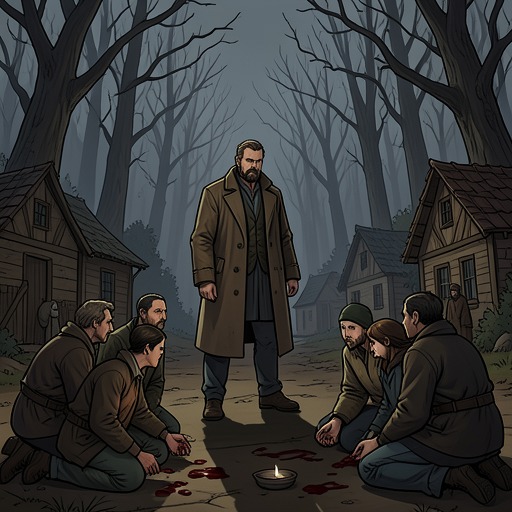
At 11:59 PM, while the town’s houses lie mostly dark and its remaining lights fall across the pavement, a dark figure stands inside the gate of Harmony Hill Cemetery, waiting for time to turn. The figure is identified in the draft material as Straker, and his deliberate stillness gives the scene the quality of a threshold rite: the ceremony waits for midnight, a boundary between ordinary time and the supernatural work that follows.
Straker speaks in a soft, cultured voice and addresses his father as the Lord of Flies. He presents spoiled meat and reeking flesh, claiming that he has made a sacrifice and asking for a sign upon the consecrated ground. His language imitates prayer while reversing its moral direction. The cemetery is a Christian burial place, but Straker treats it as an altar for a rival power; the vocabulary of devotion remains intact even as its object becomes demonic.
A voice answers from the darkness and asks what Straker has brought. Straker responds with the offering itself. He stoops and rises holding the sleeping body of Ralphie Glick in his arms. The child’s passivity intensifies the violence of the scene: Ralphie is not shown as a combatant or willing participant but as a body carried across the boundary between the living town and the ritual space. The voice accepts the offering and commands Straker to consummate the act and grow strong.
The ceremony therefore produces a decisive value shift. Ralphie’s disappearance changes from an unresolved absence into evidence of calculated evil, while the cemetery changes from a place of mourning into an active supernatural gateway. Straker’s role also changes in the reader’s understanding: he is not simply a mysterious shopkeeper or servant associated with the Marsten House, but a ritual agent who knowingly presents a child to the power behind the town’s coming catastrophe.
Participants and Ritual Structure
The ceremony has a clear sequence of separation, presentation, acceptance, and command. Ralphie is removed from ordinary family and civic life, brought into the cemetery, and offered in a space ordinarily reserved for Christian remembrance. Straker acts as priest, petitioner, and bearer of the sacrifice. The unseen voice functions as the responding authority, confirming that the rite is not an isolated act of madness but an exchange governed by a power capable of receiving and judging the offering.
The ritual also makes sacred space unstable. Harmony Hill Cemetery is associated with Danny Glick’s burial, the public gathering of mourners, and the town’s conventional religious practices. Straker’s midnight ceremony overlays that communal meaning with a private counter-liturgy. The cemetery becomes both graveyard and altar, a place where death is not concluded but redirected into the machinery of undeath and contagion.
The sacrificial object is deliberately described through opposed images of sleep and death. Ralphie is sleeping when Straker carries him, but the ceremony’s setting, its reference to flesh, and its invocation of a demonic father place that sleep under the shadow of burial. The scene’s horror comes from the collapse of distinctions the town relies on: child and offering, cemetery and altar, prayer and blasphemy, sleep and death.
Consequences and Aftermath
The sacrifice initiates the supernatural work that will spread through Jerusalem’s Lot. Ralphie’s disappearance is the first visible sign of the process by which the town’s residents are removed from ordinary human community and drawn into vampiric occupation. Danny Glick’s subsequent death, burial, and later return make the Glick family tragedy part of the same chain. When Mike Ryerson opens Danny’s coffin, he finds a face that appears vividly alive rather than dead, confirming that the town’s funerary order has been invaded by a different law of life and death.
The event also foreshadows the later confrontation with Barlow. The same narrative pattern returns when Ben Mears and Mark Petrie reach Barlow’s coffin: locks and seals split as they touch them, and Barlow appears young, vital, and terrifyingly alive. The coffin is not merely a container for a corpse but a concealed center of power. Straker’s earlier carrying of Ralphie anticipates the later movement of Barlow’s coffin into the Marsten House cellar, linking sacrifice, enclosure, and the preparation of a supernatural occupation.
The town’s later behavior reveals how deeply the breach has spread. During the crisis, awake residents turn on every light, retrieve religious symbols from drawers, attics, and jewelry boxes, and avoid looking out their windows even though they do not consciously know the truth. Their bodies respond before their minds can formulate an explanation. Straker’s ceremony thus begins a horror that operates both through explicit supernatural action and through obscure communal recognition: Jerusalem’s Lot senses that its familiar world has changed before it can name the force responsible.
Narrative Significance
Straker’s sacrifice is the hidden causal scene behind the novel’s early mysteries. It supplies the missing link between Ralphie’s disappearance and the expanding vampire threat, while preserving the atmosphere of delayed knowledge that governs the town’s experience. The reader sees what the residents cannot yet understand: the darkness has an agent, a rite, a chosen victim, and a plan.
The scene’s gothic power comes from its collision of scale. Ralphie is a single sleeping child, yet the voice’s command to grow strong implies a force whose ambitions exceed the individual victim. The ceremony is quiet, formal, and almost courteous, but its restraint makes the violence more disturbing. There is no public alarm, only a cultivated voice, a cemetery gate, an offering, and an unseen power answering from beyond the ordinary world.
In structural terms, the sacrifice turns Jerusalem’s Lot from a town that believes catastrophe happens elsewhere into a town already being claimed from within. Its later fires, disappearances, vampire attacks, and desperate religious defenses are not disconnected shocks; they are consequences of the moment when Straker brings Ralphie Glick into the cemetery and receives permission to begin the work.