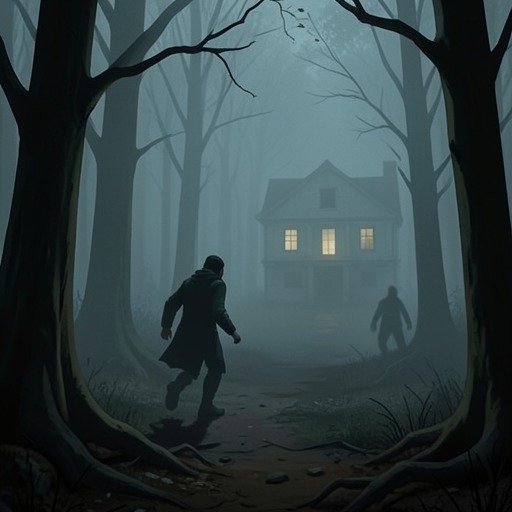
The Marsten House as a supernatural beacon of evil
'Salem's Lot: A NovelThe Marsten House as a supernatural beacon of evil is more than a haunted setting. It is imagined as a structure in which human violence has acquired an afterlife, turning a private house into a public source of dread. Ben Mears understands it as Hubert Marsten’s “monument to evil,” a “psychic sounding board” and “supernatural beacon” that may still hold the essence of its former owner in its moldering bones. Its reoccupation therefore transforms an old local horror into an active threat, linking the house’s past to the renewed disappearances in Jerusalem’s Lot.
A House Made by History
The house is inseparable from Hubert Marsten and the murder of Birdie Marsten. Ben’s investigation of old Ledger files finds that four children disappeared between 1928 and 1939, during the eleven years when Hubert and Birdie lived there. None of the children was ever found: no later hunter discovered a skeleton, and no contractor unearthed remains while taking gravel. The record offers no ordinary explanation capable of closing the case. The disappearances remain attached to the house as an unresolved historical pattern.
Minella Corey’s account deepens that history from local rumor into a vision of intimate evil. She considered Hubert Marsten one of the two genuinely evil men she had known, placing him beside Adolf Hitler. She claimed that, while working three hundred miles away in Cape Cod, she suddenly experienced a bolt of pain “like lightning” and heard a shotgun blast at the moment Hubert killed her sister. Although the account is unsubstantiated, Ben finds the possibility of psychic transmission less disturbing than the persistence of human evil itself. The important implication is not simply that the house may be haunted by a ghost, but that violence can remain active after its perpetrator is gone.
The Beacon and Its Reoccupation
Ben looks at the Marsten House as a possible monument that has continued to absorb or broadcast Hubert’s evil. The metaphor of the beacon gives the building an outward force: it does not merely contain terror but seems to announce, attract, or amplify it. The house becomes a supernatural landmark whose significance exceeds its walls, making the surrounding town’s memory, gossip, and unexplained losses converge upon one physical location.
Its occupation again is the decisive reversal. Ben had expected that returning to Jerusalem’s Lot might allow him to confront the childhood terror associated with the house on his own terms. He imagined renting it, breaking its spell, or using its atmosphere to write a frighteningly successful book. Those possibilities all depended on his belief that he controlled the encounter as an adult. Instead, the house has been bought and occupied by Richard Straker and Kurt Barlow, while another child has disappeared. The new presence destroys Ben’s sense of control: what he had treated as material for memory or fiction now appears to be operating independently in the present.
The timing makes the pattern difficult to dismiss. The previous occupation was followed by four child disappearances over ten years; after a thirty-six-year interval, the house is occupied again and Ralphie Glick disappears almost immediately. Ben acknowledges that the parallel could be coincidence, but the recurrence gives the house a pattern rather than a single legend. The past does not repeat as an identical anecdote; it returns as a structure of expectation, with the house serving as the point where repetition becomes visible.
Architecture Within the Town
The Marsten House occupies the last of the wooded hills in north Jerusalem, above the town and among old logging roads. Jerusalem’s Lot itself is arranged almost like a telescopic sight, with Brock Street crossing Jointner Avenue at right angles. The house stands within this mapped environment as an elevated and isolated focus, a place physically apart from ordinary circulation even though the town’s roads and power infrastructure frame it.
A Central Maine Power electricity pylon stands close to the house, looming over it like an alien sentinel. That image complicates any simple opposition between archaic haunted architecture and modern technology. The house is not sealed in a purely medieval past; it is crossed by the same electrical and infrastructural world that organizes contemporary life. Elsewhere, telephone wires hum with the gossip passing through them, and the leaning poles seem to preserve the town’s sense of time. The Marsten House belongs to this network of transmission while also appearing to transmit something older and darker: memory, rumor, and violence.
The wider town initially resists the possibility that such darkness could become immediate. Jerusalem’s Lot contains ordinary distinctions of farmland, trailers, businesses, schools, roads, and cemeteries, and its residents assume that nothing truly terrible can happen in so pleasant a place. The house challenges that civic self-image by making buried history spatially present. It stands above the town as a reminder that apparent stability may conceal an older and more durable order of violence.
From Local Legend to Supernatural Threat
The house’s significance changes as apparently separate incidents gather around it. Ralphie Glick’s disappearance recalls the earlier child disappearances; Danny Glick’s death, attributed to pernicious anemia, supplies a medical explanation that becomes increasingly inadequate beside the family tragedy; and the presence of Straker and Barlow makes the reoccupation concrete rather than merely spectral. The house is thus the meeting place of competing explanations—accident, disease, gossip, criminal history, and supernatural evil.
The novel repeatedly places modern procedures beside signs that exceed them. A medical examination of Mike Ryerson’s corpse proceeds with a thermometer and a watch marking the time, yet the dead man’s voice later speaks from within Matt Burke’s house after an invitation has been given. A handgun accompanies Ann Norton during her compelled attack on the hospital, but the weapon remains subordinate to the hypnotic command governing her actions. These details reinforce the Marsten House’s larger function: rational instruments and ordinary institutions continue to exist, but they no longer guarantee understanding or safety.
The house also functions as a center of occult absence. When Ben Mears and Susan Norton enter it, they listen to a silence so complete that they know they are not alone. The building’s power lies partly in what it withholds: hidden rooms, withheld histories, and a presence that does not need to announce itself in order to control the scene. Its horror is therefore architectural and epistemological at once. The house stores secrets, while its inhabitants and the town struggle to interpret the signs it releases.
Narrative and Thematic Significance
As a Gothic space, the Marsten House converts psychological trauma into an external structure. Ben’s childhood encounter with the house is not allowed to remain a sealed memory; his return places that memory beside fresh evidence of danger. The building becomes a test of whether fear is merely a private projection or a perception of an objective evil. Ben’s recognition that he is no longer in control marks the point at which childhood terror and adult investigation become one continuous crisis.
The house also embodies the novel’s recurrent power of evil. Ben distinguishes the possibility of telepathy or precognition from the more unsettling thought that “the evil that men do lives after them.” A supernatural beacon is consequently not just a source of paranormal energy. It is a form imposed on moral residue: murder, domination, and cruelty have become so concentrated in one place that the place seems capable of preserving and radiating them.
Its return to active occupancy gives the image a cyclical force. The house remains standing while generations change, telephone poles weather, roads and technologies develop, and the town reassures itself that catastrophe belongs elsewhere. Yet the same location can reopen the town’s oldest wounds. The Marsten House makes that recurrence visible, binding personal memory, communal history, social denial, and supernatural invasion into one elevated architectural symbol.