The Marsten House's accumulated evil
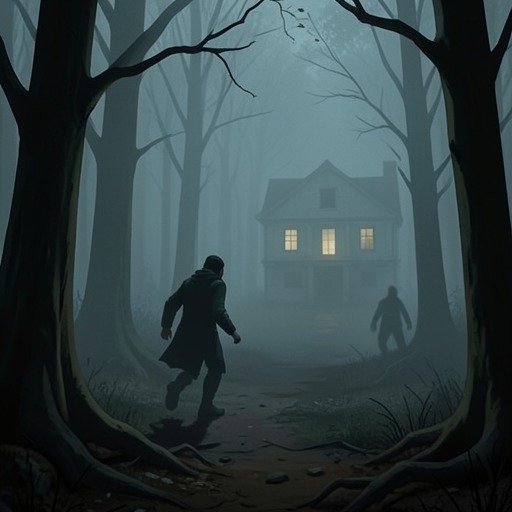
'Salem's Lot: A NovelThe Marsten House's accumulated evil is the idea that evil does not necessarily end when an evil act is finished. In Ben Mears’s theory, human beings manufacture evil as naturally as they produce bodily waste, but the result does not simply disappear; the Marsten House has absorbed and stored it, becoming an “evil dry-cell,” a malign battery whose charge continues to affect the living. The concept gives the supernatural history of Jerusalem’s Lot a physical architecture: the house is not merely a haunted setting but a repository in which violence, secrecy, and occult corruption remain active.
Origin in the Marsten History
The theory grows out of Ben Mears’s childhood encounter with the Marsten House and his research into Hubert Marsten. As a boy, Ben entered the house on a dare as an initiation into a club. Before leaving, he went upstairs to the bedroom where Hubert Marsten had hanged himself and saw the dead man open his eyes. The experience remained psychologically active for twenty-four years, and Ben returned to the Lot partly to write it out of his system. His book is therefore connected to a place that is both remembered trauma and an object of investigation.
The house’s history is made more disturbing by the old town gossip surrounding Hubert Marsten and Birdie Marsten. The older residents will discuss Hubert’s death and the murder, but discussion of the decade the couple spent in the house is guarded by what Matthew Burke describes as an almost tribal secrecy. Whispers claim that Hubert kidnapped and sacrificed small children to infernal gods. The precise truth of every rumor is not established in these conversations, but the silence itself matters: the house has become the sealed container of a communal secret, protected by the people who remember it and feared by those who do not.
The House as a Storage Battery
Matthew Burke identifies Ben’s theory as an old parapsychological notion: human beings manufacture evil, and evil remains after its perpetration. In this formulation, the Marsten House is a “malign storage battery.” Its accumulated charge explains why the house can exert influence beyond the historical acts committed there. It does not function as an ordinary building whose significance ended with Hubert Marsten’s death; it is a structure in which past acts continue to press upon the present.
The theory also creates a contrast between Ben and Susan Norton. Ben’s interpretation joins psychological experience, historical research, and supernatural possibility. Susan initially rejects it, insisting that houses are only houses and that evil dies with the perpetration of evil acts. That disagreement is not merely philosophical. It establishes two competing accounts of the house: one treats evil as a completed human act, while the other treats it as a residue capable of accumulating, surviving, and acting through space.
The ordinary geography of the Lot reinforces this concentration. Brock Street and Jointner Avenue cross at right angles through a nearly circular township, and the wooded northwest quadrant rises toward the last hills where the Marsten House stands. The house is therefore placed above the town, apart from its daily circulation yet visibly connected to it. Its elevation and wooded seclusion make it a natural beacon for what the town prefers to keep outside ordinary view.
Fear Made Physical
When Susan Norton approaches the house with Mark Petrie, the theory becomes an embodied experience rather than an abstract explanation. She first sees the house through thinning branches in broad daylight, with no visible attacker or immediate external cause, yet an oppressive fear rises from a part of the mind usually kept silent. The fear defeats the rational expectation that the building is simply undergoing slow renovation. Broken shutters, uncut grass, and apparent neglect can be explained conventionally, but the explanation does not remove the pressure emanating from the place.
Susan’s attempt to reduce fear to an equation—an unknown becomes a creaking board, and a creaking board becomes nothing dangerous—fails at the Marsten House. The fear is larger than comprehension and nearly paralyzing; moving forward becomes an act of courage because the mind cannot translate the danger into ordinary terms. The house thus exposes the limits of rational demystification. Its accumulated evil is effective precisely because it cannot be reduced to a single visible stimulus.
Crossing the threshold intensifies that effect. Susan finds a smell that seems to seep from the walls. She considers plaster rot, damp guano, and animals nesting behind broken lath, but those explanations are inadequate; the odor feels deeper, associated with tears, vomit, and blackness. After Susan pulls Mark through the window, the two listen to a dead silence without even the faint hum ordinarily heard in complete stillness. They know they are not alone before any figure appears. The house’s stored evil is presented as an atmosphere, a pressure, and a bodily certainty before it becomes an event.
Relation to the Lot’s Crisis
The Marsten House’s evil is not isolated from Jerusalem’s Lot. The town’s social structure is already organized by secrecy and observation: its many-party telephone lines ensure that people always have someone to talk about, while scandal simmers beneath the surface. The Bend produces much of that scandal, but people of higher status occasionally add to the same communal reservoir. This culture of gossip parallels the house’s storage function. The town preserves what it does not openly confront, and the house gives that principle its most concentrated and supernatural form.
The contrast between the town’s ordinary self-image and its buried darkness makes the house especially powerful. Jerusalem’s Lot receives national wars and political crises largely through television, and its residents assume that nothing truly terrible can happen in such a nice little town. The Marsten House contradicts that assumption. It stands above a community that mistakes familiarity for safety, holding a history the town has never fully processed until the supernatural danger begins to spread.
The same spatial pattern extends into the investigation. Susan and Mark enter the house through a window, move through its silence, and search for the source of the danger while the town beyond continues to possess streets, farms, trailers, stores, and familiar routines. The house converts those ordinary surroundings into the perimeter of a hidden crisis. Its evil is accumulated rather than sudden, but once activated it makes the familiar geography of the Lot feel like a network of vulnerable entrances.
Narrative and Gothic Significance
As a Gothic device, the Marsten House gives architecture the role normally assigned to a villain’s body or a supernatural object. Its broken shutters, neglected grounds, darkness, smell, and silence make history perceptible without fully explaining it. The building holds the suppressed past of Hubert and Birdie Marsten, Ben’s childhood terror, and the town’s guarded knowledge in one physical location. Fear and fascination coexist because the house is both a forbidden space and an apparent source of meaning.
The “evil dry-cell” also links private trauma to collective catastrophe. Ben’s childhood vision is not treated as an isolated nightmare; it becomes the first personal contact with a place whose buried violence is connected to the wider vampire emergency. Susan’s fear and Mark’s instinctive alarm confirm that the house communicates its danger beyond Ben’s memory. Even before they discover what occupies it, the building’s atmosphere tells them that ordinary categories are failing.
The theory’s decisive implication is that evil can become environmental. It can be stored in walls, preserved by silence, and transmitted through the social and physical spaces of a town. The Marsten House consequently functions as more than a haunted residence: it is a supernatural model of historical recurrence. What the community refuses to name remains active, and what appears to be an abandoned house becomes the charged center from which the Lot’s hidden darkness can return.