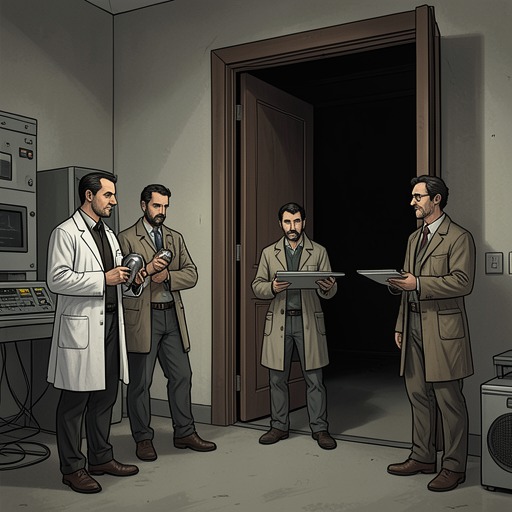
The discovery and investigation of Mike Ryerson’s corpse
'Salem's Lot: A NovelThe discovery and investigation of Mike Ryerson’s corpse turns a private disturbance into a public mystery. Matt Burke’s terror begins when Mike Ryerson’s sleeping voice answers the door with “Yes. Come in.” After hours of paralysis, Matt summons Ben Mears, and the two men inspect the body with Parkins Gillespie and James Cody, whose police and medical procedures can establish death but cannot explain the corpse’s disturbing signs. The episode therefore marks a decisive shift: Mike Ryerson’s death becomes evidence, while the investigators’ attempts to classify it simultaneously reveal how badly ordinary institutions are prepared for what is happening in Jerusalem’s Lot.
Discovery in Matt Burke’s House
Matt Burke wakes to the sound of Mike Ryerson’s voice speaking from the silent house, though Mike is dead. The words are not merely an apparition at the threshold; they constitute an invitation, and Matt understands too late that something has been admitted. Without garlic, holy wafer, holy water, or crucifix immediately available, the nonpracticing Methodist is left with fear rather than a usable protection. The supernatural threat is thus attached to a familiar domestic action and to the vulnerability of the house itself.
The next stage is not heroic intervention but delayed witness. Matt cannot enter the guest room. He remains in his bedroom for nearly four hours, then creeps downstairs and telephones Ben Mears shortly before dawn. His breathing comes through the receiver in harsh bursts as he asks Ben to come at once and refuses to explain the matter over the telephone. The telephone, normally a means of maintaining the town’s social web, carries panic here instead of reassurance; it summons a second witness without making the first witness’s account any easier to believe.
Ben finds Matt shaken and proposes that they go upstairs together. The approaching daylight briefly seems to promise restoration of reason: Matt hopes Mike Ryerson is merely sleeping, and the scene appears less credible as morning enters the house. Yet that hope collapses when Matt identifies the body as Mike Ryerson, a town groundskeeper. A private bedroom has become the first scene of a death investigation, and Matt’s inability to cross the threshold makes the corpse’s legal status inseparable from the terror surrounding it.
Medical and Police Examination
Parkins Gillespie, the local constable, walks around the body and initially asks whether Mike is certainly dead and whether anyone tried to wake him. The question sounds routine, even brusque, but it also shows the limits of the available procedure: the body is treated as a possible ordinary death before it is treated as a sign of supernatural violence. James Cody, M.D., arrives after a delivery in Cumberland, bringing the authority of clinical examination into the room. Jimmy Cody examines the corpse with a stethoscope, checks an eyelid, and shines a light into the glassy eye.
The body does not behave quite as expected. The pupil contracts under the light, and the eyelid closes with grotesque slowness. Jimmy Cody supplies a medical explanation, citing a report that pupillary contraction can occur in cadavers for as long as nine hours. The explanation preserves a naturalistic account of death, but it cannot erase the unease produced by the movement. Mike Ryerson is officially a corpse while retaining a response that makes the observers feel watched by something not entirely absent.
Jimmy Cody then tests the body more directly. He taps the right knee with a small hammer, and the toes remain motionless, confirming death by an ordinary clinical sign. He also measures the temperature at quarter to seven, sliding a thermometer into the corpse while his watch lies on the crisp sheet in the sunlight. The precision of the examination contrasts with the scene’s irrational implications. Time, temperature, reflex, and movement can be recorded, but none of them explains why Mike Ryerson’s voice seemed to invite an unseen presence into Matt Burke’s house.
Concealment and Collective Unease
Matt Burke’s earlier reference to the Glick boy threatens to connect Mike Ryerson’s death with Danny Glick’s strange illness and death. Jimmy Cody immediately denies any connection and continues his examination, converting a frightening possibility into a matter that can be withheld from the constable. Ben Mears recognizes that the men are not simply reporting facts: they are managing what can be said, to whom, and under what authority.
After the examination, Ben and Matt give Parkins Gillespie an account that is not precisely false but leaves enough unsaid to bind them in a fragile conspiracy. Ben worries that he may be assisting either harmless eccentricity or something darker. The distinction matters because Matt’s fear is not dismissed entirely; Ben believes that Matt may be frightened, but not incapable of recognizing character. Matt’s call has therefore changed Ben’s position from skeptical visitor to implicated witness.
Parkins Gillespie’s response restores the event to public administration. Carl Foreman’s funeral wagon removes the body, and Parkins asks Ben to testify before the coroner’s jury. The death leaves Matt Burke’s house and becomes the town’s official business. Parkins also reports that he has checked Ben through the Federal Bureau of Investigation and the Maine State Police, showing how quickly the investigation folds personal testimony into systems of surveillance and credentialing. The clean record makes Ben acceptable as a witness, but it does not make his testimony more capable of explaining the corpse.
From Isolated Death to Pattern
The discovery does not remain an isolated medical puzzle. Matt tells Ben that there are other people in a similarly altered state, describing them as spaced out, as if descending from an acid trip or speed. He fears that the account sounds like a madman’s raving in daylight, and the ordinary world seems to weaken the credibility of everything witnessed during the night. Ben nevertheless concludes that something is happening and increasingly associates it with the Marsten House, whose occupants are, apart from Ben himself, the only new people in town.
The suspicion acquires institutional stakes when Jimmy Cody later considers whether an exhumation order could be obtained for Danny Glick. Susan Norton asks whether the Glicks’ permission is legally necessary; Cody answers that it is not technically necessary, but that resistance could force a hearing and delay the process by two weeks to a month. More troublingly, Danny Glick is the only corpse for which the investigators possess a marker. The others have disappeared into thin air. Mike Ryerson’s body is therefore unusual not because it yields a solution, but because it remains available for examination while the larger pattern is defined by missing bodies.
The legal timetable cannot keep pace with the emergency. James Cody’s medical reasoning, Parkins Gillespie’s coroner process, and the prospect of exhumation all assume that death can be documented, bodies retained, and evidence preserved. The disappearance of corpses defeats that assumption. The investigators must work inside procedures designed for ordinary crime and disease while confronting an enemy that erases the material record on which those procedures depend.
Narrative Significance
This event is the threshold between rumor and investigation. Before it, Mike Ryerson’s death can be treated as a disturbing personal matter; afterward, Ben Mears and Matt Burke begin to act as collaborators, and Ben plans to contact Susan Norton before visiting the Marsten House. The corpse makes suspicion concrete without making it safe. It supplies a body to look at, yet the body’s voice, reflex, and implied invitation point beyond what looking can establish.
The scene also sets the novel’s central epistemological conflict in institutional form. Police authority asks whether the man is dead, medicine measures reflex and temperature, and legal authority weighs permission, hearings, and delay. Against these mechanisms stands a reality in which invitation, blood, returning bodies, and disappearance matter more than standard categories. The investigation’s failure is not a failure of attention; the investigators observe carefully. It is a failure of available language and procedure to recognize the kind of death before them.
At the same time, the event makes secrecy part of resistance. Ben and Matt’s omissions protect a fragile line of inquiry, but they also isolate the truth from the town’s official structures. By the time Ben identifies the Marsten House as the likely center of the danger, Mike Ryerson’s corpse has already performed its most consequential function: it has transformed fear into a shared, if incomplete, conviction that Jerusalem’s Lot is undergoing a crisis ordinary explanations cannot contain.