The search for Ralphie Glick
'Salem's Lot: A NovelThe search for Ralphie Glick begins after he vanishes in the woods while his brother Danny is found alone, confused, and unable to explain what happened. It is both a practical rescue effort and an early test of Jerusalem’s Lot’s collective memory and institutions: the town mobilizes police, volunteers, waterways, and family hope, yet the landscape yields nothing. That blankness becomes decisive, because the disappearance later stands beside the town’s record of unexplained child disappearances and helps prepare the reader to see the Marsten House and its history as more than local legend.
Immediate Response and Local Authority
Parkins Gillespie initially judged that there was no point in sending men into the woods that night. The deadfalls made a nighttime search dangerous, and he proposed the ordinary explanation that Ralphie had simply wandered off the path. Instead, Parkins, Nolly Gardener, Tony Glick, and Henry Petrie searched the path itself and the shoulders of South Jointner and Brock streets, calling out through battery-powered bullhorns. Their method reflects the first official attempt to contain the crisis within familiar categories: a lost child, a hazardous wood lot, and a search that could be organized by roads and voices.
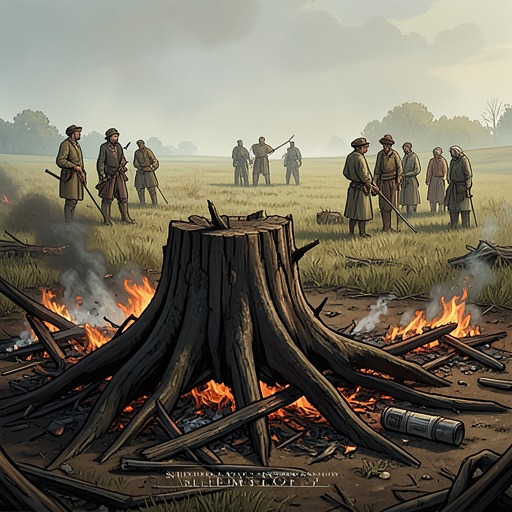
The response widened early the next morning when the Cumberland police and the state police began a coordinated search. Their presence transformed the incident from a family emergency into a formal public investigation, but the enlarged authority did not produce knowledge. The officers and searchers beat the bushes for four days, extending the effort through the woods and surrounding fields while the ancient fire’s deadfalls made movement difficult and visibility unreliable.
Volunteers, Family, and the Landscape
The Glick family’s participation gave the search its emotional center. Mr and Mrs Glick moved through the woods and fields, picking their way around the fallen timber and calling their son’s name with what the narrative presents as endless, wrenching hope. Their repeated calls turn the landscape into an answering absence: every path, field, and obstruction becomes a possible place of discovery, yet none supplies even a body or a usable clue.
The search eventually moved beyond the ground. Taggart Stream and the Royal River were dragged after the woodland search produced no result, extending the investigation into the town’s watercourses. Nothing was found there either. The progression from path to road, from brush to field, and finally from forest to stream and river gives the effort a widening physical scope while emphasizing its failure. Ralphie is not merely missing from one location; he seems to have disappeared from the ordinary geography by which the town understands itself.
Ben Mears was among the Jerusalem’s Lot volunteers who beat the bushes. The effort brought him no discovery, only pants cuffs full of cockleburs and an aggravated case of hay fever caused by late-summer goldenrod. On the third day, he returned to Eva Miller’s boardinghouse intending to eat canned ravioli and sleep before writing. In the kitchen, Susan Norton was preparing a hamburger casserole while the men who had just come home from work sat around the table, pretending to talk and watching her. When Susan asked whether there had been any luck, Ben answered that there had been none. His battered cigarettes and the smell of Old Woodsman’s on him make the search concrete as labor rather than symbolic concern: he has physically entered the town’s brush and come back carrying its irritants, fatigue, and unanswered question.
Failure and the Growth of Mystery
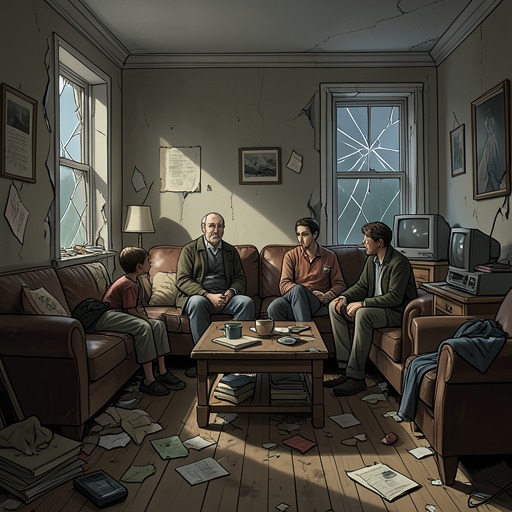
The search’s central result is not recovery but the disappearance of evidence. No one found Ralphie in the wood lot, on the roads, in the fields, in Taggart Stream, or in the Royal River. That failure leaves Danny as the only immediate witness, yet Danny cannot remember falling over anything. He recalls only darkness and then lying alone on the path; Ralphie is gone. His inability to supply a coherent account prevents the adults from converting the event into a simple accident or a conventional abduction.
The town’s later history makes the search retrospectively more ominous. Matthew Burke’s research into old copies of the Ledger from 1928 to 1939 uncovers four children who disappeared during those years. Such incidents might be explained individually as accidents in a rural area, but none of those children was ever found—not by hunters, contractors, or anyone uncovering remains later. Ralphie’s disappearance therefore enters an existing pattern of children erased without physical explanation. The search does not reveal that pattern at the time, but its failure supplies the first modern instance through which the pattern becomes emotionally and narratively active.
Jerusalem’s Lot is a place where old horrors are passed ceremonially from generation to generation. The scandal and violence associated with the Marsten House occurred before the living characters were born, yet the town retains them as a communal skeleton. The unsuccessful search belongs to the same culture of partial knowledge. Residents know fragments, repeat practical explanations, and preserve rumors, but crucial facts remain inaccessible. The town’s secrets are kept not only by deliberate silence but by missing bodies, damaged memories, and stories that never reach proof.
Retrospective Significance
The disappearance also acquires a deeper historical resonance through the recovered diary of Robert Boone. That document records events from June 1 to October 27, 1789, four days before the cataclysmic disappearance associated with the older Jerusalem’s Lot mystery. Its revelations connect the town’s early Puritan settlement, familial bloodlines, the desecrated church, and a dangerous book. Although this history belongs to another period and another layer of the narrative, it establishes that collective disappearance is a recurring form in the town’s past rather than an isolated modern anomaly.
The search for Ralphie Glick thus occupies a threshold between public procedure and supernatural implication. Its participants behave as rescuers, police officers, parents, and volunteers; their tools are bullhorns, roads, boots, bushes, streams, and riverbanks. Yet the more completely they examine the available spaces, the less adequate ordinary explanations become. The search demonstrates the town’s capacity for collective action while exposing its inability to see the force operating within familiar places.
Its consequences extend beyond Ralphie’s immediate absence. Danny’s later encounter with Mark Petrie makes the missing child return in a transformed and openly monstrous form: Mark sees Danny at the window with grave-pale skin, reddish feral eyes, dark matter around his lips and chin, and teeth grown hideously long and sharp. The earlier search had sought a lost boy; the later sight confirms that the search was directed toward the wrong kind of disappearance. The failure to find Ralphie is therefore not an empty interval in the plot but the first evidence that Jerusalem’s Lot’s geography, history, and communal memory are already being reorganized by the undead.