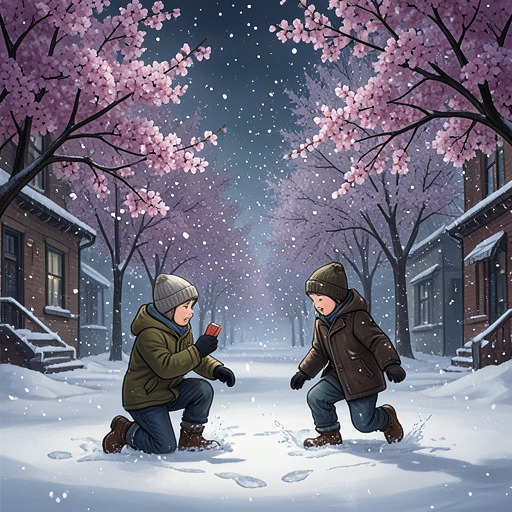
“Look, it’s almost like snow”
5 Centimeters per Second“Look, it’s almost like snow” is Akari Shinohara’s comparison of drifting cherry blossoms to snowfall, a small phrase that gathers meaning as it returns across her relationship with Takaki Tohno. First offered on a spring walk, it is initially met with his incomprehension; years later, beneath a cherry tree in falling snow, he answers in agreement. The image links two encounters without erasing the distance between them, making the phrase both a shared recognition and a measure of what time has changed.
First Image: Blossoms in Spring
The phrase first belongs to a walk home from school, when Takaki and Akari have just started sixth grade. They pass a small forest with their backpacks as cherry trees bloom overhead. Petals drift onto the asphalt until the road appears white, while a pale-blue sky and birdsong shape a quiet scene despite the nearby highway and Odakyu Line. Akari looks at the falling petals and says, “Look, it’s almost like snow.” The comparison arises from the visible transformation around them: spring blossoms cover the ground in a way that recalls winter snow.
Takaki does not share her perception then. To him, cherry blossoms are simply cherry blossoms, and snow belongs to winter. His response, “Huh? Really? I dunno…”, is uncertain rather than hostile; he cannot yet see what Akari sees. She turns toward him from a couple of steps ahead, says “Hmm. Well, never mind,” and runs on. His recollection preserves both the scene and the slight gap within it: Akari is physically ahead, and her image has reached him before its meaning does. The phrase therefore begins not as a mutual declaration but as an intimate difference in attention.
A Memory That Changes on Return
The line acquires another meaning when Takaki and Akari meet again in the snow. Akari takes him to the cherry tree she had written about in an earlier letter. A ten-minute walk from the station brings them into open farmland, without houses or artificial light; snowlight is just enough to make the landscape faintly visible. The isolated tree stands beside a footpath between rice paddies, its branches interlaced above them. Snow falls through those branches, making the scene reverse the first image: this time it is actually winter, and the tree is not covered in blossoms.
Akari repeats, “Look, it’s almost like snow.” Now Takaki answers, “Yeah, it is,” and feels that he has seen her smiling beneath a cherry tree in full bloom. His response marks a change in perception: he can now meet her comparison rather than dismiss it as an impossible confusion between seasons. But the recognition is also inseparable from remembered experience. The winter scene brings the spring image back to him, so the phrase sounds like a bridge between their encounters even as it reminds him that those encounters are separated by time.
That night, beneath the tree, they share their first kiss. Takaki experiences the moment as if it disclosed where eternity, hearts, and souls reside, and believes that the two of them have shared everything of the thirteen years they have lived. Yet the sadness immediately afterward is almost unbearable. The phrase’s return thus accompanies closeness without promising permanence: the beauty of recognition and the pain of what follows occupy the same memory.
The Phrase Reversed in a Dream
A later dream gives the image a further turn. As Akari anticipates Takaki’s departure after he has told her he will transfer schools, she feels again the anxiety and loneliness of losing his reassuring presence beside her. In that state, she wishes that the snow were a flurry of cherry blossoms, that spring had arrived, and that they could have come through winter together and continued walking home in the same town beneath the blossoms.
Her thought reverses the original comparison. In the childhood scene, blossoms resemble snow; in the dream, Akari wishes snow could become blossoms. The seasons no longer describe only what she sees. They give shape to a desire for a different outcome: not to face the separation already approaching, but to share the spring that would follow winter. The reversal preserves the phrase’s tenderness while making its longing explicit. What had once been a passing observation now carries the wish that their lives might remain joined.
Repetition, Recognition, and Distance
The phrase works through recurrence rather than explanation. Its first appearance is a child’s fresh description of petals on a road; its return under the tree is spoken by Akari and understood by Takaki; its later echo is transformed into a dream wish. Each instance changes the relation between the seasons and between the two speakers. The words remain nearly the same, but Takaki’s ability to recognize their image and Akari’s wish to exchange snow for blossoms give them different emotional weight.
The motif also holds together a contrast the story does not resolve. The cherry tree can call back a shared spring, and the falling snow can briefly make that memory present, but neither image can undo their separation. Takaki’s remembered agreement arrives alongside the sadness after their kiss; Akari’s dream imagines the spring they did not get to share. The phrase is therefore not simply a symbol of their closeness. It is a particular remembered way of seeing, once offered by Akari and eventually recognized by Takaki, that makes their closeness vivid precisely because it cannot make time stand still.