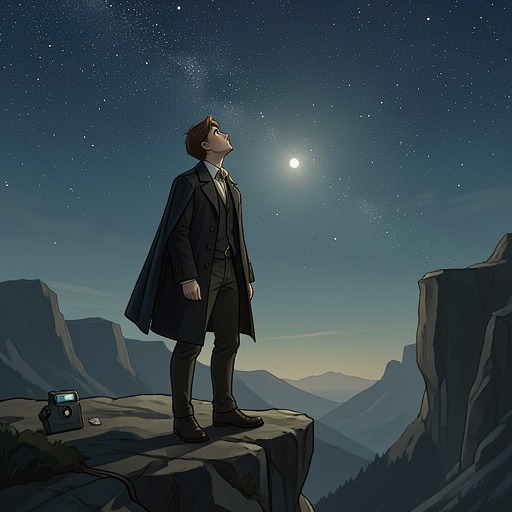
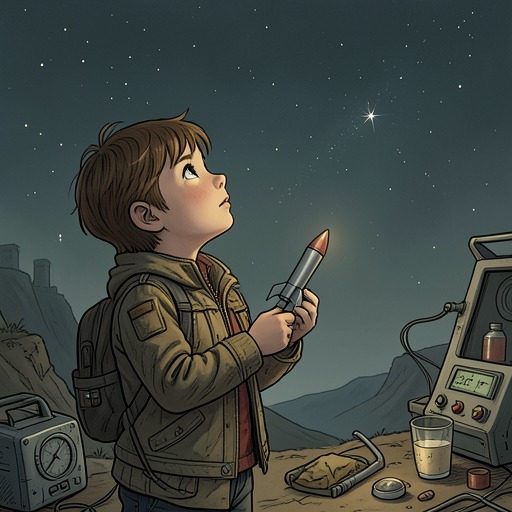
“People who die become stars, and they watch over us”
5 Centimeters per Second“People who die become stars, and they watch over us” is a consoling explanation of death offered in a conversation with Shin about the surface sky. Its force comes from the way it joins a child’s wonder at the stars to the speaker’s awareness of his own approaching death: what begins as talk about something beautiful in a distant sky becomes a hope for one last sight of it.
The expression and its setting
The words appear within a conversation shaped by a longing for the surface. The speaker tells Shin that people there say that, when night comes, stars can be seen in the sky. Shin asks what stars are, and the explanation follows: “People who die become stars, and they watch over us.” The sentence gives the stars two meanings at once. They are visible lights in the sky, but they are also imagined as the dead, still present in the lives of those left behind.
The idea is presented as something people on the surface say, rather than as an established account of how death works. That framing matters: the exchange preserves the tenderness of a belief without turning it into an impersonal rule. For Shin, the claim immediately becomes personal. He asks whether his father and mother are stars too, and the speaker answers, “Of course. You can see them shining in the sky.” The reassurance applies the image to Shin’s own parents, making the thought of the dead watching over the living intimate rather than abstract.
A comfort shaped by loss
The conversation sits beside the account of a brother whose illness as a child had made death a familiar presence. His brother later suffers from another illness, inherited from his teacher when he was young, and it eventually proves fatal. Against that history, the statement about the stars is not merely a fanciful description of the night sky. It offers a way to picture the dead as remaining near, even when death has separated them from the living.
Shin’s question about his parents shows what the reassurance is being asked to hold: not death in general, but the absence of particular people. The answer does not deny that they have died or explain away the loss. Instead, it gives their absence a new image, locating them in the sky where they can still be seen and can still watch over him. The comfort is simple enough for a child to grasp, yet the surrounding circumstances give it a gravity that the sentence alone might not carry.
From the stars to a final wish
The exchange turns from the imagined dead to the speaker’s own future. After Shin responds that the stars must be beautiful, the conversation gives way to silence. The speaker then expresses the wish, “Just once, before I die, just one time…” followed by the clear desire, “I want to see a sky filled with stars.” The hesitation and repetition make the wish feel limited and urgent: he is not asking for a life without death, but for a single experience before it comes.
That progression gives the expression its particular poignancy. The stars first provide an answer to Shin’s question about his dead parents; then they become something the speaker, facing his own mortality, longs to see for himself. A comforting idea about the dead thus also points toward a living person’s remaining desire. The promise that the stars watch over the bereaved offers consolation, while the wish to look at them exposes how much the speaker still wants from the world.
Narrative significance
The expression binds the scene’s two forms of longing: the longing for the surface and the longing to remain connected to people who have died. The surface is not described here through a detailed landscape; it is evoked through the night sky and the possibility of seeing stars. That distant image becomes emotionally immediate through Shin’s parents, then painfully personal through the speaker’s wish to see the sky before his life ends.
The sentence therefore works as both reassurance and foreshadowing. Its assurance imagines continuity beyond death, but the speaker’s request for one chance to see the stars keeps attention on the brevity of life. The scene does not resolve that tension. It lets the same image hold comfort for Shin and a finite, urgent hope for the speaker: the dead may watch from above, but he wants, while he still can, to look up.