Agartha’s day-night cycle
5 Centimeters per SecondAgartha’s day-night cycle is one of the underground world’s most striking and consequential mysteries: night and day pass even though Ryuuji Morisaki observes that the sky has neither sun nor stars. The cycle goes unexplained, but it is not merely a curiosity. Asuna Watase encounters its changing light as both a puzzle about Agartha and a condition that determines when the Izoku emerge and when they flee.
An Underground Sky Without Sun or Stars
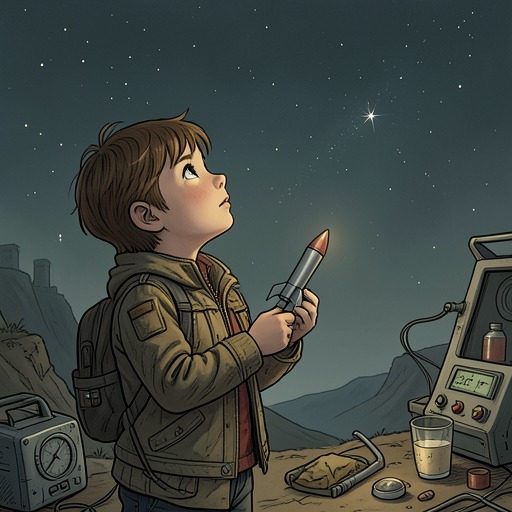
While traveling with Ryuuji Morisaki, Asuna looks up and asks, “We’re underground, so why are there days and nights?” Morisaki considers the question with her, pointing out that explaining the alternation would first require explaining why the underground world has a sky at all. As he sees it, there is no ordinary sun or stars overhead. The exchange establishes the cycle as a feature of Agartha that cannot be accounted for by the celestial markers familiar on the surface.
Asuna recognizes the contradiction and turns it over in earnest: if the sky lacks a sun and stars, why does the world still have night and day? The question is not answered. Morisaki offers that ships for the gods fly overhead, a remark delivered with unusual humor rather than as a developed explanation. Asuna is not wholly satisfied, but she and Morisaki let the matter rest. The cycle remains part of their surroundings without becoming a solved mystery.
Time Passing in Agartha
The cycle nevertheless gives Asuna and Morisaki a recognizable measure of elapsed time. After their conversation, about a week passes quickly before Asuna makes a discovery. The narrative does not explain whether Agartha’s days match the length or rhythm of surface days, or how its apparent daylight and darkness are produced. What it does establish is that day and night succeed one another in a way that makes the passage of a week intelligible to the travelers.
That ordinary-seeming succession sits beside the strangeness of the setting. The underground sky has the familiar division of daylight and darkness without the visible sun and stars that would make the division seem natural. Morisaki’s passing joke leaves the gap between appearance and explanation intact. The cycle is therefore both a practical feature of life in Agartha and a small but persistent reminder that its world does not follow the surface’s apparent rules.
Darkness and the Izoku
The distinction between day and night becomes urgent after Asuna is left alone. As the sun sets, she sits still, overwhelmed by helplessness; the gun Morisaki left lies at her feet. Darkness falls while she remains there, and only then does she notice the Izoku beginning to poke their heads out of the ground. She grabs the gun and runs, managing to reach the light before the sun has completely set. In this sequence, nightfall marks a change in immediate danger: the Izoku emerge from below as darkness arrives, forcing Asuna to move toward safety.
The danger continues into the confrontation with the Izoku. Asuna coughs and chokes while Shin guards her and holds the creatures at bay. Then Shin notices the coming dawn and says, “Dawn’s breaking.” Sunlight spills over from the eastern sky; when it strikes the Izoku, it appears to burn them, and they frantically slip back into the ground. The encounter ends with only Shin and Asuna remaining. The light’s return does not explain the origin of Agartha’s day-night cycle, but it establishes a direct consequence of the transition: dawn drives the Izoku underground and ends their immediate attack.
Narrative Significance
The cycle links an unanswered cosmological question to concrete stakes. Asuna and Morisaki can wonder how day and night exist beneath a sky without sun or stars, but the later scenes show that the alternation has consequences whether or not anyone understands it. Sunset coincides with the Izoku’s emergence; dawn brings sunlight that burns them and sends them back below. The rhythm of light and darkness thus becomes a condition of survival rather than merely a feature of Agartha’s landscape.
The sequence also sets the mystery of the world against the clarity of Asuna and Shin’s immediate predicament. No explanation arrives for the sky, the missing celestial bodies, or the source of dawn. Yet the change from night to light is legible in its effects: the Izoku retreat, and the two survivors are left alone. Agartha’s cycle remains unexplained at the level of cause while still structuring time, danger, and relief within the story.