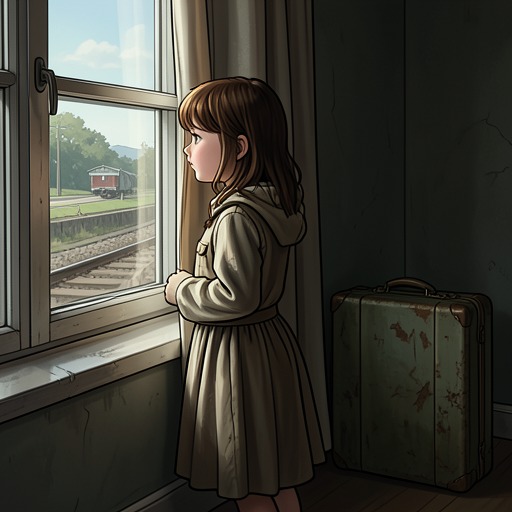
Akari rediscovers and puts away her old letter to Takaki
5 Centimeters per SecondAkari rediscovers and puts away her old letter to Takaki during the practical upheaval of preparing to move. The letter, written for a boy she loved when she was thirteen and never given to him, has survived for fifteen years among keepsakes from childhood. Finding it brings an unfinished piece of her past into the present, but Akari does not force herself to finish reading it: she returns it to its envelope and saves it for a time when she is older.
Discovery Among the Packing
As she organizes her belongings for the move, Akari opens a cardboard box that has been tucked deep in the back of her closet. Its lid is sealed with tape labeled as old stuff, a reminder that the box itself belongs to an earlier act of sorting. Curiosity leads her to open it, and its contents make the past tangible: a yearbook, school-trip guidebooks, elementary-school magazines, cassette tapes whose contents she does not know, a faded red school backpack, and the leather bag she used in middle school.
Akari examines these objects one by one. Their accumulation prompts the sense that the letter might be in the box, though she does not find it among the first things she lifts out. At the bottom is an empty cookie tin, and its appearance restores a specific memory: on the night of her middle-school graduation, she put the letter away inside it. She had carried the letter in her bag for a long time without being able to take it out. Putting it in the tin had been an attempt, at the end of middle school, to shake free of its hold and set it aside.
The discovery therefore comes in stages rather than as a single revelation. The box recalls a broad span of school years; the tin identifies the particular act by which Akari once tried to close off one attachment. Inside, the letter is shut between the pages of a thin notebook she treasured in middle school. It is not merely an old message among old possessions: Akari recognizes it as the first love letter she ever wrote.
The Letter’s Earlier Moment
The letter had been intended for Takaki Tohno, the boy Akari liked fifteen years earlier, and she had planned to give it to him on their first date. The remembered occasion was shaped by distance and delay. Akari had just turned thirteen and lived three hours by train from him; Takaki was traveling by several trains to see her. Heavy snow delayed the trains, and he arrived four hours late.
While she waited in the little wooden station building, sitting in front of its stove, Akari wrote the letter. The circumstances make the object inseparable from the wait that produced it: it was composed during an extended absence, before the anticipated meeting, and with the possibility of giving it to Takaki still ahead. The letter preserved an intention, not a completed exchange. Its presence among Akari’s belongings records what she had prepared to say while leaving intact the fact that she never gave it to him.
The contrast between the first date she had imagined and the later discovery is central to the action. As a girl, Akari carried the letter around but could not bring herself to take it out; at graduation she put it away in the tin. Fifteen years later, she finds it while preparing for another move. The past returns not through a message from Takaki, but through a small object she had stored herself.
Reading and Putting It Away
That night, Akari gently opens the envelope. The stationery inside looks brand-new, as though it had been written on only the day before, while her handwriting has changed little. These details connect the preserved page to the girl who wrote it without making the intervening years disappear: the paper appears untouched by time, and the handwriting offers a visible continuity with its author.
Akari reads only a little. She then carefully puts the letter back into its envelope rather than continuing to the end. She thinks she will read it again someday, when she is older, and judges that it is still too early. The decision is not to discard the letter or to pretend it has no meaning; she puts it away for safekeeping. The episode ends with the message preserved and its full reading deferred.
Memory, Distance, and Deferral
The action joins two acts of storage. As a thirteen-year-old, Akari put the letter in a cookie tin after carrying it in her bag for a long time; as an adult, she returns it to its envelope after opening it again. In both moments, keeping the letter and postponing engagement with it occur together. The object survives precisely because it was set aside, and its survival makes a later encounter possible without requiring Akari to resolve everything the letter represents at once.
Its physical condition sharpens the passage’s treatment of time. The stationery seems new, and Akari’s handwriting remains much as it was, although the letter has waited fifteen years in the belongings of her younger self. The scene does not turn this continuity into a completed reunion or claim that the old feeling has been restored. Instead, Akari encounters evidence of what she once intended, reads only part of it, and recognizes that she is not yet ready to continue.
The move supplies the immediate occasion for looking through the box, while the letter reaches further back, to the snowy wait at the station and the first date for which it was meant. Its path from bag to tin, notebook, box, and envelope gives the memory a concrete history. Akari’s final choice leaves the past neither erased nor fully reopened: she keeps the letter, and leaves its words for a future reading.