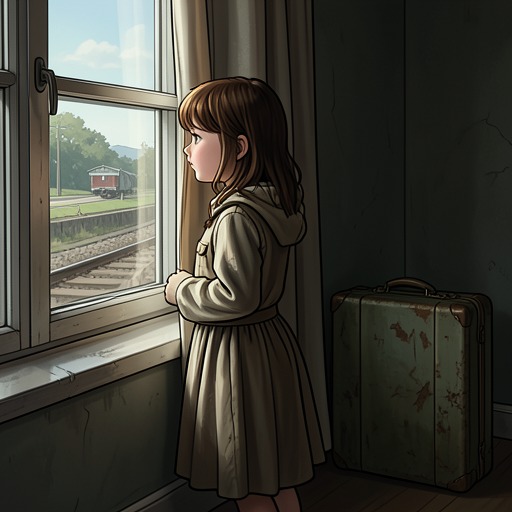
Akari’s Letter to Takaki
5 Centimeters per SecondAkari’s Letter to Takaki is the first love letter Akari Shinohara wrote to Takaki Tohno, a confession composed while she waited for him through a heavy-snow delay on the day of their first date. She never gave it to him: after they shared their first kiss, the letter seemed unable to contain what the moment had become. Fifteen years later, finding it again brings the old love and loneliness vividly back, while her decision to put it away once more leaves its words preserved but still unspoken.
Recovery and Material History
The letter returns to the story while Akari is sorting her belongings in preparation for a move. She finds it in a cardboard box at the back of a closet, among keepsakes from elementary and middle school: a yearbook, school-trip guidebooks, children’s magazines, cassette tapes, a faded red school backpack, and the leather bag she used in middle school. These things make the search a passage through stored memory rather than a deliberate attempt to recover the letter. As she handles the old objects, she has a sense that it may be somewhere among them.
At the bottom of the box, an empty cookie tin prompts the specific memory she had lost: on the night of her middle school graduation ceremony, she put the letter inside it. She had carried the letter in her bag for a long time without managing to take it out. Putting it away on graduation night was, in her recollection, a way of shaking free of it. The tin therefore marks two different acts of containment: first, the decision to remove the letter from her everyday possession, and, years later, the hiding place that allows her to encounter it again.
Inside the tin, the letter is shut between the pages of a thin notebook she had treasured in middle school. Its preservation is intimate and ordinary: a written page tucked into a keepsake, then enclosed in a box of childhood belongings. The discovery does not make the past feel safely distant. Holding the letter brings back the unease and loneliness of the wait, along with a love whose intensity surprises Akari precisely because fifteen years have passed.
The Snowbound First Date
The letter began during a long wait at a small wooden station building. Akari had just turned thirteen, and she lived three hours by train from the boy she liked. Takaki was travelling by several trains to meet her, but the heavy snow delayed the trains; he arrived four hours late. While waiting in front of the station stove, Akari wrote to him. The circumstances of the letter are therefore built into its form: she writes to the person who is expected but not yet present, with the lateness of the trains making the interval longer than she had anticipated.
The remembered delay links distance to both affection and uncertainty. The journey between them was already three hours by train; snow and disrupted schedules extended the separation on the very day they were meant to meet. Akari’s letter gives that interval a voice. Its opening addresses Takaki, asks how he is, and refers to their promise and the late trains before explaining that she is writing while she waits. The page records not a later account of the meeting, but words composed within the wait itself.
Akari remembers the day as both lonely and intensely vivid. She had wanted to see Takaki, and, holding the letter years later, she feels that desire rise again with an immediacy that makes the passage of fifteen years difficult to believe. Her recollection also identifies the event that kept the letter from being delivered: she and Takaki shared their first kiss on that date. For Akari, the kiss divided the world into a before and an after. Unable to give the letter once the day had crossed that threshold, she kept it instead.
What the Letter Says
The surviving text makes explicit what Akari had been unable to say aloud. She tells Takaki that she loves him, without locating the beginning of that feeling, and recalls him as a strong, kind boy who had always protected her from the first time they met. The letter does more than preserve a confession: it records her understanding of their history and the qualities she associates with him. Its direct address keeps the words attached to the particular person for whom she wrote them.
The letter also turns from the present wait toward Takaki’s future. Akari assures him that he will be all right and grow into a kind and wonderful adult, whatever happens. She says that she will always love him, no matter how far away he goes, and asks him to remember that. Her promise places affection and distance in the same passage: separation is imagined as possible, but it does not cancel the love she declares. The reassurance is especially striking beside the letter’s circumstances, since she writes it while waiting for him to cross the distance between them.
The text preserves the difference between a written confession and a spoken one. Akari wanted to tell Takaki aloud that day, but wrote the words in case she could not manage to say them. The letter thus holds both an intention and a contingency: she hopes to speak, yet prepares a page to carry what her voice might fail to deliver. The first kiss then changes the meaning of the occasion without bringing the written confession into use. Its words survive as the record of what she meant to say, not as evidence that she gave them to him.
Rediscovery and Significance
That night, after finding the letter, Akari opens its envelope gently. The stationery looks brand-new, as if she had written on it only the day before, and she notices that her handwriting has changed little. These details bring the preserved page into contact with the present: it remains materially legible, while the person who wrote it has lived through the fifteen years separating the two encounters. The letter’s appearance does not erase that interval; it makes the difference between the old moment and the current one visible through the persistence of the paper and handwriting.
Akari reads only a little before returning the stationery carefully to its envelope. She thinks she will read it again someday, when she is older, and feels it is still too early. She decides to keep it safely until then. The rediscovery therefore ends not in delivery or a full retrospective reading, but in another deliberate act of preservation. The letter has come back into her hands, yet she again withholds it from the present by putting it away.
As an object, the letter joins several layers of time: the thirteen-year-old waiting at the station, the middle-school student who stored it on graduation night, and the older Akari who finds it while preparing to move. Its contents make a youthful love and a promise of enduring affection concrete, while its history shows the limits of what Akari could express at the time. The page matters both for what it says and for the fact that it remained unsent. Rediscovered, it does not resolve the distance between the people addressed and the person writing; it reveals how carefully Akari has carried the words, first in her bag, then in a tin, and finally back into memory.