Distance and separation
5 Centimeters per SecondDistance and separation shape the story as both measurable geography and an intimate uncertainty: people can be near enough to meet yet unable to share a future, or far apart while remaining central to one another’s memories. The motif connects Takaki Tohno and Akari Shinohara’s childhood bond to later longing, unreturned love, adult estrangement, and the changing meanings of home. Travel routes, letters, a shared sky, and even the rooms people inhabit give physical form to what cannot be settled by distance alone.
Distance Begins as a Shared World
In retrospect, Takaki understands that he and Akari traded fragments of knowledge so intensely because each sensed a separation approaching. They were drawn to one another and wanted to remain together, yet feared that this wish might not come true. Having already experienced a school transfer, they tried to make themselves ready for the possible loss of the person who felt like their precious counterpart. Their closeness was therefore never entirely secure: even inside the little world they had built together, the prospect of distance was already present.
They imagined that a new middle-school life would widen that world and bring them closer to other people. Instead, they attended different schools. For a time, the separation was still traversable: when Takaki lived in Tokyo and Akari was in northern Kanto, he later reckoned that the journey between their towns took about three hours with several train changes. They might have visited on weekends. That possibility changed when Takaki learned his family would move during spring break to an island off the coast of Kyushu, about a two-hour flight from Haneda Airport. The move made the distance feel less like an inconvenience than the end of any likely meeting.
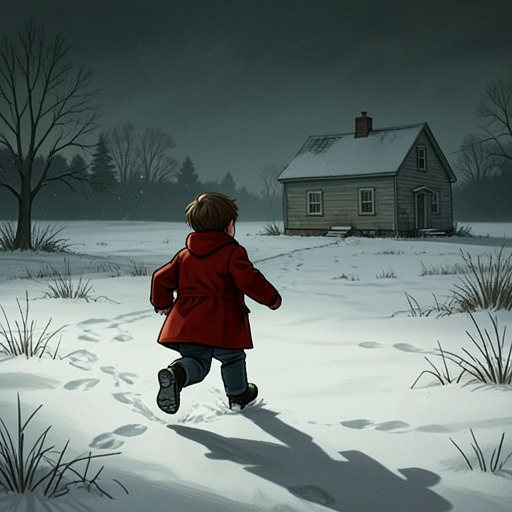
Takaki asked to see Akari before leaving. Their plans show how much effort the meeting required: he had to skip club activities, travel after class, change trains repeatedly, and return on the last train. The round trip would cost about 3,500 yen, a substantial amount for a middle-school student, but seeing her mattered more to him than the expense. On the journey, snow delays made the planned connection increasingly uncertain. With no ubiquitous cell phones for children and no home number for Akari, he could not tell her he was running late. As the train crawled onward, repeatedly checking his watch became a bodily ordeal: time advanced while the distance seemed not to, and the air felt like a tightening cage. Geography turned into helplessness because he could neither reach Akari nor communicate what was happening.
Reunion, Intimacy, and the Future
The meeting culminates in a first kiss beneath a cherry tree, but closeness does not cancel separation. In the instant their lips touch, Takaki feels he understands where eternity, hearts, and souls reside; at the same time, the sadness of the next moment is almost unbearable. He believes that he and Akari have shared everything of their thirteen years, yet cannot imagine what to do with the preciousness now between them. He knows they will not remain together forever, and the awareness of vast time ahead presses into the tenderness of the kiss. The unease eventually gives way to its warmth, but the scene holds both experiences at once: intimacy is real, and so is the distance that follows it.
Years later, distance reappears in a different form in Kanae Sumida’s love for Takaki. She has loved him for five years, but has only the final six months before high-school graduation to spend near him. After they watch a rocket rise and its smoke dissolve, they remain together in silence as evening settles. Kanae recognizes that they are looking at the same sky but seeing different things: Takaki is kind and walks beside her, yet his attention seems fixed beyond her. She believes she cannot give him what he wants and that they cannot be together. The rocket’s shared spectacle does not create shared understanding. On the way home, the full moon and the power lines mark a before and after in Kanae’s world; alone in her room, she finally lets herself cry without restraint. What had been an unspoken crush becomes a painful knowledge of emotional distance.
Places That Keep Their History
The story also measures separation through migration and the changing feeling of belonging. Takaki’s childhood move from Nagano to Tokyo once left him anxious at the sight of buildings streaming past between Omiya and Shinjuku. Five years later, he remembers that he survived the change and credits Akari with helping him; he hopes he did the same for her. The memory makes their bond more than a feeling attached to a single meeting: it becomes part of how each child endured an unfamiliar place.
Akari’s experience of Iwafune likewise changes over time. When she first arrived there from Tokyo with her mother, the tiny platform seemed desolate, and she felt so homesick that she nearly cried. She had lived in several places, including Utsunomiya, Shizuoka, and Tokyo, and could not at first imagine Iwafune as home. Later, after years there, the town and her parents have become dear to her; leaving it is difficult. The same station that once embodied unwanted distance has become a place she hates to leave. Home, in this account, is not simply a point on a map: attachment accumulates through living, memory, and relationships.
Takaki’s later return to Tokyo makes the contrast sharper. He moves there willingly for university after graduating from high school on Tanegashima, but the city feels unfamiliar and indifferent, unlike the calmer place he remembers from childhood. He adapts to its crowds and streets, spends time studying, working, watching films alone, and wandering, and forms some friendships. Yet adult life does not make belonging automatic. After three years with Risa Mizuno, the relationship ends without a last straw or a single decisive event; their roads have gradually diverged. The prospect of walking alone again leaves Takaki weary, and the breakup opens onto the loneliness he had previously recognized through the relationship. Distance can therefore emerge inside sustained proximity, as a slow loss of shared direction rather than a journey apart.
Separation as Memory and Residue
Places retain emotional traces after the people associated with them have left. Takaki thinks that sadness collects wherever someone lives, as fine dust gathers unnoticed in a room. His apartment gives that thought concrete form: a remaining toothbrush, white sheets he had hung out for someone else, and the call history on his phone. The objects are modest, but each makes an absent relationship legible. Separation is not confined to the moment someone departs; it continues as residue in ordinary surroundings.
The final railway-crossing encounter gathers the motif into a brief, suspended possibility. A woman and Takaki pass each other in the center of the crossing while the alarm sounds. As they walk in opposite directions, he believes that if he turns around, she will turn too, though he has no reason to be certain. He looks back slowly; she turns as well, and their eyes meet. The moment gives mutual recognition a physical shape without establishing what follows. An Odakyu Line express train then hides them from each other, interrupting the sight before the uncertainty can resolve. Across the story, distance is repeatedly made visible by routes, stations, weather, horizons, and barriers; emotionally, it appears in what people cannot say, cannot give, or cannot know about one another. The crossing offers a fleeting answer to separation, but the passing train leaves the larger question open.