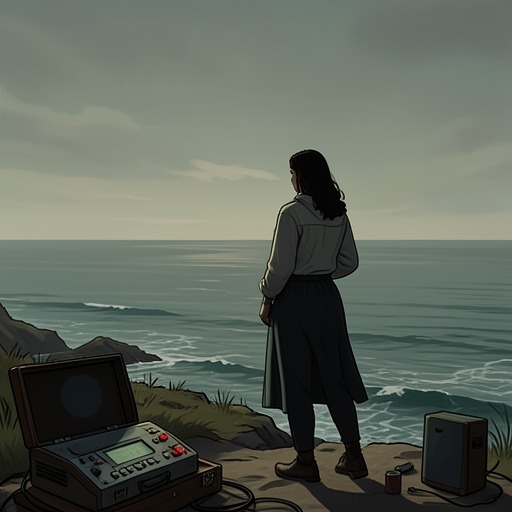
Kanae Sumida’s Unrequited Love for Takaki Tohno
5 Centimeters per SecondKanae Sumida’s unrequited love for Takaki Tohno governs her experience of her last six months of high school on Tanegashima. Her feelings grow through years of ordinary closeness and repeated hope, then reach a painful clarity when she cannot confess and realizes that they are looking at the same sky but seeing different things. The rocket launch they witness together does not bring them closer; it marks the moment she understands the limits of their relationship, without ending her love for him.
Identity and the Long Attachment
Kanae has loved Takaki for five years by the time she recognizes that only six months remain before their high-school graduation. The duration matters to her: her affection is not a sudden response to a single romantic gesture, but a feeling that has persisted and intensified through daily life. Although they are in different classes, they attend the same island high school. Kanae regards that coincidence as a kind of miracle, even while acknowledging that Tanegashima offers few schools and Takaki’s grades might have allowed him to choose elsewhere.
Her attraction begins when Takaki, newly arrived from a major city, speaks calmly and fluently in a sophisticated standard accent. Kanae imagines how self-conscious she herself would feel in his place, then wonders about the life and character behind his school uniform. She describes falling in love at that first encounter as if it were destiny. In the years that follow, he seems to stand between her and the rest of the world: at school, after class, and even while she walks her dog on the beach, she searches for him out of the corner of her eye.
Takaki’s apparent aloofness gives way to a cheerful, friendly manner, and he makes friends quickly. Because he is at ease with both boys and girls, Kanae finds opportunities to speak with him. Their familiarity is real but not equivalent to romantic intimacy. She wants to become special to him, his one and only, yet cannot imagine what dating him would be like; even being in love already feels like more than she can manage. Seeing him makes her like him more, a response she experiences as frightening and painful as well as joyful.
Daily Proximity and the Decision to Confess
The relationship takes shape through small routines that intensify Kanae’s attachment without changing its status. She manages to walk home with Takaki about once a week when lucky, or once every two weeks otherwise. They sometimes detour to I-Shop, a small convenience store that closes at nine and sells local produce as well as snacks. Takaki always buys a carton of Daily Coffee. Kanae, by contrast, hesitates over what to choose, weighing whether another drink might make her seem more attractive to him. Even an ordinary purchase becomes a private calculation about how she appears in his eyes.
Her thoughts repeatedly circle back to Takaki, and she knows she cannot afford to remain caught in indecision forever. She makes a plan: once she catches a wave, she will tell him that she likes him. Surfing thus becomes more than a test of skill; Kanae ties it to the moment when she will act on a feeling she has carried for years. After surfing, she returns to school and waits in the shadow of the building near the motorbike parking lot, hoping Takaki has not already gone home. She recognizes that hiding and waiting might look unsettling, but stays a little longer all the same.
When the opportunity to speak arrives, she cannot make herself say anything. Takaki’s voice is quiet and kind, but his face is not smiling, and his eyes hold a powerful determination. Kanae experiences his expression as a firm rejection of the confession before she can utter it. The scene’s decisive action is therefore an absence: she has prepared herself to speak, but the words never come. The cicadas continue across the island as the two make their way home in the fading light, while the unspoken confession remains between them.
The Rocket Launch and Recognition
The launch that Kanae and Takaki watch together gives form to what she has not been able to say. As the rocket disappears into the clouds, they remain silent, watching its enormous column of smoke dissolve into the wind. The sounds of birds, insects, and wind gradually return; the sun sets, the sky deepens, and stars begin to appear. In that stillness Kanae understands that although they look at the same sky, they are seeing different things. Takaki is kind and walks beside her, but she feels that his attention is fixed on something beyond her, somewhere far away.
Kanae’s realization is severe: she believes she will never be able to give Takaki what he wants and that they could never be together. The full moon and the power lines crossing it become, in her reading, an image of the divide between before and after: before she rode the wave and afterward, before she understood what was in Takaki’s heart and afterward. She sees the launch not as a shared romantic culmination but as the boundary between two versions of her world. The night does not resolve her feelings; it changes what she knows about them.
Alone in her darkened room, Kanae curls up on her futon as moonlight pools on the floor. She stops holding back and cries aloud, with tears and sobs replacing the restraint that marked her failed attempt to confess. Yet her grief does not cancel her attachment. She knows she will still love Takaki the next day and after that, and falls asleep thinking of him. The contrast between her certainty that they cannot be together and her certainty that she will continue loving him defines the state: acceptance of rejection does not immediately become emotional release.
Separation and Takaki’s Later Memory
A decade later, Takaki remembers seeing his first rocket launch at seventeen with a girl in a school uniform. He identifies her as Kanae Sumida, a lively, cute girl deeply tanned from surfing. His recollection confirms the lasting significance of the launch and of her presence beside him, while also showing the asymmetry that defined their relationship: what became a decisive emotional threshold for Kanae survives in Takaki as a memory of a girl who had become attached to him.
Takaki recalls that the intervening years softened the sharpness of his emotions, but thinking of Kanae still hurts a little. Her height, the scent of her sweat, her voice, smile, and tearful face return alongside the colors, sounds, and smells of the island. He remembers understanding why she was drawn to him, recognizing the moment she tried to confess, and knowing why he did not let her say it. Even with that clarity, he had been unable to act. His memory does not undo the rejection or suggest that they later became a couple; it preserves both his awareness of her feelings and his inability to respond to them.
When Takaki left Tanegashima for university in Tokyo, he gave his departure time to only one person: Kanae. On a bright, windy day in March, they exchanged a few final words in the small airport parking lot, a place Takaki thought resembled a ferry terminal. Their conversation repeatedly faltered, and Kanae cried throughout it, but she smiled when they said goodbye. Looking back, Takaki recognizes that she was already much stronger and more mature than he was. Their farewell gives the unrequited love a final shape: Kanae had not received the relationship she wanted, but she met their separation with a composure that Takaki himself could only appreciate later.