Kanae’s First Successful Surf
5 Centimeters per SecondKanae Sumida’s first successful surf is a brief, hard-won breakthrough: after repeated attempts and a fall into the wave, she paddles out again until she finally rides one. The achievement matters not because the sea becomes easy to master, but because Kanae discovers she can keep returning to it—and, for one perfect moment, stand within its movement.
The Approach
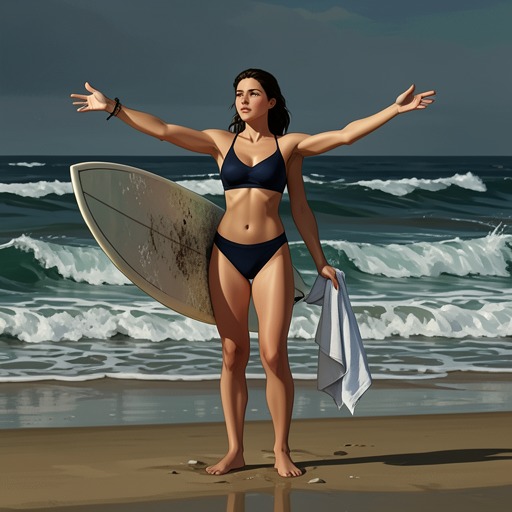
Kanae enters the water with Takaki Tohno’s example in mind: doing whatever is possible, one step at a time. As she paddles farther out and repeatedly duck-dives beneath the waves, the sky and sea appear the same blue. Her sense of the boundary between herself and the water begins to blur; reading the oncoming waves becomes almost automatic, a practiced exchange between her body, her board, and the conditions around her.
She does not challenge every wave. When one seems beyond her ability, Kanae ducks underwater with her board and lets it pass overhead. When a wave looks promising, she turns around and waits. The effort is patient and responsive rather than a straight advance toward mastery: the ocean sets the rhythm, and Kanae learns when to yield and when to try.
The First Ride
At last, a wave lifts the board. Anticipation runs through Kanae as she turns and begins to slide along its face. She raises her upper body, plants her feet, and lifts her center of gravity, trying to stand. Her eye level rises with her; for an instant, the change gives her a glimpse of the world from a new position, as if its hidden brightness has briefly become visible.
The moment does not last. The wave swallows her, an abrupt end that is no surprise after all her earlier attempts. But the fall does not settle the meaning of the scene. Kanae already understands that the enormous world is not rejecting her. Seen from the distance of her sister’s perspective, she is already part of the shining ocean, even when she is submerged.
Returning to the Water
Kanae paddles back out again, repeating the attempt until she is no longer thinking about it. The decisive change is therefore not a clean passage from failure to effortless success. She first accepts that falling is part of the encounter, then continues without treating it as a verdict on whether she belongs in the water.
That morning, she rides a wave. The success arrives so abruptly that it scarcely feels real, yet the ride is so perfect that there is nothing to complain about. Against the repeated paddling, duck-diving, waiting, and falling, its brevity gives the achievement its force: it is a single completed moment rather than proof that every future wave will be conquered.
What the Moment Means
Kanae thinks that although seventeen years may not be very many, every one of them has existed for this moment. The thought enlarges the ride without making it a permanent triumph. Her years of life seem to converge in the instant she stands on the board, while the ocean remains vast and capable of swallowing her again.
The scene’s resolution rests on that tension. Kanae succeeds, but the success does not erase the falls or put the sea under her control. Instead, she experiences herself as part of a world that had seemed immense: she can be carried by it, overwhelmed by it, and still return. Her first ride is both a physical milestone and a shift in how she understands her place in the ocean.