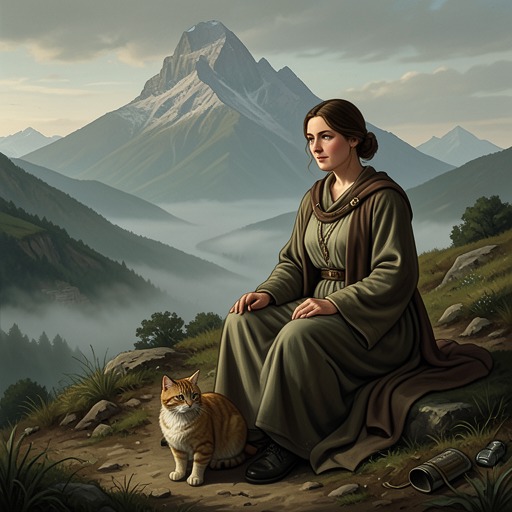
Mimi returns to Quetzal Coatl
5 Centimeters per SecondMimi’s return to the Quetzal Coatl is a farewell that Asuna cannot make on Mimi’s behalf: the cat stays in Agartha, and after her death an ancient Quetzal Coatl takes her body away. The event sets the elder’s account of death as incorporation into a larger life beside the grief of those left behind, without making that explanation sufficient for them.
Departure and refusal
Asuna is already climbing into the boat when she turns back and calls Mimi to come with her. The hesitation is costly: she wants more time for good-byes, but knows that asking for it might make leaving impossible. She can therefore appreciate Ryuuji Morisaki’s apparently heartless urgency, while recognizing that he may be lonely too. His insistence helps her move toward departure; it cannot make the parting mutual.
Mimi is sitting on Manna’s head. She answers Asuna with a meow but does not budge. Asuna’s reaction makes the separation more than a practical choice about who travels: she protests that she and Mimi have always been together, and wails the cat’s name. The narrative briefly insists on the difference between the hope that Mimi might be a god and the fact that she is a cat. That distinction does not diminish the bond. Mimi’s refusal to leave, and Asuna’s inability to persuade her, establish the boundary that the rest of the event must confront: Asuna can depart, but she cannot carry Mimi away from the life she has chosen to remain with.
Ryuuji Morisaki again intervenes when Asuna cannot let go. He quietly tells her that they will have to accept the situation, then asks the elder to take care of her. His words redirect the departure toward care for the people staying behind, especially Manna, without claiming that Asuna’s grief has been resolved. Mimi is still present, perched on Manna, when Asuna calls; later, it is Manna who lays Mimi’s body on a stone pedestal. The sequence gives the separation a continuing human consequence rather than treating it as a clean leave-taking.
Manna’s grief and the Quetzal Coatl
After Mimi’s death, Shin wakes to sobbing in the house. He is well enough to get out of bed and find the source: Manna, whom the elder is looking after. The elder tells her that Mimi’s role in this world has ended and her journey to the next has come. He urges her to weep freely for Mimi, and adds that she may grieve for the other young woman too. The words recognize grief rather than asking Manna to conceal it; they also place Mimi’s death within a larger account of departure and passage.
Once Manna has stopped crying, the elder takes her and Shin to a plain outside the village. The landscape stretches around a solitary stone pedestal. Manna runs to it and gently lays Mimi’s body there. The elder says that the expected presence should arrive soon. The pause matters: the scene does not move directly from loss to explanation, but leaves Manna’s careful act of placing Mimi at the center of the farewell.
A Quetzal Coatl approaches slowly from the horizon. It is several times larger than a human, flesh-colored, and marked with geometric patterns characteristic of its kind. Shin recognizes it as ancient, but it pays him no heed. At the pedestal, it takes Mimi’s corpse into its hands and puts her into its mouth. The action is unsettling in its plainness: Mimi is not restored to Asuna or Manna, and the creature offers no response to Shin. The elder instead describes what has happened as life becoming part of something greater. In the scene’s terms, Mimi’s body passes out of the mourners’ keeping and into the Quetzal Coatl’s custody.
Grief, resurrection, and the meaning of return
Shin immediately tests the elder’s explanation against Asuna’s loss. He asks whether she will be able to see Mimi’s fate in that way, pointing out that Mimi meant a great deal to her. The question preserves the distance between a belief that can frame death and the experience of losing someone particular. The elder’s account may give the act a place in a larger order; it does not demonstrate that Asuna can accept that order, or make her grief smaller. Shin’s concern is notable in itself: the narrative observes that an ordinary Agarthan would not have said such a thing.
The episode sits beside a wider conflict over resurrection. When Ryuuji Morisaki asks Nami about the price of bringing someone back, she explains that the cost varies with the time, situation, and individual. He hesitates before asking whether that is why Eve is absent. Nami confirms it: Eve was the price of her resurrection, a life exchanged for a life. This revelation sharpens the contrast with Mimi’s fate. The Quetzal Coatl’s taking of her body is presented as a passage into something greater, while resurrection is shown to demand another life and leave the returned person bereaved. Neither account gives the living a simple way to undo loss.
Later, after the attempt to resurrect Lisa, Ryuuji Morisaki begs Shin to kill him. Shin refuses, saying that his brother spoke to him and told him to embrace loss and keep living. As Morisaki’s tears fall on Asuna’s cheeks, she slowly opens her eyes and hugs him. This later moment does not erase Mimi’s absence or establish that Asuna has adopted the elder’s explanation. Instead, it carries forward the event’s central tension: love persists after death, but honoring that bond does not necessarily mean reversing death. Mimi’s return to the Quetzal Coatl marks one form of passage; the survivors’ task is to go on living amid what cannot be brought back.