Nishi-Shinjuku
5 Centimeters per SecondNishi-Shinjuku is both a visible part of the city and a repeated destination in the unnamed man’s daily route, marking the distance between work, home, and the life he imagines beyond routine. Its skyscrapers first appear across the city from his apartment, then draw nearer through train windows and rise around him on foot. Their changing appearance gives the district a shifting emotional force: at times it seems to point toward something distant and beautiful; later, its dark buildings resemble the remains of a vanished world.
Setting and Distant Views
After graduation, the man returns to an empty apartment with his possessions already boxed. From the kitchen’s south-facing window, gaps between mixed-use buildings open onto the skyscrapers of Shinjuku, small in the distance and more than two hundred meters tall. Their appearance changes with the hour and the weather. Morning light can make them shine like mountain peaks, while rain blurs them into shapes resembling a wharf in a rough sea. The view is not a fixed urban backdrop: over four years, he has seen it through a range of emotions.
That evening, as darkness falls, city lights appear to push it back. Sitting cross-legged on the tatami, he lights a cigarette beside the boxes and watches the lights through the thick atmosphere. The scene places his imminent departure from the apartment against a city that remains vivid and illuminated. His thought that this is where he will live makes the view feel less like a picture of a settled home than an attempt to claim a future in the city.
A Chosen Route Toward the Skyscrapers
After graduation, the man moves to a small one-room condominium in Nakano-Sakaue and begins working for a company in Mitaka. Though rent would have been cheaper nearer the office, he resists living close to work. He wants instead to draw nearer to the distant skyline he had seen from his former apartment in Ikebukuro. The choice gives Nishi-Shinjuku a practical as well as a visual place in his life: it becomes the direction toward which his home and daily journey are oriented.
His regular trip home runs from Mitaka Station on the Chuo Line to Shinjuku Station, followed by a walk to Nakano-Sakaue. He sometimes takes a taxi when exhausted, but usually walks the roughly thirty minutes. On the train, after passing Ogikubo, he watches the Nishi-Shinjuku skyscrapers emerge beyond the buildings outside the window. They slip in and out of sight, then grow into imposing forms as the train approaches. The sequence turns distance into something measured through motion: the skyline is at first small and interrupted, then bold and close.
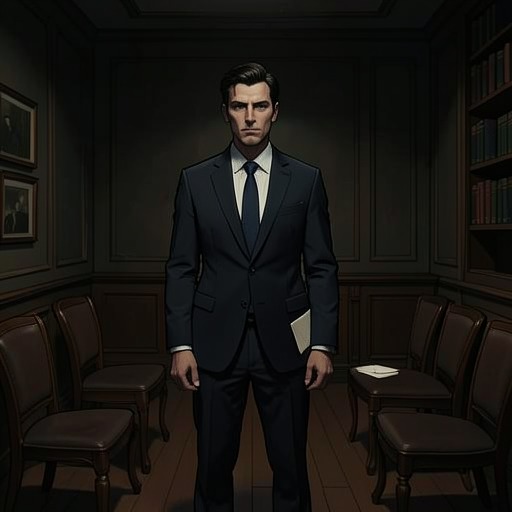
At night, the buildings stand in silhouette against a sky that remains oddly bright. Yellow-lit windows reveal people still at work, while red aircraft warning lamps blink steadily above them. For the suited commuter, these details produce a feeling that he is still bound for something distant and beautiful. The sensation briefly unsettles the inner stillness of an otherwise repetitive routine; morning brings him back to the office, its coffee machine, timecard, computer, and programming work.
Night Walks and the City’s Changing Aspect
The commute’s repetition eventually acquires a more estranged quality. On the nearly empty late-night train, with its faint smell of alcohol and fatigue, the man looks toward the approaching skyscraper lights and imagines himself from high above. The train becomes a thin line of light crawling across the planet toward buildings that seem like gravestones. When he gets off at Shinjuku Station, he looks back at his seat, unable to shake the impression that his exhausted, suit-clad body might still be there. The journey has brought him home physically, but his own sense of presence seems to lag behind it.
In December, after a project lasting nearly two years ends, he feels little beyond a further increment of fatigue. He works briefly, prepares to leave his job, and still takes the last train home. It is Friday night and Christmas when he reaches Shinjuku Station. Faced with a line at the West Gate taxi stand, he gives up on a cab, walks through the underground passage toward Nishi-Shinjuku, and emerges among the skyscrapers. The route is familiar; the occasion is not. His phone vibrates as he walks close to the buildings’ foundations, and the message is from Risa Mizuno. The passage through the district thus coincides with a renewed personal contact, though the message’s contents are not disclosed here.
The Final Journey and Narrative Significance
On the man’s last trip home, the train windows are clouded with condensation, and the skyscraper lights blur outside. He feels neither liberated nor urgently driven to find another job; instead, he is unsure what to think. Leaving the train, he follows the same underground corridor and emerges once more in Nishi-Shinjuku. This time the cold night air defeats both his coat and muffler, while most of the skyscrapers’ lights are out. Their enormous forms look like ancient creatures destroyed long ago.
He walks slowly through the valleys between the buildings and thinks of himself as a selfish idiot. The district’s imagery has shifted decisively since the bright, distant skyline that once made his commute feel directed toward possibility. The same towers that drew him forward now loom as dark, monumental hulks around a moment of self-reproach. Nishi-Shinjuku does not change its geography, but its recurring place in his routes allows the narrative to register a change in his relation to the future: the city remains immense, while the promise he once felt on the way toward it has dimmed.