Omiya
5 Centimeters per SecondOmiya is a major railway interchange in the novel and, for Takaki Tohno, a place where the pressures of travel converge with the memory of migration. On his winter journey to meet Akari Shinohara, he changes trains there amid delays and crowds; the sight of its railway landscape also recalls his earlier arrival in Tokyo from Nagano. Omiya thus marks more than a point on a route: it joins the immediate fear of failing to reach someone with the older experience of learning to live in an unfamiliar place.
A transfer point on the journey to Iwafune
Takaki’s planned route makes Omiya one link in a carefully timed chain. He intends to leave Gotokuji Station at 3:54, travel by the Odakyu Line to Shinjuku, transfer to the Saikyo Line for Omiya, and continue on the Utsunomiya Line to Oyama. From there, the Ryomo Line is to take him to Iwafune Station at 6:45, in time to meet Akari at seven. He has never made such a long train journey alone, but trusts the schedule he has copied into a memo and tells himself the trip will be manageable.
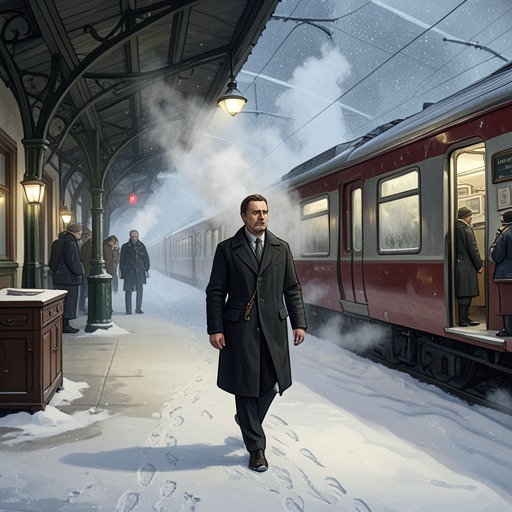
The route begins to unsettle that confidence before he reaches Omiya. At Musashi-Urawa, the train pauses for a rapid service, and an announcement directs passengers bound for Omiya to transfer across the platform. Takaki joins the people moving over. Between elevated tracks and falling snow, the low western sun appears through breaks in the clouds; pale light catches hundreds of roofs. The view is unfamiliar at first, then suddenly recognizable.
Omiya itself is smaller than Shinjuku but still an enormous terminal. Takaki leaves the Saikyo Line, climbs a long stairway, and crosses through crowds to the Utsunomiya Line platform. Commuters returning from work or study fill the platform, gathering in long lines where the train doors will stop. Takaki waits apart from them, expecting not to get a seat. Inside the station, the smell of snow feels especially strong, while the crowd’s shoes are wet with melting snow. The busy interchange makes his private journey feel exposed: he is surrounded by people moving homeward, yet must continue alone toward a meeting whose success depends on the connections ahead.
The delay and its consequences
At Omiya, the schedule begins to fail. An announcement says that snow has put the Utsunomiya Line train for Oyama and Utsunomiya about eight minutes behind. Takaki checks his memo and watch: the train he meant to board was scheduled for 5:04, and it is already 5:10. Two minutes later, the train arrives, but the delay is only the beginning. The older, crowded carriage, with its four-person box seats, takes him away from the dense city and into a landscape of snow-covered fields, scattered house lights, and power-line towers stretching toward a distant mountain.
The journey to Oyama, which would ordinarily take an hour, grows much longer as the train crawls between stations and waits for delayed services. Repeated announcements promise only further waiting. With no way to contact Akari—cell phones are not yet commonplace among middle-school students, and Takaki does not know her home number—he can only watch the time pass. The planned arrival at Iwafune becomes impossible. After a further fifteen-minute wait at Nogi, he finally reaches Oyama after 7:40 and runs to the Ryomo Line platform. The memo that had organized the trip has lost its purpose; he crumples it and throws it away.
Omiya is therefore a hinge in the journey, not its endpoint. The transfer there initially keeps the meeting within reach, but the snow and ensuing delays turn each later connection into another source of uncertainty. The station’s crowded, functioning order contrasts with Takaki’s diminishing control over time: he can follow the route, board the trains, and watch the clock, but none of those actions can guarantee that he will arrive when Akari is waiting.
A childhood landscape remembered
The view near Omiya awakens a memory from just before Takaki began third grade, when he moved with his parents from Nagano to Tokyo. He had taken a train from Omiya to Shinjuku. The buildings streaming past the window differed so sharply from the familiar rural scenery of Nagano that he was overwhelmed by anxiety. Thinking that he would have to live amid buildings stretching in every direction frightened him so much that he nearly cried.
Now thirteen, Takaki recognizes that the route is not new after all. Five years have passed since that first journey, and he has managed to endure life in Tokyo. The thought does not erase what the move cost him; he regards it as a plain fact rather than a triumphant transformation. In his recollection, Akari is central to that survival: he thinks that she saved him and fervently hopes he has done the same for her. The memory gives the present journey an emotional history. He is not merely crossing a region on the way to a meeting; he is passing again through the landscape of an earlier displacement, now carrying a bond that helped make his new life bearable.
Migration, recognition, and narrative significance
Omiya’s significance comes partly from how the novel makes one route serve different moments in Takaki’s life. During his childhood move, the train journey between Omiya and Shinjuku represents a feared separation from the known world of Nagano. On the winter trip, the same stretch becomes familiar enough to trigger recognition, while the onward journey toward Iwafune exposes him to fresh uncertainty. The landscape has not simply changed from strange to known: the older memory returns inside the present, allowing Takaki to measure both the years he has crossed and the vulnerability that remains.
The station also belongs to a wider pattern of movement between places. Takaki later recalls that Tokyo, where he had lived from eight to thirteen, was the only part of the city he really knew when he returned there for university after growing up on Tanegashima. Even the city he had once feared could become familiar, then become unfamiliar again when approached from a different life. Omiya’s role in that history is concrete—the railway departure point on the journey from Nagano to Shinjuku—and its narrative force arises from the return of that memory during another consequential trip.
By placing the remembered move inside the delayed journey, the novel turns a transfer station into a meeting point between past and present. Omiya brings together a child’s near-tears at the prospect of a new home and a thirteen-year-old’s determination to reach Akari despite worsening delays. In both passages, railway travel makes distance tangible: it measures the separation between places, while the memory of who helped Takaki endure that separation gives the journey its emotional weight.