Quetzal Coatls
5 Centimeters per SecondQuetzal Coatls are the ancient beings that once guided humanity and later withdrew underground, leaving gatekeepers to guard the way to Agartha. Their presence connects the world’s earliest gods to its strange living creatures and to the journey’s opening song; at the end of a Quetzal Coatl’s life, memory itself becomes the means by which it remains in the world.
Identity and Origins
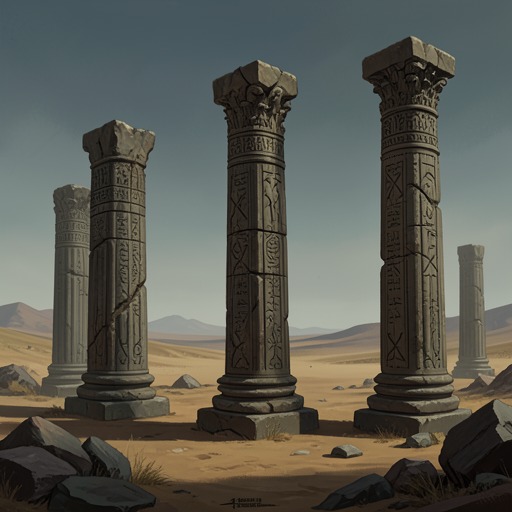
Morisaki identifies Quetzal Coatls for Asuna after she sees a photograph of the bearlike monster whose corpse she has encountered. He then shows her photographs of grotesque statues, explaining that they represent Sumerian gods from more than three thousand years ago. The statues’ resemblance to the creature makes a striking connection between ancient religious images and beings that still exist: in Morisaki’s account, the gods once found throughout the world were Quetzal Coatls.
Their story begins with a change in humanity’s relationship to them. As people outgrew their gods, the Quetzal Coatls recognized that their role had ended and went underground. They did not simply disappear: they left gatekeepers behind, and a few clans followed them below. The account thus links the creatures to both Agartha’s hidden world and a much older human past. Asuna hears the term clans but receives no further explanation, leaving that part of their history open.
Gatekeepers and Encounters
The Quetzal Coatls serve as guardians of the gates to Agartha. The explanation returns when Asuna encounters another creature: one sitting before a corridor, with upright horns longer and more twisting than those of any deer she knows. Its back bears the same sort of geometric patterns as the bearlike monster. Morisaki identifies it as probably a gatekeeper, a Quetzal Coatl, extending the earlier explanation from the photographed corpse to a living presence in Agartha.
Asuna’s responses to the two forms differ. The bearlike creature’s corpse had prompted her recognition in the photographs; the deerlike gatekeeper does not frighten her in the same way. She wonders whether its herbivore-like shape accounts for her relative ease, but cannot be sure. The contrast keeps the creatures from becoming a single, familiar monster-image: their shared markings and role connect them, while their forms and the reactions they provoke are not identical.
Yadoriko and the Continuity of Life
Morisaki’s account of Yadoriko reveals another connection between Quetzal Coatls and living beings. Yadoriko are animals in whom a child of a god has come to dwell. They are raised alongside humans, and when their role ends they become part of a Quetzal Coatl, living forever as part of it. This is not simply a story of a creature guarding a boundary; it describes a form of continuity in which an animal’s life is joined to a larger being.
The old man’s explanation also places the creatures within a world governed by rules about change and mixture. He describes the Izoku as a cursed race that abhors light and water, but also as one of the mechanisms seeking to keep the world as it is; for that reason, they hate admixtures. In the same conversation, he explains that Manna’s father is a Topsider, an unusual occurrence. The account distinguishes the Izoku from the Quetzal Coatls, but situates them within a shared pattern of beings and forces that preserve the existing order and react against mixture.
Death, Song, and Memory
Near the end of the story, Shin recognizes a Quetzal Coatl as the being that had made Mimi part of itself. He tells Asuna that it has probably come there to die. The creature then sings, and its song carries both sadness and joy. The scene gives the earlier explanation of Yadoriko’s incorporation a concrete, mortal counterpart: the creature that can contain another life is itself approaching the end of its own.
Before dying, a Quetzal Coatl pours its memories into a song and leaves them behind. The song changes shape and travels through everything, carried by vibrations in the air; it can become part of people without their realizing it. In this way the creature is remembered forever somewhere in the world, not because its body remains, but because its memories pass into other lives and places. Asuna recognizes the song as the one she heard before, the sound that began her journey. That return binds the story’s beginning to the creature’s death: what first called Asuna onward is revealed as memory already moving through the world, a legacy that can be received before its source is understood.