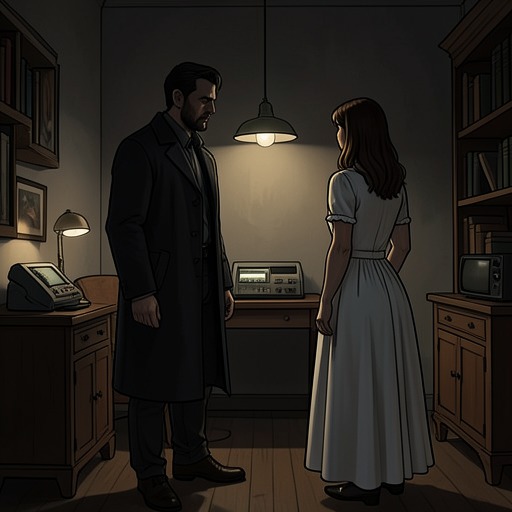
Resurrection of the dead
5 Centimeters per SecondResurrection of the dead is the wish that draws Ryuuji Morisaki toward Agartha and the limit that eventually forces him to confront the cost of trying to undo a loss. The possibility first appears as part of Agartha’s reputed power to grant wishes; there, it becomes a forbidden act governed by a principle larger than individual desire. The story then complicates that prohibition with the account of Nami, whose return from death was paid for by her lover, Eve. Morisaki’s attempt to recover Lisa brings these ideas together: resurrection is imaginable, but it cannot simply restore the past without demanding something in return.
The Wish and the Prohibition
The idea reaches Asuna Watase through Morisaki’s account of Agartha, the world below. He says that some humans went underground with the Quetzal Coatls, and that Agartha is believed to preserve the lost wisdom of the gods. Among the rumors about it is a place where any wish can be granted. Morisaki makes the most extreme possibility explicit: even the dead might be brought back. The prospect changes the meaning of his journey. Agartha is not merely a hidden world to discover; it may hold the answer to a loss he cannot accept.
That hope is set against a direct prohibition. When Asuna is reminded of the question she had nearly forgotten, she recalls that resurrection is forbidden in Agartha. The prohibition is explained not as a practical obstacle but as a matter of the order of life itself. While pouring tea, a man tells her that life and death belong to a much greater flow, one humans are not entitled to interrupt. He warns that doing so will bring happiness to no one. Asuna wonders whether this could nevertheless bring Shun back, revealing how easily an abstract rule becomes personal when the dead have a name. Morisaki does not retreat from his purpose.
An Exception and Its Price
The account of Nami complicates any simple understanding of the prohibition. She first explains that no one in Agartha has resurrected the dead, then identifies an exception: someone was brought back by her lover. Nami says that she herself died five years earlier and that her lover was Eve. Her living presence makes the subject more than rumor, while her history shows that a return from death is possible without making it a remedy freely available to others.
Nami explains that the god governing death does not spare people without a price. To do so would release humans from death and obstruct the greater flow of life. When Morisaki presses her to say what must be paid, she answers that the price differs according to the time, the situation, and the individual. His question about Eve’s absence brings the cost into focus: Nami confirms that Eve is not there, and says that Eve was the price for bringing her back, a life for a life.
For Asuna, this exchange makes the supposed miracle cruel rather than consoling. She compares it to O. Henry’s The Gift of the Magi, but distinguishes Nami and Eve’s outcome from the short story’s warmth: here, the exchange leaves Nami without the person for whom life mattered. The rule is therefore not merely a condition attached to a wish. It exposes the emotional contradiction at the heart of resurrection: a person may return, while the relationship that made that return meaningful is destroyed by its cost.
Morisaki’s Attempt to Restore Lisa
Morisaki’s pursuit of resurrection is rooted in his bond with Lisa. At the Gate of Life and Death, memories pass through his mind as he acknowledges that he once tried to get over her death but could not. He says that he can find no meaning in a world without her, then makes his wish with all the fervor he can muster: Lisa is to return to him. The clavis shines, and a glowing rift opens before the god. The scene turns his long-held desire into an actual appeal, but the opening does not amount to an uncomplicated restoration.
The god’s response focuses on what resurrection would require: a living vessel to house the soul. Morisaki repeats the condition, and an internal struggle begins. The request shifts the question from whether his love is strong enough to call Lisa back to what he would be willing to do to make such a return possible. The earlier account of Nami and Eve has already shown that resurrection exacts a cost; now the possibility of a living vessel makes the demand immediate for Morisaki. These moments establish the crisis without presenting resurrection as a simple reversal of death.
Loss, Survival, and the Meaning of the Rule
After the encounter, Morisaki asks Shin to kill him. Shin refuses and tells him that his brother spoke to him, urging him to embrace loss and continue living. The advice gives the story’s prohibition an emotional counterpart: rather than treating grief as a problem that resurrection can erase, it directs the living toward carrying loss forward. Asuna slowly opens her eyes as Morisaki’s tears fall on her cheeks, and she gently hugs him while Shin speaks behind her. The scene places comfort beside grief, not in place of it.
Resurrection thus serves as more than a supernatural possibility. It tests the difference between continuing a bond with the dead and attempting to cancel death itself. Morisaki’s memories and enduring attachment to Lisa remain real, but his inability to imagine meaning without her drives him toward a wish whose cost threatens to deepen the loss. Nami’s story makes that danger concrete through Eve’s absence; Shin’s appeal to embrace loss points toward another response. The rule does not make grief disappear or deny the force of love. It insists that the dead cannot be restored without consequence, and that the living must still face the world that remains.