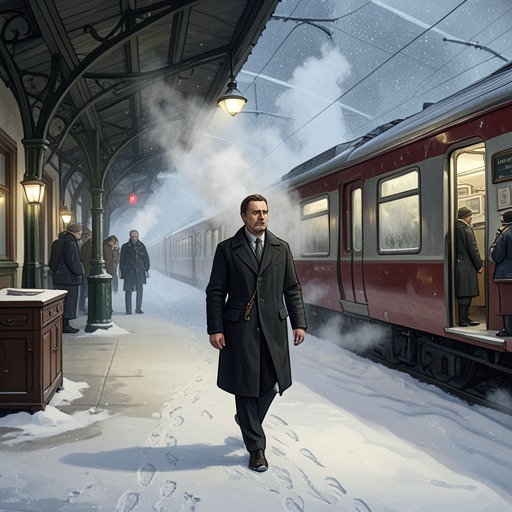
Shinjuku Station
5 Centimeters per SecondShinjuku Station is one of the recurring thresholds in Takaki Tohno’s life, changing from a confusing gateway into an unfamiliar city to the urban hub through which his adult routine passes. As a child, he associates the route there with the anxiety of relocation; at thirteen, he crosses the station alone on the way to meet Akari Shinohara; as an adult, he repeatedly arrives there late at night, carrying work fatigue and a growing sense of distance from other people.
A Gateway Remembered
Takaki first encountered Shinjuku Station on the journey from Omiya with his parents, after his family moved from Nagano to Tokyo because of his father’s job. The view between the two stations differed sharply from the mountainous scenery he knew. He feared the prospect of living amid buildings as far as he could see, and the unfamiliar landscape left him close to tears. Years later, when he travelled the same route again, he recognized the view and measured the distance he had come: he was still only thirteen, but had survived five years in Tokyo. He credited Akari with having saved him and hoped he had done the same for her.
That memory complicates the station’s role as a point of arrival. Shinjuku was not simply the gateway to a new home: the city beyond it initially represented dislocation, and the journey remained vivid enough to return to him when he passed through the area again. His later adult move back to Tokyo also carried this history. Although he had lived in Setagaya between the ages of eight and thirteen, he remembered little of the city beyond that district. After his teenage years on Tanegashima, Tokyo again felt like largely unknown territory. This time, however, he had chosen to live there, and he told himself that he was no longer a powerless child facing a move arranged by his parents.
The Snowbound Journey
At thirteen, Takaki passed through Shinjuku Station alone on his way to Iwafune Station, where he planned to meet Akari. His carefully prepared itinerary required him to leave Gotokuji Station at 3:54, change trains several times, and reach Iwafune at 6:45 for their seven o’clock meeting. He had never made such a long train journey alone. Shinjuku, which he had visited once before with a classmate, had made a stronger impression through its confusing scale than the movie they had gone to see.
This time, he moved through the station by reading signs and following directions. From the Odakyu Line gate, he crossed a vast hall crowded with pillars to reach the JR ticket machines. Their touchscreens briefly confused him because he expected buttons. Beyond the ticket gate, ranks of platform signs led him past the Yamanote, Sobu, and Chuo lines. He stopped to study a station map, found that the Saikyo Line platforms lay at the very back, and checked the memo in his pocket against his black G-Shock watch. At 4:15, with eleven minutes before his train was due to leave, he believed he had plenty of time.
Before boarding, he went to the bathroom because the next stretch would take about forty minutes. Under fluorescent lights, he saw that he had grown during the previous six months and wondered whether he looked more mature. His cheeks were red from excitement or cold, and the sight embarrassed him: he was on his way to meet Akari. The station’s hurried navigation and functional landmarks thus hold a private anticipation that its crowds do not share.
Shinjuku was only the first major test of his plan. Snow delayed the Utsunomiya Line, and later the train on the Ryomo Line stopped in the blizzard, leaving him more than two hours behind the agreed meeting time. The station’s orderly signs and transfer instructions could help him find the right platform, but they could not protect the journey from weather or give him a way to tell Akari he was late. His passage through Shinjuku begins a trip in which meticulous preparation meets circumstances beyond his control.
The Adult Commute
After university, Takaki returned to Tokyo and found work in a quiet office where employees interacted mainly through work messages. He lived first near Ikebukuro, then moved to a small one-room apartment in Nakano-Sakaue. Although living in Mitaka, near the company, would have been cheaper, he resisted being so close to work. He wanted to be nearer to the distant view of the Nishi-Shinjuku skyscrapers that he had seen from his earlier apartment.
Shinjuku Station became the hinge of his daily commute. After work, he took almost the last Chuo Line train from Mitaka to Shinjuku and usually walked the remaining distance home, a journey of about thirty minutes; only when completely exhausted did he take a taxi. His preferred moment often came on the train after Ogikubo, when the Nishi-Shinjuku towers appeared beyond the nearer buildings and gradually grew larger. Their black outlines, illuminated windows, and blinking red aircraft-warning lights seemed to promise something distant and beautiful. The image briefly stirred something deep in him, even as his life settled into repetitive work and solitary travel.
That commute also turned the station into a place where fatigue became difficult to distinguish from estrangement. On the nearly empty late-night train, Takaki imagined the thin line of lights moving across the ground toward buildings that resembled gravestones. He pictured himself as part of that line, then, upon reaching Shinjuku Station, looked back at the seat he had occupied. He could not shake the feeling that his suit-clad body, burdened by exhaustion, might still be there. The brief backward glance makes the platform more than a point where he gets off: it marks the uneasy separation between his moving body and his sense of self.
A Christmas-Night Threshold
When a project that had lasted nearly two years ended in December, Takaki felt little beyond the fatigue that had accumulated during the work. He took the last train home again. At Shinjuku Station, the line for taxis at the West Gate made him recognize the Friday-night crowd; it was also Christmas. He gave up on getting a cab, walked through the underground passage toward Nishi-Shinjuku, and emerged among the skyscrapers.
On the familiar route, close to the buildings’ foundations, his phone vibrated. The caller was Risa Mizuno. He stopped before taking out the phone, but could not answer. The name on its small screen brought a hurt he could not explain, and after vibrating several times, the phone fell silent. Shinjuku connects this moment to the repeated journey home, but the familiar route offers no resolution: he continues on foot, unable to respond to someone with whom his contact has already dwindled.
Movement and Distance
Across these episodes, Shinjuku Station gathers together several kinds of passage without making them equivalent. The young Takaki reads signs, checks a timetable, and hurries toward a hoped-for reunion; the adult Takaki follows a well-worn route between an impersonal workplace and a private apartment. The station’s scale first magnifies his uncertainty, then becomes ordinary through repetition. Yet familiarity does not erase his unease. His story returns him to the same urban hub, where trains carry him onward while the relationships and feelings he associates with those journeys remain difficult to reach.