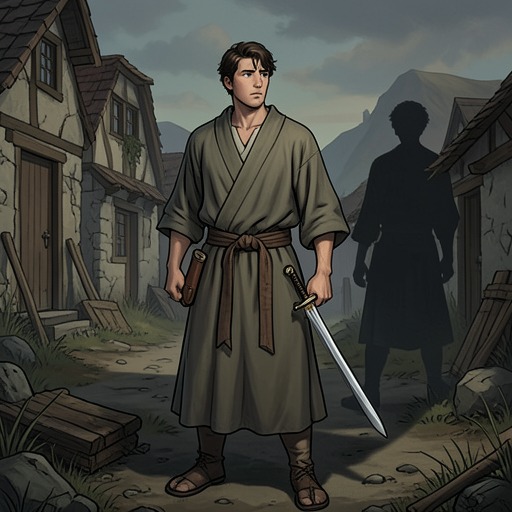
Shun’s Dagger for Shin
5 Centimeters per SecondShun’s Dagger for Shin is a short sword that carries its giver’s affection into the most consequential choices Shin makes. Given as preparation for a duty Shin has not yet received, it becomes more than equipment: first a keepsake he can scarcely bear to think about, then a weapon that intervenes in a confrontation and ultimately breaks the clavis. Its passage from gift to action binds Shun’s remembered care to Shin’s protection of others and his refusal to let the clavis remain intact.
Origin and Intended Use
Shun gave the sword to his younger brother on the day he returned home after completing what the narration calls his last duty. He offered it with the same kind smile he always wore and explained that Shin would someday be given a duty of his own and might need it. The gift therefore anticipates a future role for Shin: it is not presented as a trophy or an heirloom without purpose, but as a practical object entrusted to him in advance of a responsibility still to come.
The sword was brand-new, yet it felt easy and familiar in Shin’s hand. Shin recognized that it had probably cost a great deal, but the price mattered little to him. Its significance came from who had given it: because it was Shun’s gift, Shin regarded it as priceless. The contrast between monetary cost and personal value is central to the object’s meaning. Its worth cannot be measured by its material expense; it rests in the bond the gift preserves and in the care with which Shun imagined his brother’s future.
The Keepsake Before It Becomes a Weapon
At a later moment, Shin returns to his room, takes out the short sword, and gazes at it while it remains in its sheath. The scene pauses over the weapon before it is used. Shin’s attention is fixed not on its edge or practical readiness but on the object as a reminder of Shun. He begins to think of it as the last something connected to his brother, then shakes his head before the thought is completed. The interrupted sentence leaves the pain of that association present without explaining it away; the sword is cherished, but contemplating what it represents is difficult.
That hesitation gives the weapon’s later use additional weight. The object first appears as something Shin can look at and hold, carrying a memory that he cannot finish articulating. It does not remain sealed away as a private relic, however. When danger arrives, he acts with it. The movement from quiet recollection to physical intervention does not erase its meaning as a gift: it makes the gift’s intended use in Shin’s future concrete, while placing that use in circumstances Shun could not have specified.
Disarming and Protecting
When Morisaki prepares to fire another round at the soldiers of Amaurot, Asuna wants to stop the killing. Morisaki answers that the soldiers are trying to kill them and readies his weapon. A short sword then flies in from an unexpected direction and knocks the gun from his hands. The throw is precisely aimed at the firearm; Morisaki is not injured. The sword’s first decisive action in this confrontation is thus not to wound a person but to take a weapon out of play.
Shin arrives on horseback immediately afterward. Without slowing the galloping horse, he jumps off, retrieves the sword, and faces the soldiers of Amaurot with it ready, placing himself between them and Morisaki and Asuna. The sequence makes the object an instrument of protection as well as attack: its throw interrupts Morisaki’s next shot, and Shin’s recovered blade marks his choice to shield the pair from the soldiers. The sword has crossed the space between the fighters before its owner appears; Shin’s arrival reveals who sent it and turns a sudden intervention into a direct confrontation.
The Clavis and the Sword’s Final Use
Later, Shin sees the brilliantly shining clavis and runs toward it. He takes up the short sword—the blade Shun had given him—and slashes at the crystal. The clavis repels the blade easily, and an invisible force knocks Shin flying. He attacks again. When Morisaki turns toward him, Shin is still striking at the clavis and calling to Asuna; the repeated blows continue even as the sword’s tip finally chips.
The damage to the blade makes the struggle visible in the object itself. A sword that had felt familiar and ready in Shin’s hand is no longer simply a durable gift: its tip gives way under repeated attacks against the clavis. Yet Shin keeps using it. At the scene’s culmination, his sword shatters the clavis into pieces, and Morisaki turns toward Lisa as she staggers back. The evidence connects the destruction of the crystal with Lisa’s reaction; the sword’s role is not merely to oppose an enemy in combat, but to bring the clavis’s destruction about.
Significance
The sword’s story is structured by a change in what it does without a change in what it means. Shun gives it for Shin’s future duty; Shin first holds it as a treasured reminder; then it disarms a gun, helps him face the soldiers of Amaurot, and is used repeatedly against the clavis. In each later use, the gift becomes consequential through Shin’s actions, not through any special property attributed to the weapon. It is familiar in his hand, but it is neither invulnerable nor effortless: it can be resisted, its tip can chip, and Shin must keep striking.
That material vulnerability sharpens the connection between inheritance and choice. The sword reaches its greatest effect only after Shin has persisted through its failure to penetrate the clavis at first. What Shun intended as preparation for a duty becomes the means by which Shin protects others and destroys the crystal. The object thus carries the brotherly bond into the present without turning Shin into a mere custodian of the past: he gives the gift its decisive use himself.