Takaki and Akari’s Long-Distance Separation
5 Centimeters per SecondTakaki and Akari’s Long-Distance Separation transforms a close childhood bond into a relationship carried across changing homes, school routines, and long journeys. Their monthly letters briefly make the distance bearable, but a second move threatens even the possibility of meeting; after the correspondence fades, Takaki’s private writing preserves the separation as an unfinished part of his life.
The move that divides them
Takaki Tohno and Akari Shinohara had already experienced a school transfer together, and they were drawn to one another with the hope of remaining together. Looking back, Takaki understands their intense exchange of knowledge and personal details as a response to a loss they could sense approaching. The bond mattered precisely because neither child could be sure it would survive the next change in their lives.
That change arrived during sixth grade. One winter night, Akari called to explain that they would not attend the same middle school. Her father’s job meant that her family would move to a small town in the northern Kanto region during spring break. The news overturned their expectation that they had both been admitted to West Middle: Akari’s schooling would instead be arranged with a public school in Tochigi. She apologized, her voice unsteady, while Takaki struggled to understand why the separation had to happen. He describes the shock as bodily as well as emotional: heat rushed through him, while the center of his head seemed to turn cold.
At twelve, Akari had no choice in the move, but that did little to soften Takaki’s sense of injustice. He felt that something beyond his understanding was taking her away and could not imagine recovering from the loss. The new term nevertheless began, and he attended alone the school they had expected to share. He made friends, joined the soccer club, and filled his days with practice, homework, and company. His activity was not evidence that the separation had stopped hurting: spending time alone, once comfortable, had become painful, so he sought out other people and went to bed as soon as his work was done.
Letters as a bridge
Takaki hoped that Akari would gradually forget him in her new surroundings, and thought he ought to forget her too. The arrival of her letter, after half a year apart, unsettled that effort. Its pale-pink envelope made him feel bewildered rather than simply happy: contact renewed the absence he had been trying to accommodate.
Akari’s short letter described the practical texture of her new life. She rode a four-car train to public middle school, joined the basketball club to build up her strength, and cut her hair to keep it out of her face. She wrote of feeling nervous, but did not explicitly say that she missed Takaki. Her account made her seem to be adjusting; Takaki nevertheless sensed loneliness and a wish to see and speak with him, feelings he recognized because they were his own. Her recollection of Tokyo’s humid summers, hot asphalt, shimmering buildings, and overcooled department stores and subways also showed how a familiar place persisted in memory after she had left it.
After that first letter, the two began writing to each other about once a month. The correspondence did not become a catalogue of everyday complaints. Instead, its importance lay in the knowledge that someone else understood. For Takaki, that knowledge changed how he experienced school and soccer: he could identify the pain of rigorous practices and customary hazing rather than simply endure it without a name. Recognizing the hardship made it easier to bear. Their letters thus offered a form of mutual support without removing the distance or restoring their shared daily life.
The routine carried them through summer and autumn into winter. Takaki grew seven centimeters, gained muscle, and became less susceptible to colds; the world around him began to feel closer to a manageable distance. He sometimes wondered what Akari now looked like. In a letter, she wrote that she wanted to see cherry blossoms with him again, as they had in grade school, and described a large tree near her home. The image gave their correspondence a future-facing hope: an imagined meeting attached to a particular season and place, rather than a return to the life they had already lost.
A second move narrows the future
After Takaki began his third term, he learned that his family would move during spring break to Kagoshima—not on Kyushu proper, but on an island off its coast. By then he was more accustomed to changes of home and school, yet this move threatened something different. He and Akari had not met face-to-face since the beginning of middle school, but their homes had still been close enough for a weekend visit: her town in northern Kanto was about three hours from his part of Tokyo by train. Moving to the distant south, he realized, would end even that possibility.
Takaki therefore wrote to ask to see Akari before he left. Their school examinations, his preparations for the move, and her club activities left only an evening at the end of term. He worked out a route involving the Odakyu, Saikyo, Utsunomiya, and Ryomo lines, planning to leave after class, reach the station near her home by seven, spend a couple of hours talking, and return on the last train. The round-trip fare would be about 3,500 yen, a substantial sum for a middle-school student. The detail of this plan makes the distance concrete: preserving the chance of an in-person conversation required time, money, several transfers, and a journey paced by the last train.
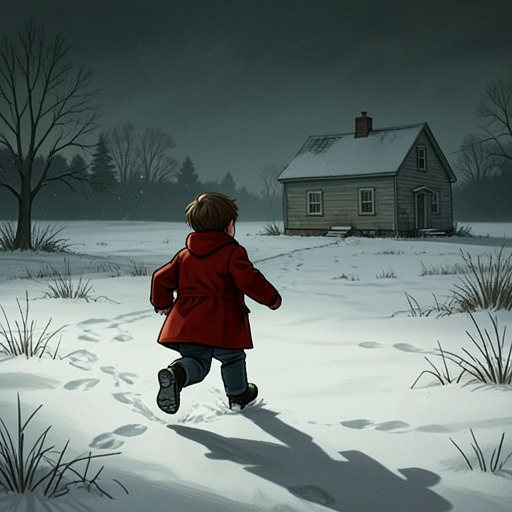
The journey also recalls an earlier displacement. When Takaki moved from Nagano to Tokyo just before third grade, the view from Omiya toward Shinjuku had seemed like an overwhelming expanse of buildings, unlike the rural landscape he knew. Five years later, on the route toward Akari in falling snow, he remembered that fear and recognized that he had survived the move. He credited Akari with having helped him through it and hoped he had done the same for her. Their bond had become part of how he understood his ability to endure unfamiliar places, even as repeated moves kept testing that ability.
What remains after correspondence
The separation outlasts the monthly letters. As an adult, Takaki remembers writing text messages he never sent, initially addressing them to a girl whose email address he did not know. After the two had stopped corresponding by letter, he continued composing these private messages whenever an emotion felt too difficult to contain, then deleted them. In time, the writing ceased to address anyone in particular, became a vague soliloquy, and finally stopped. Takaki interpreted that disappearance as preparation for setting out alone; he was also certain that no more letters from Akari would arrive.
That certainty does not amount to a clean resolution. Remembering the expectation of no further letters brings back raw anxiety, and Takaki fears that his present self may remain too closely connected to the ignorant, arrogant, and cruel boy he remembers. He counters that fear by recognizing that someone else is now special to him, but the memory of the earlier bond still supplies the measure against which he assesses change. The separation has become less an active exchange than a private history of words written, sent, withheld, and ultimately no longer expected.
The two characters’ later memories also complicate the idea that moving simply means losing a place. Akari remembers arriving at Iwafune Station after leaving Tokyo and feeling that its tiny platform was desolate, despite having visited the town as a child. Later, she regards the same town as her own quiet hometown and finds leaving it difficult. Takaki, meanwhile, moves from Tanegashima to Tokyo for university and initially finds the city coarse and unfamiliar, though he recalls having once felt anxious there as a child and homesick for it after moving to the island. These later experiences do not undo the distance between him and Akari; they show how places once associated with separation can change in meaning. The bond began in a world where each move threatened what the children shared, and its lasting trace is visible both in Takaki’s private words and in the different homes each eventually learns to inhabit.