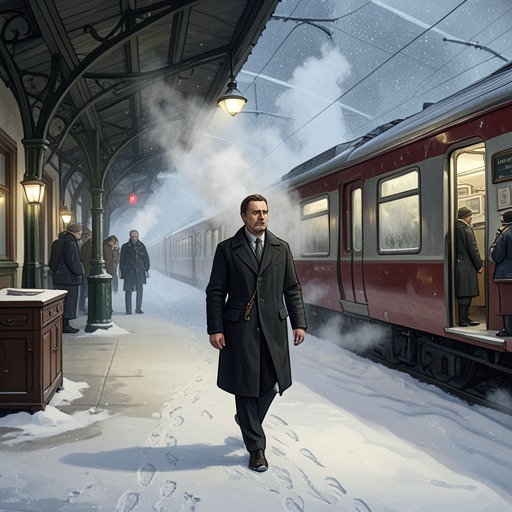
Takaki’s Snowbound Journey to Meet Akari
5 Centimeters per SecondTakaki’s Snowbound Journey to Meet Akari is a childhood journey turned into a test of whether affection can survive distance, bad weather, and time beyond anyone’s control. On the day Takaki is meant to meet Akari at Iwafune Station, snow steadily disrupts his route across the region. He cannot tell her he is late, loses the letter he planned to give her, and arrives in the dead of night. The journey is both an attempted reunion before another move separates them and an early expression of the story’s recurring tension between emotional closeness and physical distance.
Background and the plan
The meeting becomes urgent when Takaki learns that his family will move during spring break to an island in Kagoshima, far south of Tokyo. He and Akari have not met face-to-face since the beginning of middle school, but their separation has so far seemed manageable: her town in northern Kanto is only a few hours away by train. The move threatens to make visits impossible, so Takaki writes to ask to see her before he leaves. Their schedules allow only an evening after class at the end of the term.
Takaki plans the trip around a seven o’clock meeting. He will skip club, leave school immediately, and take a chain of ordinary trains: the Odakyu Line from Gotokuji Station to Shinjuku Station, the Saikyo Line to Omiya, the Utsunomiya Line to Oyama, and the Ryomo Line to Iwafune Station. His handwritten memo gives a 3:54 departure and an expected arrival at 6:45, leaving just enough time to meet Akari. The roundtrip fare is about 3,500 yen, a significant sum for a middle-school student, but seeing her matters more to him than the expense. He expects to return around midnight and leaves a note for his parents, who do not know the circumstances of the meeting.
The weather begins to undermine the plan before the journey starts. Rain falls through the school day beneath a solid gray sky, then changes to snow as classes end. Takaki carries the letter in his school bag, but after school moves it to his coat pocket so that he can feel it there and keep it close. He has never taken such a long train journey alone. Reassuring himself that the transfers are manageable, he sets off into the snow with the meeting time and route carefully fixed in his mind.
The journey slips beyond his control
The trip initially follows its timetable, but the weather turns ordinary transfers into a mounting crisis. At Musashi-Urawa, Takaki remembers that this route is not wholly unfamiliar: five years earlier, he had traveled from Omiya to Shinjuku with his parents after the family moved from Nagano to Tokyo. Then, the cityscape had seemed so alien that he had nearly cried. Now, at thirteen, he recognizes that he has managed to live through the change. In that recollection, he credits Akari with having saved him and hopes that he has done the same for her. The memory makes the planned meeting more than a farewell visit: it is bound up with what their friendship has meant during successive changes of home.
At Omiya, the Utsunomiya Line is already crowded, and an announcement reports an eight-minute delay caused by snow. Takaki checks the time and his memo, trying to hold to a schedule that is already failing. The train is packed with tired commuters, its windows fogged and beaded with water; beyond them, urban buildings give way to snow-covered fields and scattered house lights. The unfamiliar landscape intensifies his worry. If he misses the meeting, he has no way to contact Akari: he does not know her home phone number, and mobile phones are not common among middle-school students.
The train crawls toward Oyama, stopping for long periods as delays accumulate. Takaki repeatedly checks his watch, while the minutes pass and the distance to his destination seems not to shrink. At seven, the agreed meeting time, he is still at Nogi, two stations short of Oyama; even after that transfer, Iwafune Station is another twenty minutes away. He has eaten nothing since lunch. When fatigue finally overwhelms his rigid tension, he sits in an empty box seat and takes Akari’s letter from his pocket. The appointment has passed, and he imagines her beginning to worry as she waits without news.
He reaches Oyama after 7:40, abandons his now-useless timetable memo, and runs to the Ryomo Line platform. That line, too, is significantly behind schedule. Though hungry and cold, Takaki declines to buy food because he thinks Akari may also be hungry while waiting; he decides that a hot can of coffee will have to suffice. As he takes out his wallet, the letter slips from his coat pocket. A gust sweeps it off the platform and into the dark. He nearly cries, but holds back his tears and does not buy the coffee. In retrospect, he doubts that giving Akari the letter would have changed much: their lives would continue to change, and his intense feelings would change with them. The lost paper becomes a poignant failure of delivery, but not, in his later understanding, the single cause of what follows.
The stranded train and the meeting
The Ryomo Line train eventually stops in the middle of its route, with no estimate for when service will resume. Beyond the window, a snowfield stretches through a blizzard, while the announcement offers no practical answer to Takaki’s need to reach Iwafune. The meeting time is already two hours past. He removes his watch and places it on the small table beneath the window, unable to bear watching more time pass. The carefully measured itinerary has given way to waiting without a known end.
After more than two further hours, the train starts moving again. Takaki reaches Iwafune Station after eleven at night, more than four hours later than promised. His shoes sink into fresh snow as he steps onto the platform. The wind has died; snow falls quietly, and the open platform faces a snowfield that seems to continue without limit. The town’s lights are sparse and distant, and the idling train’s engine is the only sound he can hear. The stillness contrasts with the repeated delays and crowded trains that have defined the journey.
Takaki crosses a small pedestrian bridge and enters the wooden station building. The waiting room is warmed by a kerosene stove. There, a girl in a white coat sits with her head lowered. At first she looks like a stranger; when Takaki calls her name, she slowly raises her head. The scene resolves the journey’s central uncertainty: despite the cold, the lost letter, and the hours of delay, Akari has remained at the station. Their reunion begins not according to the plan Takaki made, but in the quiet after the storm has exhausted his timetable.
The journey’s later echoes
The journey draws its force from Takaki’s earlier experience of displacement. The memory of traveling from Nagano to Tokyo shows how a new landscape can make a child feel cut off from the world; his hope that he and Akari have each helped the other gives their bond a reciprocal importance. Years later, after graduating from high school on Tanegashima and moving to Tokyo for university, Takaki again faces an unfamiliar city. He tells himself that he has moved before and can make a home in a new place, yet he also recalls feeling rejected when his family moved to Tanegashima. The snowbound trip thus belongs to a pattern in which movement changes the physical distance between people without resolving what that distance means to them.
Iwafune also acquires a different meaning for Akari over time. In a later recollection of arriving there with her mother after leaving Tokyo, she remembers the small platform as desolate and remembers being homesick. As an adult, however, she regards the town as her hometown and finds it painful to leave. The station where she waited for Takaki is therefore not simply a remote meeting point: it becomes part of a life and a place she comes to love, even though it once represented separation from the familiar.
The adult Takaki’s reflections on his apartment give this pattern a further resonance. He thinks that sadness gathers wherever a person lives, gradually, like dust collecting in a room; ordinary remnants of a relationship make his apartment feel saturated with what has passed. His late train commute through Tokyo also turns him into a small moving light among many, and at Shinjuku Station he looks back at the seat he has left as though his exhausted body might still be there. These later scenes do not undo the childhood meeting. Instead, they echo the journey’s images of transit, delay, and arrival, while showing how places and routines can preserve feelings after the moment that first gave them meaning.