Tokyo
5 Centimeters per SecondTokyo is a recurring destination and difficult home for Takaki Tohno: first the unfamiliar city he reaches as a child, then the place where he spends his early adolescence with Akari Shinohara, and finally the metropolis he elects to return to after years on Tanegashima. Its meaning changes with those circumstances. Tokyo can offer friendship and a shared world, but it can also feel crowded, indifferent, and thick with accumulated sadness; even in adulthood, its spring blossoms connect the city to memories that remain unfinished.
A City Entered Through Moves
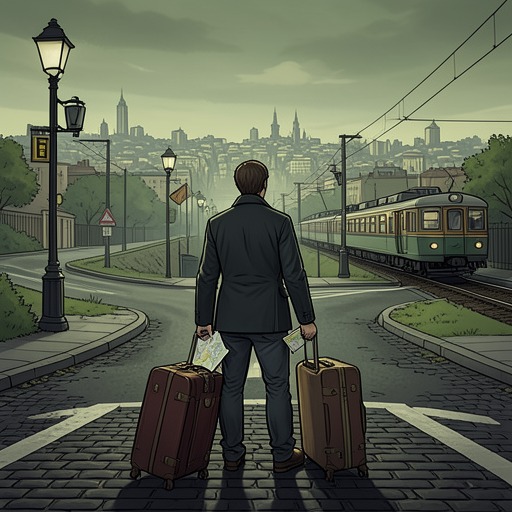
Takaki first came to Tokyo from Nagano shortly before starting third grade, traveling by train with his parents from Omiya to Shinjuku. The view from the window—buildings stretching across the landscape instead of the mountains he knew—made the move feel almost impossible to imagine. He feared living in a place that seemed to contain nothing but buildings and remembered being close to tears. Five years later, on another journey through Omiya, he recognized the railway view and measured the distance he had traveled: he was still a child, but had survived the change. In his recollection, that survival was inseparable from Akari, who had helped him feel less alone in the city.
The Tokyo of Takaki’s childhood was not a single, settled home. His family lived in Setagaya, where he and Akari both attended grade school after arriving from elsewhere: Takaki from Nagano and Akari from Shizuoka. Their fathers’ work required frequent moves, and that shared experience helped draw them together. Both children felt out of place among classmates who seemed more mature and found the crowds near the station difficult to bear. For Takaki, the city was at once the setting of an anxious adjustment and the place where he found someone who understood it.
Childhood Routes and a Shared World
The city’s everyday geography helped make their friendship durable. The children lived in separate company housing, but their route home overlapped for part of the way. They spent lunch breaks, afternoons, and weekends together, preferring books, the library, and long conversations to noisy groups or the athletic field. Tokyo did not erase their sense of being newcomers; instead, a common experience of displacement gave them a private point of connection within it.
One remembered walk gives that childhood Tokyo a quieter scale. In spring, as Takaki and Akari walked home from school with their backpacks, they passed a small forest near a major highway and the Odakyu Line. The cherry trees were in full bloom, and petals drifted over the asphalt until it appeared white. Although the highway and railway were close, their noise scarcely reached the children; birdsong and the empty path made the scene feel separate from the surrounding city. Akari’s comparison of the falling petals to snow became part of Takaki’s lasting memory of their time together. In later recollection, the scene returns not as a complete account but as a series of images: two children seen from behind, with Akari running ahead.
Tokyo also framed the approach of separation. Takaki and Akari had imagined attending the same private middle school, but their plans did not hold. After they entered different schools, they stayed in contact by letter. When Takaki learned that his family would move to Kagoshima, far to the south, he understood that the distance between them would become harder to cross. Before leaving, he arranged to travel to Akari’s town to see her. Their planned meeting was a journey away from Tokyo, but its urgency arose from the possibility that the city would no longer be the place from which they could reach each other.
Return to an Unfamiliar Metropolis
After graduating from high school on Tanegashima, Takaki chose to return to Tokyo for university. He rented a small apartment about a thirty-minute walk from Ikebukuro Station, but the city he entered as an adult differed from the one held in his childhood memory. He recalled Setagaya as calmer and more refined; now, streets seemed littered with cigarette butts, plastic bottles, magazines, and discarded convenience-store containers. The people appeared rougher and more indifferent than the residents of the island where he had spent his teenage years. His judgment of Tokyo therefore carried two impressions at once: a remembered place he had once called home and a present-day city he barely recognized.
The move was nevertheless his own decision, unlike the transfers arranged around his father’s work. Takaki reminded himself that he had moved before and learned to make a home in unfamiliar surroundings. His memories of the journey from Nagano to Tokyo and, later, of leaving Tokyo for Tanegashima showed how belonging could reverse with a change of direction: the city that first overwhelmed him later became the place he missed when the island felt foreign. Standing among unpacked boxes in his new apartment, he regarded Tokyo as a place he had chosen, while acknowledging that no place had proved permanently strange or permanently familiar.
His four university years unfolded in fragments rather than through a strong attachment to campus. Science classes occupied much of his time, but he also worked part-time, went to movies alone, and wandered around the city. Sometimes he passed the university and read in a small park on the way to Ikebukuro Station. The number and variety of people there initially unsettled him, then became familiar. He made friends through school and work; most connections faded, while a handful grew close enough for long nights of conversation at one another’s apartments. Tokyo offered opportunities for routine and companionship, but those ties did not automatically produce a lasting sense of belonging.
Memory, Sadness, and Renewal
In Takaki’s adult life, a Tokyo apartment becomes a measure of what remains after a relationship has drained away. A single toothbrush by the sink, white sheets hung out for someone else, and the call history on his phone make absence tangible. He thinks of sadness as something that collects in a place gradually, like fine dust settling into a film. The city is not simply a backdrop for that feeling: the apartment’s ordinary objects give it a location, turning private loss into part of the lived environment.
Tokyo’s seasonal imagery offers a counterpoint without erasing that sadness. In April, three months after leaving his company, Takaki wakes late after working through the night and sees spring sunlight on the city’s skyscrapers. Their windows catch the light, and cherry trees bloom in the spaces between buildings. He has recently begun taking independent design and programming jobs, using connections from his former workplace; after a long pause, he finds pleasure again in programming. The city’s blossoms recall the childhood landscape shared with Akari, but they appear amid a new routine that Takaki is beginning by choice. Tokyo thus holds both the persistence of memory and the possibility of renewed work: it is not a simple return to the past, but a place where old associations remain visible as adult life starts to move again.