
A Boy and His Dog
Overview
A Boy and His Dog is a post-apocalyptic science-fiction novella by the American writer Harlan Ellison. It is also the central work in the later Vic and Blood cycle. The story was first published in short-story form in 1969 and was subsequently expanded into novella length for Ellison’s collection The Beast That Shouted Love at the Heart of the World. It won the 1969 Nebula Award for Best Novella. The book is often described as science fiction, but its form and effect also draw on dystopian fiction, black comedy, violent satire, and the tradition of the dark fable.
The action takes place in a ruined United States after a civilization-ending catastrophe, generally understood as a nuclear war or its aftermath. The surface has become a dangerous wasteland where scattered survivors search abandoned places for food, weapons, and anything left from the old world. Vic is a young surface survivor with little education and an almost entirely instinctive understanding of society. His closest companion is Blood, an unusually intelligent dog who communicates telepathically. Blood is not merely Vic’s animal companion: he is a strategist, guide, protector, and frequently the more perceptive moral presence in the pair. Their relationship is the emotional and structural center of the story.
While roaming the ruins, Vic and Blood encounter Quilla June Holmes, a young woman from an underground community. Her appearance draws Vic into a hidden society that has preserved buildings, rituals, and social organization from the pre-catastrophe world. The underground settlement initially seems to offer an alternative to the brutal surface, yet its order is also bound to coercion, reproduction, hierarchy, and the control of individuals. Vic is fascinated by Quilla and by the possibility of belonging to another kind of society, while Blood remains suspicious. The resulting conflict forces Vic to choose among sexual desire, personal survival, escape, and loyalty to his dog. The plot is therefore not a conventional adventure in which an innocent hero becomes virtuous. Instead, it exposes what remains of morality when institutions have collapsed and survival appears to excuse every form of cruelty.
Themes and Style
Ellison’s central subject is the fragility of civilization. The surface survivors and the underground citizens seem to represent opposite social conditions, but both worlds can be organized around domination, possession, violence, and fear. The underground community is especially satirical: it has retained the outward forms of civilized life without necessarily retaining compassion, freedom, or ethical responsibility. The story asks whether civilization is a collection of buildings and ceremonies or a set of humane choices.
Blood creates the novella’s sharpest reversal of familiar assumptions. He is a dog, yet he can reason, communicate, remember, and judge. His loyalty is practical rather than sentimental, and his understanding of responsibility often exceeds Vic’s. Vic, by contrast, is sexually aggressive, violent, and morally stunted. Ellison deliberately gives him language and impulses that can repel the reader. Explicit sexuality, coarse speech, brutality, and grotesque humor are not incidental decorations; they are instruments of the book’s examination of power and dehumanization. The reader is repeatedly forced to ask whether biological survival has any value when the survivor has abandoned empathy.
The novella also reflects the anxieties of Cold War America: nuclear destruction, authoritarian social systems, gendered power, and the persistence of consumer-era images after catastrophe. Ellison’s prose is fast, abrasive, and darkly comic. His wasteland is not a romantic frontier where a resourceful individual can begin again. It is a moral landscape in which the old world’s violence has been stripped of its respectable institutions.
Influence and Legacy
A Boy and His Dog became one of Ellison’s most recognizable works because of the unforgettable, unsettling partnership between Vic and Blood. Ellison later wrote two additional stories featuring them, “Eggsucker” and “Run, Spot, Run.” The three stories were collected in the 1989 graphic novel Vic and Blood. He also contemplated a larger book called Blood’s A Rover, but the projected full novel was never completed and published in that form.
The 1975 film adaptation expanded the story’s public profile and won a Hugo Award, although its choices differ from the novella and have generated continuing debate. The original work’s influence can be felt in later post-apocalyptic fiction, film, comics, and games, particularly in visions that combine underground shelters, mutated life, ruined American landscapes, and remnants of mid-century culture. Its importance does not depend on presenting Vic as admirable. Rather, the book remains powerful because it makes the reader confront the unsettling intimacy between a damaged human being and the dog who may understand loyalty and civilization better than he does. It stands as one of Ellison’s most important, controversial, and enduring works of science fiction.
About the Author
Life and Formation
Harlan Ellison was born in Cleveland, Ohio, in 1934. He became an American science-fiction writer, short-story author, editor, critic, and screenwriter whose career extended across fiction, television, film, comics, and literary nonfiction. He grew up in Ohio and attended Ohio State University, although he did not pursue a conventional academic career there. His early experiences of isolation, conflict, and resistance to authority helped shape the combative voice that became central to his work. After leaving university, he served in the United States Army and then devoted himself increasingly to professional writing. During the 1950s he lived and worked in New York and other parts of the United States, building a career through a remarkable volume of short fiction, essays, and criticism.
Ellison came of age during the Cold War, the expansion of mass media, and an era marked by nuclear anxiety, urban violence, and struggles over civil rights and social authority. He rejected the idea that science fiction should be limited to technological marvels or distant planets. His fiction repeatedly asks how institutions, machines, and ideologies can reduce human beings to objects. His prose is often aggressive, compressed, theatrical, and darkly comic. He used shock, abrupt changes of tone, and disturbing images to prevent readers from treating social injustice or technological fear as abstract subjects.
Major Work
Ellison began publishing professionally in the 1950s and established his most influential reputation during the 1960s. ““Repent, Harlequin!” Said the Ticktockman,” published in 1965, examines social discipline and resistance through a society organized around time. “I Have No Mouth, and I Must Scream,” published in 1967, presents an artificial intelligence tormenting the last human survivors and became a landmark story about consciousness, technology, and imprisonment. In the same year, Ellison edited Dangerous Visions, an influential anthology that helped bring experimental and socially challenging science fiction to a broad readership.
A Boy and His Dog first appeared in 1969 and won the Nebula Award for Best Novella that year. Its ruined America, telepathic dog, sexual violence, and cynical treatment of civilization show Ellison’s interest in nuclear catastrophe, power, and moral collapse. His later collection Deathbird Stories, published in 1975, demonstrated his continuing ability to combine myth, American culture, and dystopian speculation. He also wrote for television and film, including work associated with Star Trek, and produced introductions, criticism, screenplays, comic scripts, and editorial projects. His range made him more than a genre novelist: he was a major literary presence within and beyond science fiction.
Ellison continued developing the Vic and Blood material. Two further stories, “Eggsucker” and “Run, Spot, Run,” were eventually collected with the original in the 1989 graphic novel Vic and Blood. He also planned a larger work titled Blood’s A Rover, but the complete novel was never published in the form he envisioned.
Reputation and Death
Ellison was known for prolific output, forceful opinions, and an unusually direct public persona. He received numerous Hugo Awards, Nebula Awards, and other honors, and is widely regarded as one of the most important and controversial American science-fiction writers of the second half of the twentieth century. His work challenged conventional ideas about gender, government, technology, censorship, and literary respectability. The violence, explicit sexuality, coarse language, and emotional intensity that made his stories difficult for some readers were also part of their disruptive power.
Harlan Ellison died in 2018 at the age of eighty-four. He left behind a large body of fiction, screenwriting, criticism, and editorial work. His lasting reputation rests on more than awards or productivity. He treated science fiction as a way to interrogate the present rather than escape from it, and he expanded the range of subjects, tones, and narrative strategies available to the genre. Stories such as “I Have No Mouth, and I Must Scream,” ““Repent, Harlequin!” Said the Ticktockman,” and A Boy and His Dog continue to influence writers, filmmakers, comic artists, and game designers. His work remains memorable because it combines imaginative invention with anger, moral discomfort, and an unwillingness to offer easy consolation.
StoryFlow
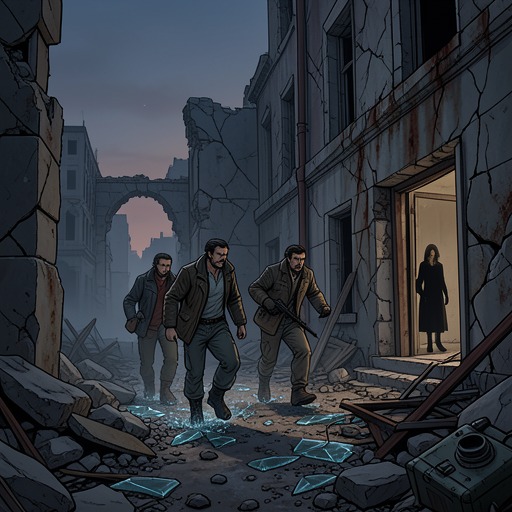
The Hunt for a Woman
Tracks the opening quest that launches the story: Vic and Blood's scavenging patrol, the discovery of a hidden woman in the Metropole, and the stalk through the ruins that ends in the YMCA.
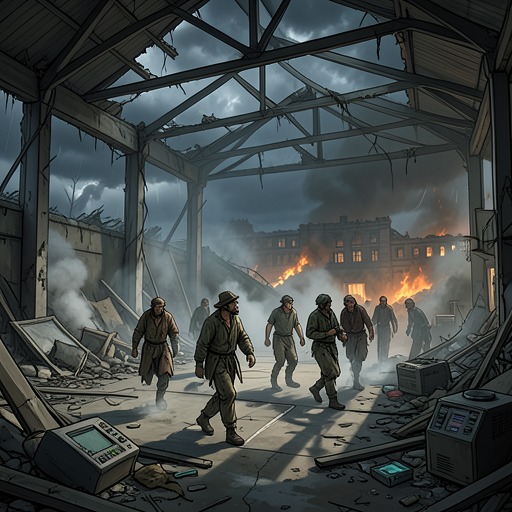
The Siege of the YMCA
Follows the roverpak attack on the ruined gymnasium, the firefight from the girder, and the desperate decision to burn down the building as a shroud for escape.
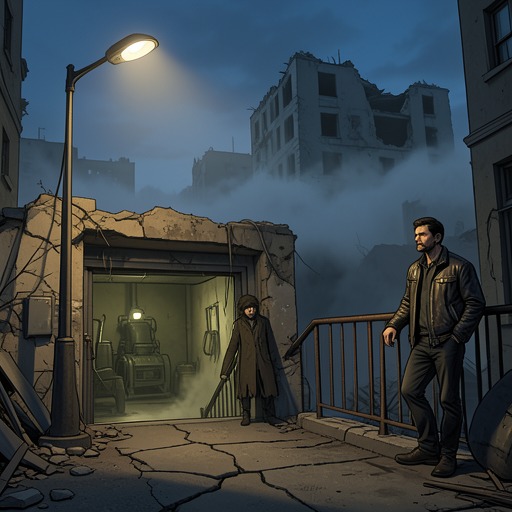
The Descent into Topeka
Traces the pivot of the plot: Quilla June's escape, Vic's discovery of the identity plate, his rejection of Blood's counsel, and his capture inside the underground city.
