
The Question of Love
A Boy and His DogTracks the novella's philosophical through-line: the repeated interrogation of love, its definitions, its tests, and its final violent answer.
increasing Bearing strength in each event
 decreasing
Bearing strength in each eventdecreasingThe Conversation in the Boiler
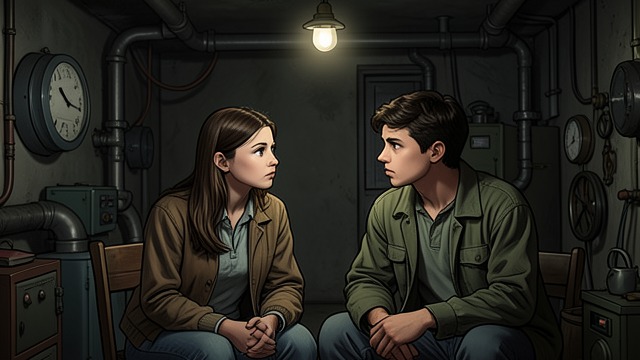
The Conversation in the Boiler
The Girl's Question
'Have you ever been in love?' Quilla June asks in the dark, and Vic's answer, 'Well, I damn well guess I haven't!', is both honest and inadequate. The question has been planted in the story's center, and it will not let go.
The Boy's Defense
Vic argues he knows love the way he knows a bullet in the head, without having taken one. The sophistry is the novel's thesis under attack: he claims knowledge without experience, and the rest of the story will force the experience on him.
The Love That Climbs
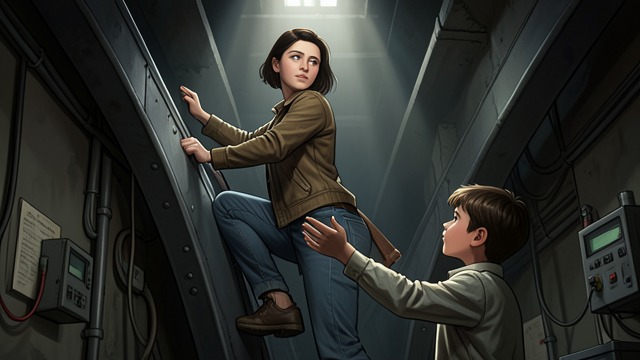
The Love That Climbs
The Word as Fuel
Strapped into the dark of the duct, Quilla June asks what she really needs: 'Vic, do you love me?' He says yes because it helps her keep climbing. The answer is true and it is a tool; the ambiguity is the point.
The Utilitarian Vow
For Quilla June, love is the promise that keeps her going. For Vic, saying it is the mechanism that keeps the escape moving. The word has not yet acquired its final, terrible meaning; it is still functional, negotiable, a rope in the dark.
The Conditional Love
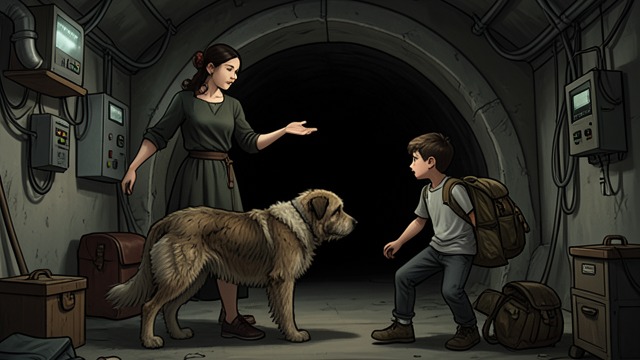
The Conditional Love
The Price of a Verb
'If you love me, you'll come on!' Quilla June makes love conditional: it is a performance to be witnessed, a choice to be demonstrated by abandoning the dog. Her definition is the conventional one, love as exclusive devotion to one beloved.
The Weighing of Devotions
Vic's response is to expose the condition. Love, it turns out, cannot be bargained; it is not a promise of presence but a fact of necessity. The moment crystallizes the book's argument: what we call love is revealed by what we feed.
The Love That Feeds

The Love That Feeds
The Unshown Act
The killing of Quilla June happens off-page, between an ultimatum and a small fire. The narrative refuses to display the act, forcing the reader to imagine it. The ellipsis is the story's moral challenge: the reader must decide what was done and what it means.
The Conversion of Love
Love is converted into nutrition: her body becomes the dog's strength. The literalness of the metaphor is the novella's radicalism, love is not an abstraction but an expenditure of flesh. Vic's final definition of love is metabolic.
The Sentence That Ends the Book

The Sentence That Ends the Book
The Catechism Answered
'A boy loves his dog.' The final sentence is the answer to every question Quilla June asked. It is also an epitaph, a thesis, and a horror. The simplicity of the words conceals a total inversion of every romance the downunder taught.
The Open Question
The line can be read as the discovery of true love or as the final proof of its impossibility. A boy loves his dog, and the reader is left to ask whether the capacity for love has been rescued from the wasteland or merely revealed as a sharper form of appetite.
the night inside the YMCA boiler
the air duct ascent
the final twilight on the wasteland
the small fire, in the story's ellipsis
the last line
