Human–animal bond
A Boy and His DogHuman–animal bond is the decisive relationship structure in A Boy and His Dog: it keeps Vic and Blood alive in the wastelands, gives an animal an unusually forceful subjective presence, and turns the meaning of love into the book’s final moral question. Their connection is neither a simple master-and-pet arrangement nor an uncomplicated ideal of loyalty. It is a hard, reciprocal alliance shaped by hunger, danger, sex, injury, resentment, memory, and the practical fact that each has become difficult to imagine without the other.
Definition and Survival Function
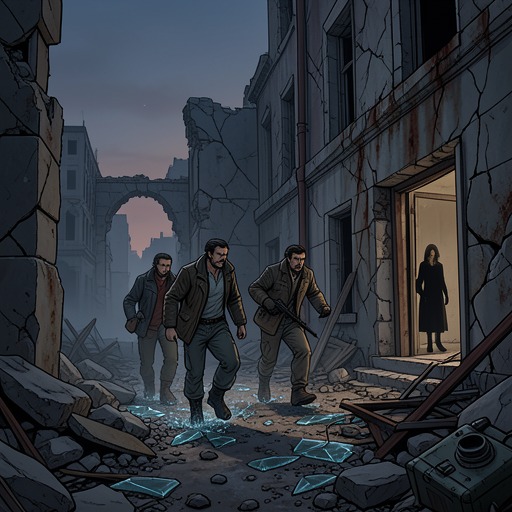
The bond begins as a material exchange. Vic scavenges food for Blood, including water rats and a manicured poodle lost in one of the underground settlements, while Blood uses his telepathic abilities and knowledge of the wasteland to help Vic find women. The arrangement is crude and exploitative in its language, but it is also genuinely reciprocal: Vic ensures the dog eats, and Blood helps him navigate a ruined society in which an isolated boy would be far more vulnerable alone. Their companionship therefore operates simultaneously as affection, economy, protection, and habit.
The story’s world makes this interspecies partnership historically plausible. Before the Third War, animal research involving altered spinal fluid, surgery, grafting, and selective breeding produced dogs capable of telepathically communicating sense-impressions. The resulting Skirmisher dogs could be trained to track gasoline, troops, poison gas, or radiation when connected with human controllers. Blood inherits this history through his ancestry: Ginger, a Los Angeles Police Department narcotics dog able to locate marijuana hidden among 25,000 boxes, and Ahbhu, an early telepathic Puli, are identified as his ancestors. The bond between human and dog is thus not a return to an untouched natural order; it is the product of scientific intervention, war, breeding, and long-term coadaptation.
Vic and Blood as Companion Partners
Blood possesses a voice, opinions, grievances, and a persistent sense of responsibility that prevent him from functioning as a mere instrument of Vic’s will. He mocks Vic by calling him Albert, recalls dangers Vic has forgotten, and objects when Vic decides to return to the underground civilization. When Blood reminds Vic that Vic has a responsibility toward him, the statement gives their bond an explicit ethical dimension. Blood is not merely asking for food or obedience; he is invoking the shared history that makes Vic answerable to him.
That history is nearly three years long, encompassing what Blood calls the good and bad times. In the confrontation over Quilla June Holmes, Blood explains that he is frightened Vic will not return, that he is injured and hungry, and that life without Vic would leave him dependent on another group. His fear is practical as well as emotional: most isolated survivors now belong to groups, and Blood worries that, as an aging and wounded animal, he would be unwanted or subordinate. The scene makes dependence reciprocal but unequal in changing ways. Vic needs Blood’s guidance and companionship, while Blood’s physical condition makes him increasingly dependent on Vic’s care.
Their communication also reveals how intimacy can coexist with irritation. Vic opens the story by describing Blood as annoying him, yet the irritation is grounded in familiarity rather than distance. Blood’s teasing, repeated warnings, and demands are part of an established conversational world. The dog’s ability to speak does not erase animal difference; instead, it makes that difference audible. Blood remains hungry, wounded, territorial, and vulnerable, but he is also a social partner whose judgments can challenge the human protagonist.
The Bond Tested by Quilla June Holmes
Quilla June Holmes exposes the limits of Vic and Blood’s arrangement. Blood has traditionally guided Vic toward women, reducing sexual encounters to a survival routine, but Quilla June draws Vic into a closed underground civilization and changes the direction of his desire. The encounter is violent from its beginning: Vic threatens and overpowers her, while her fear becomes visible to him in her face. For a moment, her terror makes him want to speak reassuringly, an unprecedented hesitation in his usual treatment of women. The impulse passes, and he continues to control her at gunpoint, but the interruption shows the bond’s old sexual economy beginning to fracture under a new emotional attachment.
Quilla June later tells Vic that she loves him and that she had been sent out to lure him underground. Her confession transforms the relationship from apparent romantic possibility into a structure of deception, captivity, and political use. Vic’s anger is intensified by the discovery that she has manipulated him, yet he still asks whether she will leave with him. Her willingness to escape, together with her hostility toward her prayer-shouting Poppa, gives the pair a temporary shared objective. The human bond threatens the established human-animal bond because Vic’s attention, loyalty, and bodily risk are redirected toward a woman and toward the possibility of a different society.
The contrast is not simply between a supposedly loving human relationship and a supposedly lesser animal one. Quilla June’s love is entangled with fear, coercion, assigned duty, and the underground population’s social controls. Vic’s relationship with Blood is also coercive and verbally brutal, but it has been tested through prolonged survival. The narrative places both forms of attachment under pressure and refuses to make intimacy automatically virtuous. Love may call a person toward another being, but the call does not by itself remove violence or dependence.
Separation, Return, and Recognition
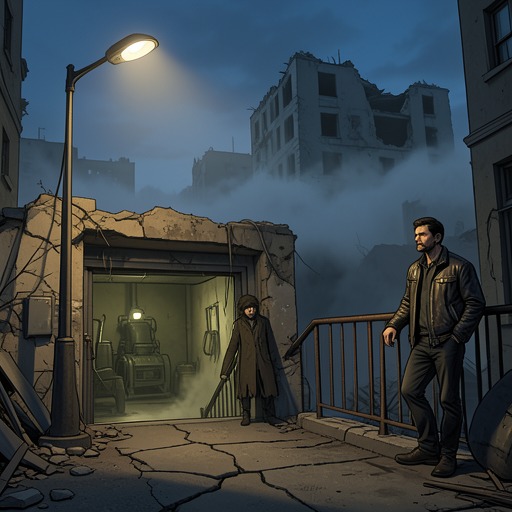
After Vic leaves Blood behind, the dog waits at the access dropshaft despite his weakness. When Vic and Quilla June return, Blood can scarcely rise because his wounds have deteriorated, yet he greets Vic softly. Vic’s response is immediate and physical: he lifts Blood’s head, smiles, and expresses relief at seeing him. The scene reverses the earlier tension between the dog and the woman. The underground adventure has not erased the older partnership; it has made the cost of abandoning it unmistakable.
Blood’s waiting gives the bond a powerful image of endurance. He does not pursue Vic into the underground civilization, nor does he receive a triumphant rescue through his own strength. He remains where the relationship’s shared route has brought him, injured but expectant. Vic’s return restores contact, but it does not restore innocence. Blood is still limping, and the pair must move slowly. The physical damage records the consequences of Vic’s divided loyalty more clearly than any declaration could.
The return is followed by a question that remains in Vic’s mind: whether he knows what love is. The answer, reduced to the plain statement that a boy loves his dog, is deliberately simple after the story’s ugliness. It does not prove that Vic has become gentle or morally redeemed. Instead, it identifies the bond with the one form of attachment he can recognize as durable and mutual. Love here is not sentimental purity; it is the act of returning to an injured companion, continuing to care for him, and acknowledging that survival has become shared rather than individual.
Ahbhu and the Real-Life Origin of the Bond
The personal essay about Ahbhu extends the theme beyond the fictional world. Harlan Ellison describes Ahbhu as his closest friend for eleven years and as the inspiration for the story about a boy and his dog. He rejects both reducing Ahbhu to a pet and treating him as a human in disguise. Ahbhu was, in Ellison’s account, a person in the sense of possessing a distinct personality and chosen social life, yet he remained irreducibly a dog. This insistence preserves animal specificity while granting the animal genuine individuality.
Ahbhu’s behavior gives that individuality social force. Visitors to Ellison’s house were affected by him; he welcomed people he judged favorably, begged successfully for scraps, and maintained an intimate circle of friends that sometimes had little connection with Ellison. His reactions to newcomers became a kind of moral barometer. When Ahbhu rejected someone Ellison liked, the person often proved untrustworthy, and Ellison admitted that the dog’s judgment influenced his own. The bond therefore ran in both directions: the human interpreted the animal, but the animal also shaped the human’s choices and social perceptions.
The essay’s final scene makes attachment visible through grief. At the veterinary clinic, Ahbhu looks at Ellison with an appeal not to be left among strangers. Ellison holds him as the veterinarian administers the injection, carries him home on the same seat where the dog had ridden eleven years earlier, and digs a neat rectangular grave by hand while crying and speaking to him through the sheet. The repeated journey home turns the beginning and end of their life together into a single frame. The fictional bond between Vic and Blood is consequently illuminated by an actual human-animal relationship founded on recognition, chosen companionship, and mourning.
Narrative and Ethical Significance
Human–animal bond destabilizes the assumption that language and intelligence belong exclusively to humans. Blood’s telepathy gives him access to speech-like exchange, but the text keeps attention on his bodily needs, ancestry, wounds, and animal judgments. He is neither a decorative symbol of loyalty nor merely a technological product. His agency complicates Vic’s authority and forces the reader to consider whether a relationship can be loving when it also contains dependency, instrumental use, threats, and unequal power.
The bond also functions as a counterpoint to the fractured human societies around it. The postwar world is organized by violence, rape, scarcity, raiding, captivity, and rigid social boundaries, while Vic and Blood preserve a partnership whose continuity predates the immediate crisis. Yet the story does not idealize them as morally clean. Vic’s treatment of women is violently exploitative, and Blood participates in the sexual survival system by directing him toward women. Their bond can therefore be more faithful than the surrounding human arrangements without being ethically innocent.
Its deepest significance lies in the way it makes love a matter of obligation rather than a decorative feeling. Blood’s reminder that Vic has responsibility toward him, his fear of being abandoned, his patient waiting while injured, and Vic’s return all give love a concrete cost. The final assertion that a boy loves his dog is moving precisely because it emerges from a world in which love has been confused with possession, sex, and control. The book leaves the human-animal bond as its most persistent form of shared life: damaged, unequal, fiercely loyal, and capable of making both partners answerable to a being who is not human.