Skirmisher dogs
A Boy and His DogSkirmisher dogs are the engineered shock troops of the postwar world: dogs altered through cetacean experimentation, selectively bred for telepathy, and trained to detect threats that ordinary soldiers could not reliably find. They embody both the extraordinary intelligence of animals and the violence of turning that intelligence into military infrastructure. Their legacy survives in Blood, whose abilities connect the intimate partnership of a boy and his dog to the history of war, experimentation, and dependence.
Creation and Military Function
Skirmisher dogs emerged from experiments conducted before the Third War. In Los Angeles, Buesing bred dogs as watchmen, sentries, and attackers, while Ginger, a four-year-old German shepherd bitch working for the Los Angeles Police Department’s narcotics division, demonstrated how far canine detection could already be developed. She found five marijuana packages hidden inside three sealed cartons in a warehouse containing 25,000 boxes, locating every package within seven minutes. At the same time, cetologists in Santa Barbara drew and amplified dolphin spinal fluid and injected it into Chacma baboons and dogs, combining the procedure with altering surgery and grafting.
The first successful product of this cetacean experimentation was Ahbhu, a two-year-old male Puli capable of communicating sense-impressions telepathically. Cross-breeding and continued experimentation then produced the first Skirmisher dogs in time for the Third War. Their telepathy worked over short distances, and their training allowed them to track gasoline, troops, poison gas, and radiation when linked with human controllers. These capacities made them shock commandos of a new kind of warfare: animals were not merely companions or sentries but sensory extensions of military personnel.
The program also relied on heredity rather than a single laboratory breakthrough. Dobermans, greyhounds, akitas, pulis, and schnauzers became steadily more telepathic, and the selected traits bred true. Skirmisher dogs therefore represent a continuing biological line, not an isolated artificial specimen. Their existence joins surgical intervention, interspecies experimentation, selective breeding, and wartime necessity into one history of deliberate animal transformation.
Ancestry and Blood’s Inheritance
Ginger and Ahbhu were Blood’s ancestors. The account of their history had been repeated to Vic a thousand times in the same form, and Vic had dismissed it until the present evidence made the inherited possibility difficult to ignore. The revelation changes Blood from an unusually capable dog into a descendant of a documented experimental and military lineage. His intelligence is not presented as a vague marvel; it is attached to named predecessors and to a specific history of engineered communication.
That ancestry also creates a contrast between two generations of canine life. Ginger’s achievement was olfactory detection under human employment, while Ahbhu’s innovation was telepathic communication; the Skirmisher dogs combined such abilities with battlefield tracking. Blood inherits the consequences of this progression in a world where the old war has ended but the altered relationship between humans and dogs remains. His possible specialness is therefore both personal and historical: it belongs to the dog in front of Vic, but it also carries the buried memory of the laboratories and battlefields that produced his kind.
Dependence After the War
By the time Vic describes them, Skirmisher dogs have gained telepathy but lost the ability to hunt food for themselves. The loss is crucial because it reverses the apparent hierarchy created by their military usefulness. Their enhanced minds and tracking abilities make them valuable to humans and to other survivors, yet their altered bodies leave them dependent for basic nourishment. The traits that made them effective instruments of war have simultaneously weakened their capacity to live independently.
That dependence reorganizes the surrounding social world. Solos and roverpaks must hunt for Skirmisher dogs, while dogs like Blood locate women for solos. The arrangement is practical, reciprocal, and unequal at once: dogs provide a service that humans need, but humans or human-aligned groups must also supply food that the dogs can no longer obtain for themselves. The relationship cannot be reduced to ownership, because survival runs in both directions, but neither can it be called free of power. The dogs’ engineered abilities have made cooperation necessary while making the terms of that cooperation part of their inherited burden.
Bond, Responsibility, and Significance
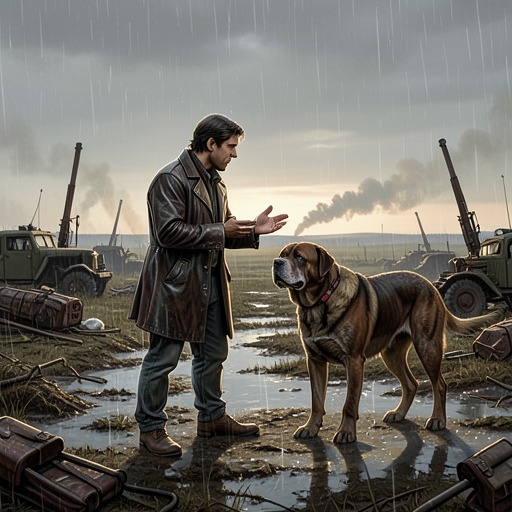
Skirmisher dogs give the human–animal bond a material foundation. Blood helps Vic navigate the dangerous postwar environment and find what he wants, while Vic remains responsible for the dog who makes those pursuits possible. When Blood reminds Vic that he has a responsibility to him, the statement turns companionship into an explicit ethical claim rather than leaving it as background sentiment. The dog’s wartime lineage thus becomes relevant to the everyday obligations of the pair.
The creature’s history also sharpens the book’s final affirmation that a boy loves his dog. The statement is simple, but the history behind it is not. Skirmisher dogs were created through invasive experiments, bred for combat, and left unable to feed themselves; nevertheless, Blood is not finally treated as a weapon or a biological device. His telepathy, ancestry, labor, injury, and demands all press Vic toward recognizing him as a partner with needs of his own. In that tension lies the species’ narrative importance: Skirmisher dogs are products of human violence, yet they become the beings through whom mutual dependence and responsibility remain possible.