Solo
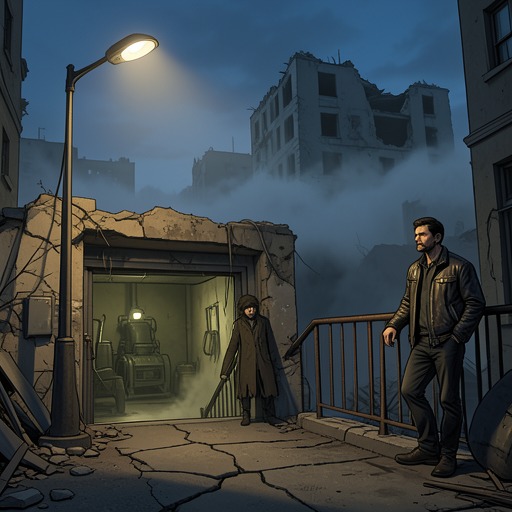
A Boy and His DogSolo names the precarious human condition at the center of the postwar social order: to live without a roverpak, relying on personal skill, weapons, and an animal companion rather than on a settled collective. The status suggests freedom, but it also means exposure. A Solo can enter neutral territory, trade for food and entertainment, and move between hostile groups, yet has no pak’s protection or dependable supplies. The novel therefore treats the Solo less as an isolated individual than as a social category produced by war, demographic collapse, and the failure of ordinary institutions.
Definition and Social Position
A Solo exists outside the roverpaks, the mobile bands that dominate the surface. Our Gang is described as a roverpak that could not survive by simple foraging, so it converted its territory into a service economy by taking over the area around the Metropole Theater. Its control was tolerated because everyone needed films, and the group kept the theater operating even for Solos such as Vic and Blood. The arrangement reveals the contradiction in Solo life: independence is possible only within a landscape structured by collective powers.
The Solo’s lack of institutional protection is visible when Vic enters the Metropole. Our Gang requires him to check both his .45 and Browning .22 at the ticket booth, while armed guards with Bren guns control the weapons rack. He pays admission with a can of Oscar Mayer Philadelphia Scrapple for himself and a tin of sardines for Blood. When water leaks from a broken ceiling pipe onto his guns, he must threaten the checker before the weapons are moved to a dry place. Even in a sanctuary, a Solo has to defend his property personally, calculate whether resistance will cost him admission, and read the guards’ willingness to intervene.
Inside, the theater is packed with Solos and dogs. Vic and Blood force their way into a row, while a Doberman growls and Blood’s fur rises before he lets the provocation pass. The Metropole is neutral ground, but neutrality does not remove danger; it merely establishes a temporary limit on violence. Vic’s spike and knife, kept in oiled sheaths at the back of his neck, remain reassuring even after his firearms have been surrendered. Solo identity is thus defined by constant readiness rather than by the absence of conflict.
Origins in War and Demographic Collapse
The social category is rooted in the consequences of the War. Vic explains that the War killed most of the girls, leaving nearly all Solos and roverpak members male. Births have also become catastrophically abnormal: children are seldom clearly male or female and are killed immediately after being taken from the mother. The scarcity of women is therefore not merely a matter of romance or sexual frustration; it is a demographic condition that reshapes power, movement, and survival.
The few women who remain aboveground are described as solitary, hardened survivors, while others have gone downunder with the middle-class communities. Vic’s account makes sexual access another form of competition among Solos and roverpaks. A woman may be claimed as roverpak property, taken during a raid, or come aboveground from a downunder community out of curiosity. Each possibility exposes the same brutal economy in which bodies are treated as scarce resources and relationships are organized through force.
This scarcity also produces conflict among men. Vic distinguishes between sexual practices among Solos, acknowledging that there are not enough women while rejecting the “jockey-and-boxer” arrangement because he sees it as a source of dependency and jealousy. His judgment is shaped by the practical pressures of roverpak life: an attached partner can become an additional liability, and disputes over sexual possession can trigger fights within larger groups. The Solo ideal of self-sufficiency is therefore bound to a harsh code of bodily autonomy, aggression, and suspicion.
Solos, Roverpaks, and Civilized Enclaves
The roverpaks are not simply larger versions of Solos. They are collective adaptations to scarcity, with different groups maintaining different economic niches. The Dragons keep an entire power plant operating to collect tribute, Ted’s Bunch controls the reservoir, the Bastinados work in marijuana gardens, and the Barbados Blacks lose members while cleaning radioactive pits. Our Gang, by contrast, gains its livelihood by running a movie house. Solo movement across this map brings the individual into contact with these specialized systems without granting him membership in any of them.
The Metropole’s sanctuary agreement arose from the destructive history of roverpak violence. A previous fight at the old Loew’s Granada left ten or twelve roverpak members and their dogs dead, burned down the theater, and destroyed several films. Afterward, the roverpaks agreed that movie houses should be sanctuaries. The rule does not represent a general moral transformation. It is a negotiated suspension of violence in a place whose usefulness is shared by enemies. Solos benefit from the agreement, but they remain dependent on the paks’ continued recognition of it.
The contrast with the downunders is sharper still. Blood warns Vic that a downunder is organized, knows everyone, hates Solos, and will have defenses against raids by roverpaks. The warning identifies the Solo as an outsider to a closed society whose security has been built partly in response to aboveground predation. The downunders’ order may appear comfortable and settled, but that stability is defended by exclusion. A Solo approaching such a community is not received as a traveler; he is treated as a possible invader.
Blood and the Relational Solo
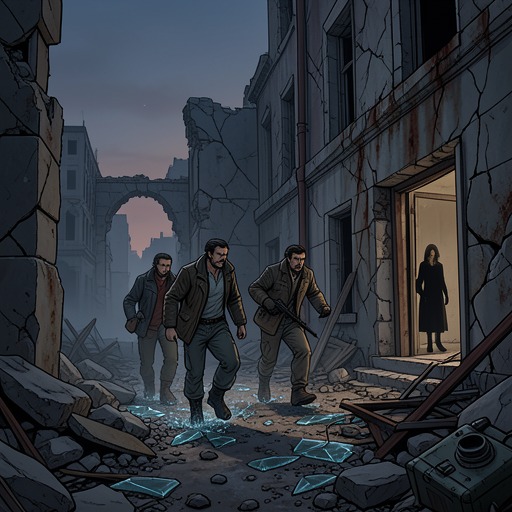
Although the term implies solitude, Vic is not literally alone. His identity as a Solo is inseparable from Blood, whose tracking ability and companionship make movement possible. At the Metropole, Blood locates a possible woman among the crowd by concentrating until his body is tense, his eyes closed, and his muzzle quivering. Later, while crossing the bombed-out city, he detects danger near a crater and warns Vic before the threat fully emerges. Blood is not merely an animal carried by a human survivor; he is a partner whose senses extend Vic’s ability to navigate the ruined world.
Blood also exposes the emotional cost of the Solo ideal. When Vic considers entering the downunder after the woman he has followed, Blood insists that the plan will get him killed. He reminds Vic that they have been together almost three years through good and bad, then admits that he is afraid Vic will not return. If abandoned, Blood would have to seek another human who would take him on, and because most Solos now belong to paks, he fears becoming a low-ranking mutt despite no longer being young and while already badly injured. The exchange turns Solo independence into a question of mutual obligation: Vic’s freedom is also Blood’s security, and Vic’s attempt to pursue another life threatens the bond that has sustained them both.
Blood’s warning also marks a limit in the Solo worldview. Vic treats the downunder as a possible destination because the woman has made him imagine crossing the boundary between surface and enclosure. Blood sees the same boundary as a military and social fact. The Solo may move freely, but mobility does not mean acceptance. It can carry a person toward a place where every advantage of solitary life becomes a liability.
Institutional Absorption and Thematic Significance
The strongest reversal of the Solo condition occurs when Vic is captured by the people of Topeka. Instead of allowing him to behave as an armed, sexually aggressive outsider, the community removes him from the immediate scene, gives him a room in a boarding house, and asks him to spend time learning the town before beginning the work expected of him. The residents need time to accept what will have to be done and appear to be considering whether additional young bulls might be imported from aboveground if Vic proves suitable.
This response transforms the Solo from a mobile predator into a managed biological resource. His weapons, movement, and personal objectives cease to define the situation; Topeka’s reproductive needs define it. The community does not initially kill him, but neither does it recognize him as an equal guest. It contains him, studies him, and prepares him for a function within its population strategy. Solo status here means being excluded from collective membership while still being valuable enough for a community to appropriate.
Yet Vic’s first sustained experience of Topeka is unexpectedly positive. He spends time getting to know the town, its people, and the way they live, and concludes that it is nice. The judgment complicates the opposition between the violent surface and the civilized downunder. A Solo can regard enclosure as attractive once he encounters ordinary social life, even though the same society has detained him for its own purposes. The concept therefore gathers an unresolved tension between freedom and belonging: the Solo is protected from no one, but joining a community may require surrendering the very autonomy that made him a Solo in the first place.
As a literary concept, Solo links the book’s episodic movement to its social critique. Vic’s outsider position lets the narrative pass through roverpak economies, movie-house rules, sexual scarcity, animal partnership, and downunder population control without adopting any group’s official values. His perspective is practical, violent, comic, and frequently unreliable in its judgments, but precisely because he belongs nowhere securely, each social arrangement becomes visible as a bargain rather than as a natural order. Solo is consequently both a survival identity and a critical vantage point: it names the person left outside society while revealing how every society depends on boundaries, scarcity, and negotiated violence.