Topeka access dropshaft
A Boy and His DogThe Topeka access dropshaft is the principal vertical passage connecting the ruined surface around Topeka with the city concealed below it. In the plot, it is more than infrastructure: it is a threshold that converts Vic’s impulsive pursuit of Quilla June Holmes into captivity, exposes the scale and artificiality of Downunder, and later helps define the practical problem of escape. Its movement is one-way in emotional terms even when the characters can eventually find a way out: the shaft leads Vic downward into a world he experiences as a sealed container, while the search for another route upward becomes the beginning of his resistance.
Surface Threshold and Pursuit
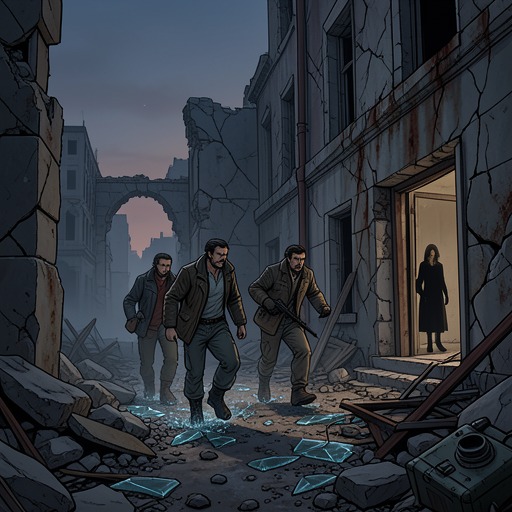
The dropshaft is located beyond the ruined outskirts of the city, near hills where bluish-green radiation still flickers. Blood identifies the area as one of the few places where the missing girl could have gone, since the surrounding wasteland contains little besides Burnpit-screamers and the shaft leading to the Downunder. The setting gives the object an immediate double character. It is a piece of surviving technology in a landscape damaged by World War III, but it is also a guarded boundary between two radically different forms of survival: the exposed, contaminated surface and the enclosed population below.
Vic reaches the shaft because anger overrides caution. After finding the metal identity plate Quilla June Holmes has left behind, he decides to pursue her even if doing so requires entering the Downunder. He walks for an hour toward the access point while Blood, wounded and hungry, follows at a distance. Vic is not undertaking a planned expedition; he is acting on the conviction that Quilla June has deceived him and that he must find her and punish her. The dropshaft therefore begins as an instrument of pursuit, carrying the force of his rage toward a place whose nature he does not yet understand.
The Black Pillar and Its Mechanism
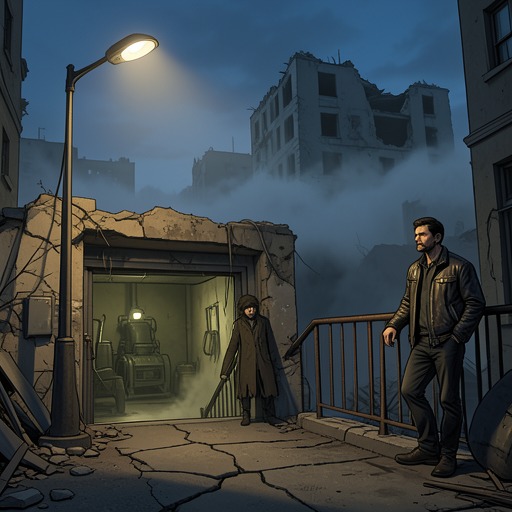
At the surface, the access dropshaft presents itself as a tall, straight, featureless pillar of shining black metal, approximately twenty feet in diameter, flat on top and apparently disappearing directly into the ground. The structure conceals its operating seams so completely that its entrance seems seamless until Vic uses Quilla June’s metal card. After he finds the slot and inserts the card, a section of the pillar dilates, opening a circular passage through which he steps.
The threshold is also the last point at which Vic and Blood remain together. Blood watches from outside as the pillar hums, and the two exchange farewells before the opening closes around Vic. This separation gives the access mechanism a personal consequence that its impersonal design disguises. The shaft does not merely admit a traveler; it divides the partners who have depended on one another in the surface wasteland. Vic enters with the expectation of recovering Quilla June, while Blood remains behind, injured and uncertain whether he will still be waiting when Vic returns.
Once the outer iris closes, the shaft reveals its interior operation. The circular compartment pulses with cool light and a louder mechanical hum. The deckplate dilates beneath Vic, and he begins to drop through the tube as another iris closes overhead. The descent is steady rather than violently uncontrolled, but its duration and enclosure make the mechanism frightening. Markings on the walls include technical labels such as “10 LEV,” “ANTIPOLL 55,” “BREEDER-CON,” and “PUMP SE 6,” suggesting that the shaft is part of a large, organized life-support and population system rather than an isolated entrance.
Vic continues downward without stopping until he reaches the bottom, where the wall identifies the destination as “TOPEKA CITY LIMITS POP. 22,860.” The figure gives the shaft a civic and demographic scale: it is not simply a tunnel to a bunker but an access route to a city with a recorded population. A much larger iris opens when Vic uses the metal plate again, and the passage delivers him into the full extent of the subterranean settlement.
Descent into the Downunder
The access dropshaft opens onto a Downunder roughly twenty miles across, enclosed by a curved metal wall and capped by a ceiling about an eighth of a mile overhead. From the bottom of the tube, Vic sees a complete artificial town: neat houses, curved streets, trimmed lawns, a business district, and the visual order of the Topeka preserved in old surface books. The shaft thus functions as a dramatic reveal. It does not merely take Vic underground; it frames the first view of a civilization that has reproduced the appearance of a Midwestern town inside a vast metal container.
The resemblance to a surface city is immediately undermined by absence. The Downunder has no sun, birds, clouds, rain, snow, cold, wind, ants, dirt, mountains, oceans, fields of grain, stars, moon, forests, or freely roaming animals. The access dropshaft has carried Vic into an environment that imitates civic life while excluding the natural world that once made such life open and expansive. The passage therefore marks a descent not only in physical space but into an engineered substitute for the surface.
Vic’s response turns the shaft into a psychological boundary. He realizes that the people below are “canned,” like dead fish, and the enclosed city begins to feel as though it is closing around him. The weight of the earth above him becomes part of the experience of the dropshaft and its destination. Within a week, he is ready to scream; he later becomes claustrophobic, then angry, surly, quiet, and emotionally dulled. The structure’s engineering promises protection from the irradiated world, but for Vic that protection becomes confinement.
Entrapment and the Search for an Exit
After Quilla June and the people of Topeka capture and contain him, the access dropshaft remains the obvious route back to the surface but is no longer a simple doorway. Vic is given considerable freedom within the town only so long as he behaves, and the green sentry box remains nearby as a reminder that his movement is supervised. The shaft is consequently transformed from an available path into a controlled boundary: it represents freedom physically while captivity determines whether Vic can reach it.
Vic eventually begins to reason his way around that apparent dead end. He remembers the poodle he once fed Blood and realizes that the animal must have come from a Downunder, yet could not have traveled up through the dropshaft. That inference proves that another exit exists. The access shaft remains important precisely because it is insufficient. Its visible, official route has been secured by the subterranean society, so Vic turns to an unadvertised passage discovered through observation and deduction.
The escape route leads through a large air-intake duct rather than back through the access dropshaft. Vic takes Quilla June by the arm and brings her toward the southern end of Topeka, reaching the duct in about fifteen minutes. After climbing through the duct, he shoots away filter covers and hatch bolts, and the pair emerge a mile from the access dropshaft. Their distance from the official entrance emphasizes the difference between authorized access and escape: the shaft belongs to the Downunder’s regulated system, while the air duct becomes a vulnerability in that system.
Later Meaning and Narrative Significance
The dropshaft’s consequences continue after Vic and Quilla June reach the surface. Blood, who has conducted reconnaissance after Vic’s descent, reports that the people below discovered that Vic and Blood had not been killed in the gym and may have tracked them by scent. He warns that they might come up from the dropshaft. Even after Vic escapes through the air duct, the shaft remains a possible channel for pursuit, linking the subterranean threat to the exposed landscape above.
At the same time, the object becomes part of the fragile reassembly of Vic and Blood. Vic finds Blood wounded and starving near the surface, and Quilla June urges him to leave quickly. Instead, Vic makes a small fire, feeds Blood, carries him to the air duct, and spends the night holding him on a ledge inside it. The air duct, discovered because the dropshaft could not serve as a viable escape route, becomes a temporary refuge where the bond between Vic and Blood is restored. The official passage downward produces separation and captivity; the improvised passage upward helps make reunion possible.
As an image, the Topeka access dropshaft concentrates the book’s opposition between mobility and enclosure. The surface is dangerous because of radiation, craters, and predatory creatures, while the Downunder is orderly, fed, and protected yet experienced by Vic as a metal can closing around him. The shaft joins these worlds without reconciling them. It offers entry into safety at the cost of freedom, and its presence forces Vic to discover that survival cannot be measured only by shelter. In the narrative’s spatial logic, the descent reveals a society that has preserved the shell of ordinary life, while the escape around the shaft affirms the continuing value of uncertainty, open movement, and the surface bond between Vic and Blood.