World War III
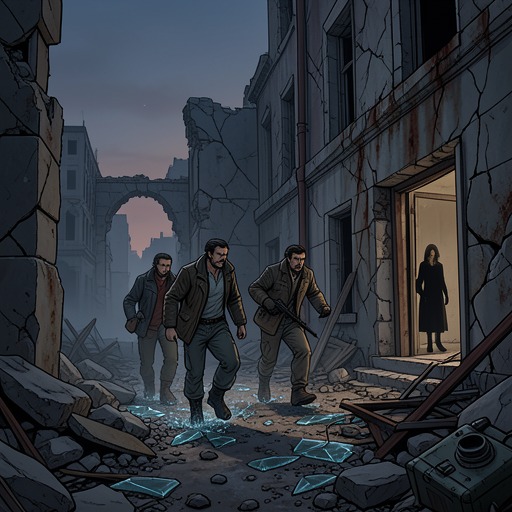
A Boy and His DogWorld War III is the foundational catastrophe of the story’s postapocalyptic United States, a nuclear conflict between the Americans and the Soviets whose consequences govern nearly every surviving institution and relationship. Although the war is largely encountered through aftermath, recollection, inherited stories, and old films rather than through a continuous battlefield narrative, its presence is immediate: the surface remains a war-torn wasteland, radiation flickers from the hills, and survivors organize their lives around scarcity, violence, and remnants of military technology.
Causes and Historical Background
The war belongs to an alternate history in which John F. Kennedy survived, while scientific breakthroughs in animal research and telepathy produced forms of communication between humans and animals. Before the conflict had fully begun, researchers were already altering animals through surgery, grafting, and biological experimentation. In Los Angeles, Buesing trained dogs as watchmen, sentries, and attackers; one German shepherd named Ginger worked for the Los Angeles Police Department’s narcotics division and could locate marijuana hidden inside layers of cellophane, tin foil, brown paper, and sealed cartons. In a test involving 25,000 boxes in an auto-parts warehouse, Ginger found all five planted packages within seven minutes.
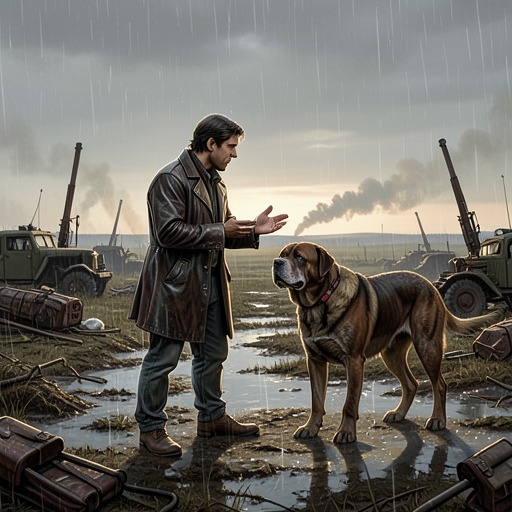
At the same time, ninety-two miles north in Santa Barbara, cetologists drew and amplified dolphin spinal fluid and injected it into Chacma baboons and dogs. The first successful product of that experimentation was Ahbhu, a two-year-old male Puli capable of communicating sense-impressions telepathically. Continued experimentation and cross-breeding produced the skirmisher dogs, which were telepathic over short distances and could be trained to track gasoline, troops, poison gas, or radiation while linked to human controllers. They became shock commandos during World War III, and their selectively bred traits continued through later generations. Ginger and Ahbhu were Blood’s ancestors, making the war’s military science part of Blood’s biological history rather than merely an external historical fact.
Course and Immediate Destruction
The evidence presents World War III as a nuclear war whose damage persists beyond the formal conflict. The United States is described as war-torn, and the surface environment remains marked by radiation and dangerous unexplained life. When Vic and Blood move toward the edge of the city, bluish-green radiation still flickers from the hills. The access dropshaft to the Downunder lies in this contaminated landscape, alongside creatures known as screamers. The war therefore does not produce a clean division between wartime and peacetime; its residue remains embedded in the terrain through which survivors travel.
The war also reshapes the human population. Vic understands that almost all the surviving solos and roverpak members are male because the conflict killed most of the girls. Blood explains that this pattern is typical of wars, while reproduction has become grotesquely uncertain: many births result in beings that are seldom male or female and are destroyed immediately after being pulled from the mother. The shortage of women turns sex into a central survival pressure and intensifies conflict among roverpaks, isolated men, and the few women who remain on the surface. World War III thus destroys not only cities and ecosystems but also the demographic conditions of ordinary intimacy and family formation.
Long-Term Social Consequences
After the war, the surviving population divides between the exposed surface and the enclosed Downunder civilizations. Only a couple of hundred Downunders remain in what was once the United States and Canada. These settlements were built at wells, mines, other deep holes, or natural cave formations, often extending two to five miles below the ground. Their founders were conservative middle-class groups, including Southern Baptists, fundamentalists, and rigid law-and-order communities, who rejected further progress and dissent after using the last scientists to create the systems that made subterranean survival possible.
The Downunders preserve an imagined older social order by suppressing change. Their inhabitants seek a quiet life modeled on the period before the First War, while the surface reflects the unregulated consequences of the later catastrophe. This contrast suggests that World War III produces two competing responses to disaster: armed improvisation in the open air and total social control underground. The Downunder communities survive physically, but their survival depends on rejecting the freedom and uncertainty associated with the surface.
Culture, Memory, and Militarized Remnants
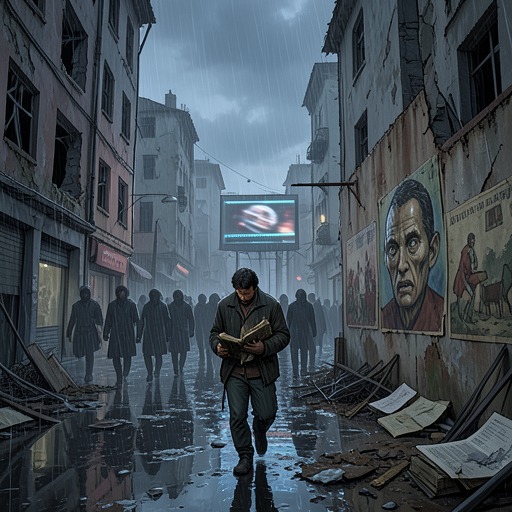
The war survives in popular culture as well as in radiation and biology. At the Metropole Theater, a film made during the Third War is shown as part of a triple feature. Made in 1992, twenty-seven years before Vic’s birth, it depicts skirmisher greyhounds equipped with napalm throwers burning a town. Blood enjoys the spectacle and pretends that the dogs are his ancestors, despite both characters knowing that the claim is invented. The film turns wartime atrocity into entertainment, while Blood’s fascination links the destructive military breeding program to his own inherited identity.
The theater itself reveals how postwar society has institutionalized violence without entirely surrendering culture. Our Gang, a roverpak of movie-oriented children, controls the territory around the Metropole because it keeps films running. The theater is treated as neutral ground and sanctuary after an earlier fight at the old Loew’s Granada left ten or twelve rovers and their dogs dead, burned down the building, and destroyed several valuable Cagney films. The resulting agreement makes movie houses sanctuaries, showing that even armed groups recognize the need to preserve fragments of prewar culture. World War III has not eliminated communal rules; it has forced them to emerge from remembered catastrophe.
Environment and Narrative Significance
The war’s most enduring violence is gradual and environmental. Radiation still flickers in distant hills, craters interrupt travel across the surface, and the surviving world contains screamers and other threats whose existence belongs to a damaged ecology. These conditions have become ordinary enough to guide daily movement, which makes the catastrophe feel less like a completed historical event than a permanent background pressure. The war’s effects are slow, dispersed, and difficult to escape: they appear in contaminated ground, altered animals, reproductive collapse, and the narrowing of available food, shelter, and companionship.
The Downunder provides the starkest architectural answer to this damaged environment. Its enormous metal enclosure reproduces the appearance of a prewar town, with houses, streets, lawns, and a business district, but lacks a sun, birds, clouds, rain, snow, cold, wind, ants, dirt, mountains, oceans, grain fields, stars, moon, forests, and wild animals. It offers protection from the surface while removing nearly every element of natural freedom. Its inhabitants eat artificial peas, fake meat, ersatz corn, bogus bread, and other manufactured substitutes that taste to Vic like chalk and dust. World War III therefore functions as both a historical rupture and a test of what survival means: the surface preserves exposure and freedom amid contamination, while the underground preserves life by enclosing it within an artificial imitation of the lost world.