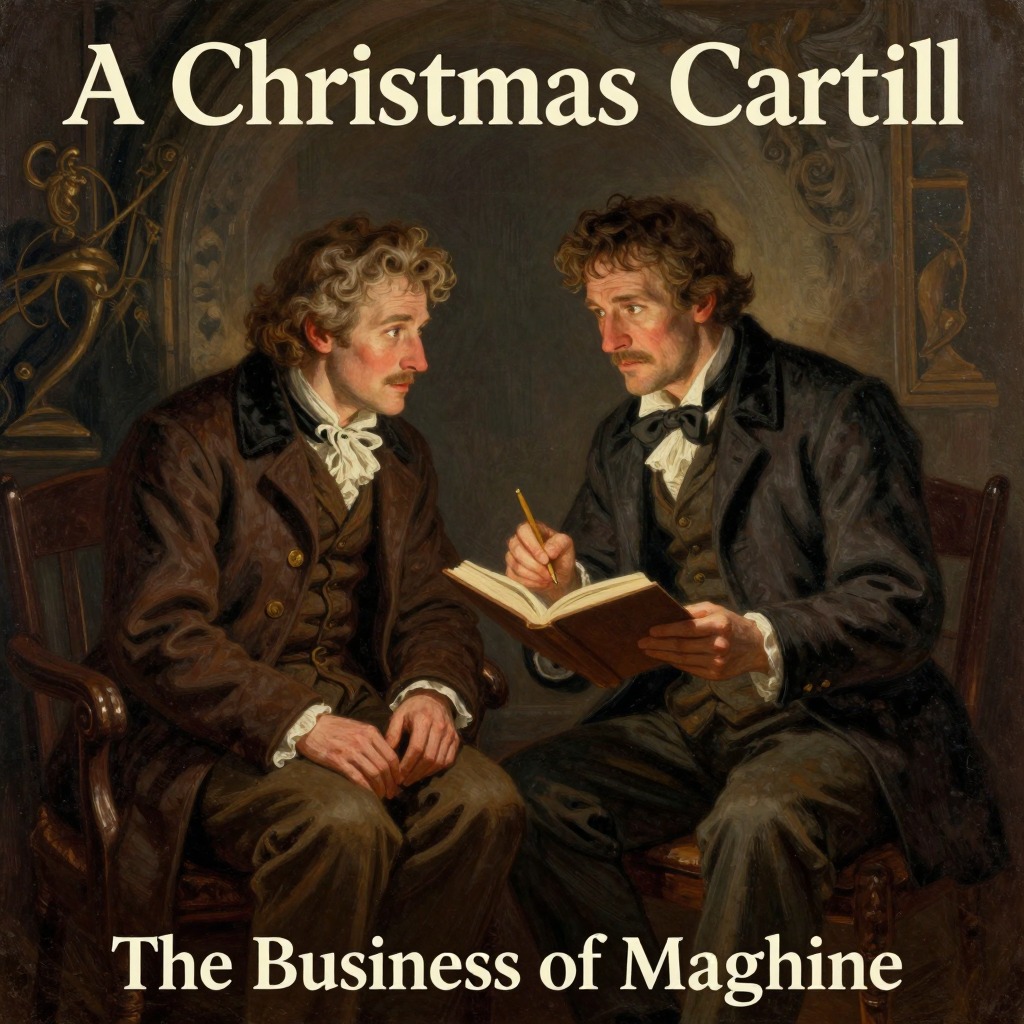
Mankind was my business
A Christmas CarolThe phrase "Mankind was my business" is the moral fulcrum of Charles Dickens's A Christmas Carol, the moment when the ghost of Jacob Marley articulates the story's central ethical inversion: that the true calling of every person is not commerce but compassion, not accumulation but connection. Uttered in Scrooge's chambers on Christmas Eve, the declaration transforms the word "business" itself, wrenching it away from ledgers and counting-houses and redefining it as the active pursuit of charity, mercy, forbearance, and benevolence. It is the first explicit statement of the principle that the three Christmas Spirits will spend the rest of the story teaching Scrooge, and it echoes through every subsequent scene of redemption.
Origin and Context
The declaration comes during the climactic confrontation between Scrooge and the ghost of his former partner, Jacob Marley, who appears bound by a heavy chain forged from cash-boxes, keys, padlocks, ledgers, deeds, and steel purses. Marley has just explained that his spirit is condemned to wander the earth witnessing the happiness it might have shared but never did. When Scrooge, still clinging to his old worldview, protests that Marley "was always a good man of business," the ghost erupts with the correction that redefines the entire moral framework of the tale: "Mankind was my business. The common welfare was my business; charity, mercy, forbearance, and benevolence were, all, my business. The dealings of my trade were but a drop of water in the comprehensive ocean of my business!" The speech is a direct repudiation of the philosophy Scrooge has lived by—the belief that a man's sole responsibility is to his own commercial affairs, a principle he had voiced earlier that same evening when he told the charity collectors, "It's enough for a man to understand his own business, and not to interfere with other people's."
Contrast with Scrooge's Earlier Philosophy
Before Marley's visit, Scrooge had systematically rejected every appeal to human solidarity. To his nephew Fred, who spoke of Christmas as "a kind, forgiving, charitable, pleasant time" when people "open their shut-up hearts freely," Scrooge responded with contempt. To the gentlemen seeking donations for the poor, he offered only the state's punitive institutions—prisons, workhouses, the Treadmill, and the Poor Law—and when told that many would rather die than enter them, he replied, "If they would rather die, they had better do it, and decrease the surplus population." This cold calculus, which treats human beings as surplus to be managed rather than as neighbors to be loved, is precisely the worldview that Marley's declaration condemns. The ghost's words expose the lie at the heart of Scrooge's self-justification: that a man can be "a good man of business" while being utterly indifferent to the human consequences of his actions.
The Principle in Action: The Ghost of Christmas Present's Rebuke
The principle that "Mankind was my business" is not left as an abstract maxim; it is dramatized and tested throughout the rest of the story. When the Ghost of Christmas Present shows Scrooge the Cratchit family's meager Christmas dinner and reveals that Tiny Tim will die if the future remains unchanged, Scrooge protests, and the Spirit throws Scrooge's own words back at him: "If he be like to die, he had better do it, and decrease the surplus population." The rebuke is devastating precisely because it forces Scrooge to hear his own philosophy applied to a child he has come to care about. The Ghost then expands the critique into a universal principle: "Will you decide what men shall live, what men shall die? It may be that, in the sight of Heaven, you are more worthless and less fit to live than millions like this poor man's child." This is the logical extension of Marley's declaration—if mankind is everyone's business, then no one has the right to judge another's worth or to decide who deserves to live.
The Redemption as Fulfillment of the Principle
Scrooge's transformation on Christmas morning is the practical fulfillment of the principle that "Mankind was my business." He sends the prize turkey to the Cratchit household anonymously, raises Bob Cratchit's salary, becomes "a second father" to Tiny Tim, and embraces his nephew Fred's family. The narrator's final summary makes explicit that Scrooge has internalized Marley's teaching: "He became as good a friend, as good a master, and as good a man as the good old City knew." The story's closing benediction—"God bless Us, Every One!"—spoken by Tiny Tim, is the communal echo of Marley's individual declaration, affirming that every person is indeed everyone's business. The phrase thus functions as the story's ethical cornerstone: it names the sin that condemned Marley, the lesson Scrooge must learn, and the virtue that ultimately saves him.